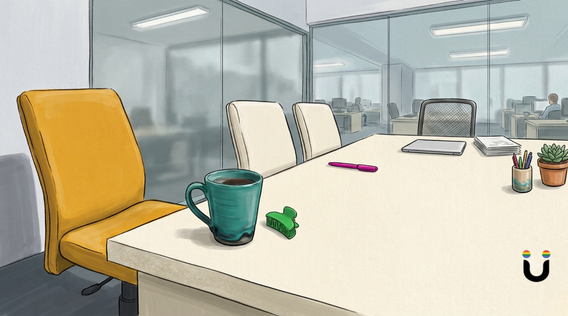
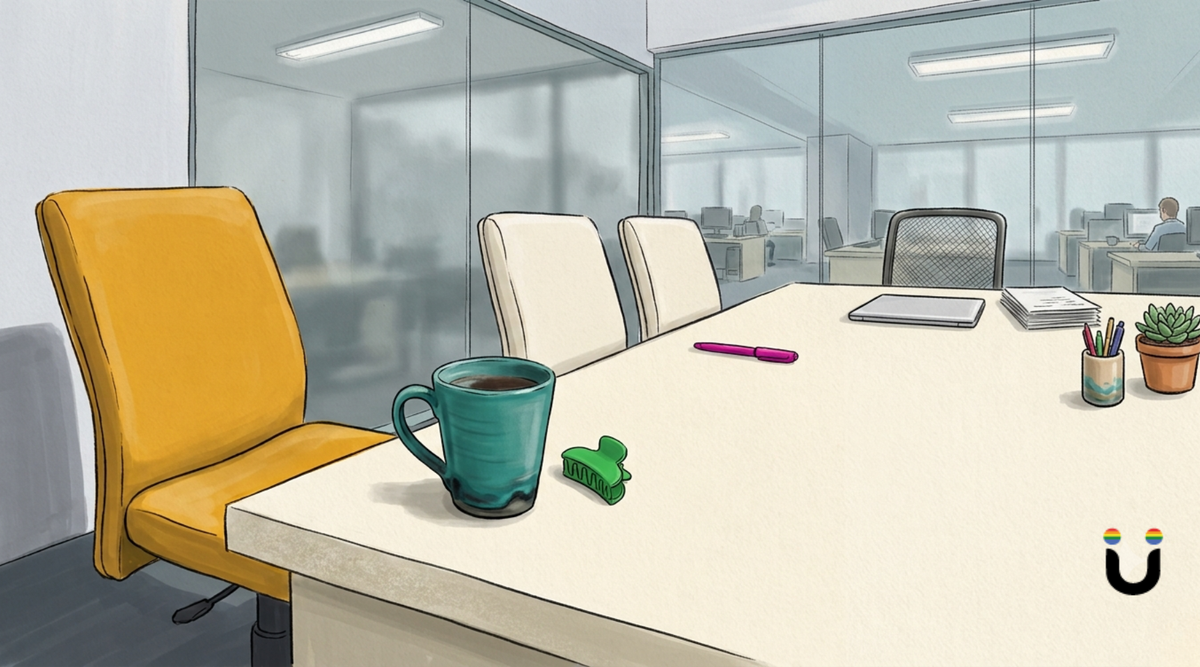
The meeting ended at 4.40. By 4.52 you had replayed the moment you interrupted your manager three times, and by the time the cab reached Bandra you had built the version of the afternoon where everyone on the call now thinks you are difficult. Nobody said that. Nobody has said anything at all. You have been running a trial with no witnesses for two hours, and you are the only one in the room.
Overthinking after a meeting is a form of post-event processing: a detailed replay of a social situation in which the ambiguous moments get reinterpreted as evidence you performed badly. It runs hardest in people who watch themselves closely at work. It is common in Indian offices, where hierarchy makes silence hard to read, and it is treatable.
The clean story is that you are conscientious. You care how you come across, you hold yourself to a high standard, and the replay is simply the cost of caring. That is the version you would tell at dinner. It is also the version that lets the replay keep running, because it dresses the replay up as a virtue with a slightly high price tag.
What is your mind actually doing after the meeting?
It is finishing the meeting without the other people in it.
In 1995 the psychologists David Clark and Adrian Wells described a pattern they called post-event processing, in which a person runs a detailed post-mortem of a social interaction and, in the running of it, reinterprets anything ambiguous as negative. A 2007 study by Laura Dannahy and Lusia Stopa in Behaviour Research and Therapy tested this with a simple design: participants had a conversation with a stranger, rated their own performance, and were then tracked for a week. The people higher in social anxiety replayed the conversation more and rated themselves worse, both straight afterward and a week later, even though nothing new had happened in between.
Nothing new had happened. That is the part to hold on to. The meeting is over and cannot get any worse. The only thing still moving is the account of it, and the account is being written by the most anxious person present, which is you, at 4.52, in a cab.
Here is what the replay does with the raw material. Your manager paused after you spoke. In the meeting, that was a pause. In the replay, it is disapproval. A colleague looked at her laptop while you were talking. In the meeting she was probably checking the deck. In the replay she has decided something about you. The replay does not invent events. It changes what they mean, always in the same direction, and then it hands the changed meaning back to you and calls it memory.
Why does it hit harder in Indian workplaces?
Because in most Indian offices you cannot just ask.
The pause after you spoke would be cleared up in thirty seconds if you could turn to your manager and say, "did that land badly?" But there are rooms where a junior person does not ask a senior person that question, and most of us work in one. So the ambiguity the replay feeds on is structural. Hierarchy manufactures the silence, and silence is what post-event processing eats.
There is also the specific weight a job carries here. It is rarely just a job. It is the EMI, the parents who tell relatives where you work, the visa application, the proof that leaving the home town was the right call. When the meeting is carrying all of that, a three-second pause ends up carrying all of it too. The National Mental Health Survey of India found that neurotic and stress-related disorders, the group that includes anxiety, were roughly twice as common in urban metros as elsewhere, at 6.9 percent against 3.5 percent nationally. The survey did not ask anyone about meetings. We would guess a fair number of those people could describe one.
The meeting is over and cannot get worse. The only thing still moving is the account of it.
Is the replay ever right?
Sometimes. That is the part the reassuring version leaves out, and we are not going to leave it out.
You may in fact have interrupted your manager three times. She may in fact have minded. The replay is a biased edit of real footage. So the honest move is to do the one thing the replay cannot do for itself: check.
Checking is smaller than it sounds. It means noticing what you actually observed (a pause) and holding it apart from what you concluded (disapproval). It means asking, where the room allows it, one small question: "I think I cut across you earlier, sorry, did I miss something?" The replay hates that question, because whichever way it gets answered, the trial ends. If she says "no, not at all", the replay has lost its evidence. If she says "a bit, yes", you have got a real thing to repair, which is far easier to carry than a suspected thing to dread.
And if the room does not allow the question, that is worth naming too, because it tells you the replay is partly a symptom of the room. We wrote about whether psychological safety is possible in a hierarchical workplace, and the short answer is that it is, but it has to be built on purpose, because it does not happen by itself in a culture where nobody asks upward.
What does the replay cost you?
More than the two hours.
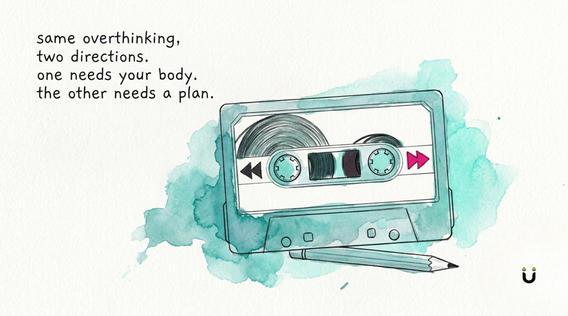
Dannahy and Stopa's participants who replayed the first conversation harder still rated themselves poorly a week later, before a second conversation they had been told was coming. The replay is a rehearsal for the next meeting, and what it rehearses is failure. So the person who spends Tuesday evening reviewing Tuesday afternoon walks into Wednesday already braced, speaks less, watches herself more, gets less from the room, and ends up with more ambiguous material to replay that night. This is the loop. It is a maintenance cycle, and a maintenance cycle can be broken at any point on the circle.
The interruption that works is unglamorous. When the replay starts, write two columns: what you observed, and what you concluded. Most people find the first column runs to three items and the second runs to a paragraph. Then pick the one item you can actually check, and check it tomorrow. Then do something with your hands until tomorrow comes. If the writing itself helps, Night Pages is a set of nightly writing prompts built for exactly this, one a night for 21 nights, then it stops. Most of what looks like overthinking is unfinished feeling, and the feeling under the post-meeting replay is usually a very old fear of being found out. Imposter syndrome at work and post-event processing are, in the room, often the same person on different days.
What is the harder question underneath?
Whose approval you are actually replaying for.
It is rarely the manager. The manager is standing in for someone older. Most of us who replay meetings learned early, at a dinner table, that a pause from a parent meant something, and that the safest response was to review our own performance until we turned up the flaw. The office is just where the habit found itself a new audience.
We would love to tell you that noticing this makes the replay stop. It does not. It makes it slightly less convincing, which is a different thing, and on a Tuesday evening it is enough. If the replay is running most evenings, if you are dreading meetings you used to be fine in, or if you have started going quiet in rooms where you have got something to say, a conversation with a psychologist is a place to finally ask the question out loud and watch what happens when someone answers it.
The cab reaches Bandra. The trial is still running. You are, at least, now aware that you are the only juror.
What else do people ask about overthinking after meetings?
Why do I replay meetings in my head?
This is post-event processing, described by Clark and Wells in 1995: a detailed review of a social situation in which ambiguous moments get reinterpreted as negative. It is most common in people who monitor themselves closely, and in workplaces where hierarchy makes it hard to ask for feedback directly.
How do I stop overthinking after a meeting?
Separate what you observed from what you concluded, then check one observation with a real question the next day. Do something physical in the meantime. Reassurance from friends tends not to work, because the replay reopens after each round. A checked fact ends it. If it is mostly a night-time loop, we wrote separately about what the loop is doing when the house goes quiet.
Is overthinking after meetings a sign of social anxiety?
It can be. Post-event processing is one of the maintaining factors in social anxiety, and Dannahy and Stopa's 2007 study found it was stronger and more negative in people higher in social anxiety. The occasional replay is ordinary. Most evenings, with dread of the next meeting, is worth talking to a psychologist about.
Why does it feel worse in Indian offices?
Because hierarchy makes it harder to ask a senior person whether something landed badly, so the ambiguity stays unresolved and the replay has more to work with. A job in India also often carries family expectations, EMIs and the justification for having moved cities, which raises the stakes of every pause.
Sources
Dannahy L, Stopa L. Post-event processing in social anxiety. Behaviour Research and Therapy, 2007, 45(6), 1207 to 1219. UK undergraduate sample, conversation task with one week follow up; model reference is Clark DM and Wells A (1995), A cognitive model of social phobia, in Heimberg et al. (eds), Social Phobia: Diagnosis, Assessment and Treatment, Guilford. PubMed record
Gururaj G, Varghese M, Benegal V et al. National Mental Health Survey of India, 2015 to 16: Summary. NIMHANS Publication No. 128, 2016. Neurotic and stress related disorders 3.5 percent nationally, 6.9 percent in urban metros (Figures 7 and 18). Full summary report (PDF)
This piece is for understanding, not diagnosis. If you feel close to harming yourself or someone else, please reach out now. Tele-MANAS: 14416 (24 hours). iCALL: 9152987821 (Mon to Sat, 10am to 8pm).