Say you're thirty-two, a product manager, and a work trip to Bangkok is already booked.
Your mother has no power to stop it. You don't want her to stop it. And still you've spent forty minutes, first on the train and then in the shower, working out how to tell her, because what you actually want, and cannot have, is a version of the conversation where she says nothing to anyone afterwards.
Overthinking what your parents will think is usually about the network standing behind them: the aunts, the neighbours, the family WhatsApp group, the person at the wedding who will ask. In Indian families the self is built to be seen by that network, so a decision is never only yours. The loop is one mind rehearsing a whole community's reaction.
Full disclosure: this is a piece we've started and abandoned several times, because the easy version of it already exists everywhere online, and the easy version is wrong in a way that matters.
What log kya kahenge is actually doing in your head?
It's running a simulation of every person whose opinion has ever been used to steer you, before you've said a single word.
The phrase usually gets translated as "what will people say", which makes it sound like vanity. It's closer to a threat assessment. The people in question aren't strangers. They're the ones who'll be at your sister's wedding, who'll ask your father at the temple, who'll forward the news to the cousin in Pune. Overthinking, in this form, is reconnaissance.
The cultural psychologists Hazel Markus and Shinobu Kitayama gave this a name in a 1991 paper in Psychological Review. They drew a line between an independent construal of the self, where a person is a bounded unit with preferences that exist regardless of anyone else, and an interdependent one, where the self is made of its relationships and gets evaluated through them. Their evidence came from comparing Japanese and American samples, so we hold the specifics to those populations. But their description of the interdependent self reads, to anyone raised in an Indian family, like a description of home. What people will say isn't a side question to your decision. Structurally, it's part of what the decision even is.
Which is why "just stop caring what people think" is useless advice here, and why the search results for this topic are clogged with it. Telling someone with an interdependent self to stop caring about the network is like telling them to stop caring about their own left hand. It's attached. The overthinking is what it feels like to try to move it anyway.
Why is the loop worse for daughters?
Because daughters are the surface a family's reputation gets written on. That isn't a metaphor.
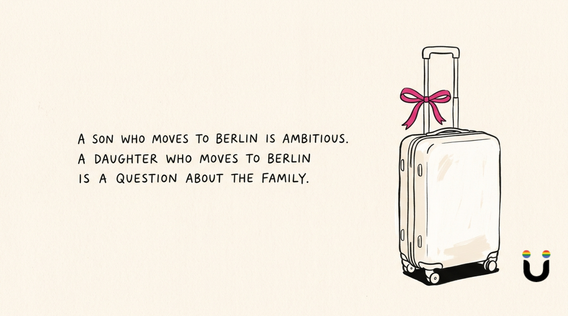
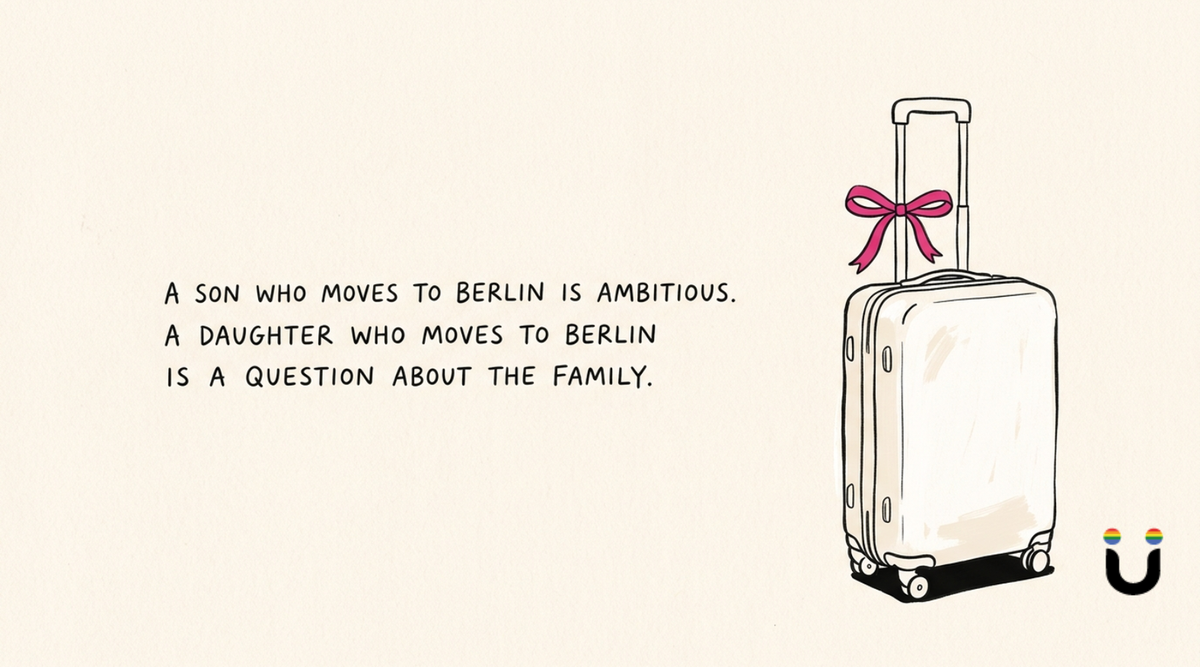
In most Indian communities the markers that a family is doing well, a good marriage, children, restraint, are carried disproportionately by its women, and a daughter's choices, in career, clothes, partner, timing, get read as a statement about her parents' success in raising her. A son who moves to Berlin is ambitious. A daughter who moves to Berlin is a question about the family.
So the daughter's overthinking simply has more variables loaded into it. She's simulating her mother simulating the neighbour, and she's been doing it since she was eleven, so the simulation runs now without her ever asking it to. The Bangkok trip was booked and paid for. The mind was still running the wedding conversation where someone asks why a married woman is travelling alone.
The National Mental Health Survey of India, run by NIMHANS across 12 states in 2015 and 2016, found that neurotic and stress-related disorders, the group that includes anxiety, affected women at nearly twice the rate of men, and that close to 80 percent of people with a mental disorder had received no treatment despite having been unwell for more than a year. The survey names stigma as a roadblock to seeking care. It doesn't name the mechanism. We will: the same loop that stops a woman booking the trip stops her booking the therapist, because the network would have plenty to say about that too.
A son who moves to Berlin is ambitious. A daughter who moves to Berlin is a question about the family.
What does the "just be yourself" version leave out?
Here's the half of the story that the comfortable reading skips, and it implicates us, the urban, therapy-literate, English-speaking readers of pieces exactly like this one.
We talk about log kya kahenge as though it were a hangover, something our parents' generation does to us that we'll eventually shake off. That reading flatters everyone who holds it. It puts us on the side of progress and the aunties on the side of the past.
It's also incomplete. The network that judges is the same network that shows up. The aunt who will have an opinion about the divorce is the aunt who drove to the hospital at 3am when your father collapsed. The cousin who forwards the news is the cousin who found you the flat, the job, the doctor. Interdependence is the infrastructure of Indian life, and the judgement is the maintenance fee on it. You can't keep the 3am hospital run and decline the opinion about the divorce. Nobody has worked out how to do that yet, and anyone who claims they have usually just moved far enough away that the aunt can't reach them.
And we do it too. Read any comment section under a woman's post about leaving her marriage, or a man's post about quitting a corporate job to teach. The people typing "but what will people think of this" are us, thirty-two years old, with a therapist on retainer, performing the exact same function in a different accent. Some of the loop in your head is yours, and it points outward at other people just as often as it points in at you.
Can you overthink your parents less without cutting them off?
Yes, and the route is smaller than the internet wants it to be.
The loop is a simulation, and simulations run on missing information. The mind rehearses a mother's reaction because it doesn't actually know what the reaction will be. In our experience the real conversation is usually far shorter than the rehearsal was: a question about whether the hotel is safe, a reminder to carry the blood pressure tablets. Forty minutes of simulated reputation management, against ninety seconds of a slightly worried parent.
It doesn't always go that way. Sometimes the reaction is exactly as bad as the simulation, and sometimes it's worse, and we won't pretend otherwise. But the simulation is always bad, and reality is only sometimes bad, and that gap is where the work happens. In clinical terms it's exposure: the thing you keep rehearsing loses its power a little each time you do it for real and survive the actual outcome rather than the imagined one. Our piece on being angry at your parents and still loving them is about the feeling underneath the loop, and why talking about our parents is so hard covers what happens when the simulation follows you into the therapy room.
The other move is to prise apart the two things the loop has fused together: your parents' actual reaction, which is finite and knowable, and the network's imagined reaction, which is infinite and isn't. The first you can find out by asking. The second you were never going to settle by thinking, because there's no end to the number of people who might one day say something. Most of what looks like overthinking is unfinished feeling, and the unfinished feeling here is usually grief: for the version of your life in which you could be fully yourself and fully theirs at the same time.
What are you actually choosing?
Something a good deal smaller than freedom versus family.
That grander framing is what the easy version sells, and it's why so many of the people we see have made a huge, painful decision, moved cities, cut contact, and are then startled to find the loop still running in the new flat. The network came along with them. It was never outside in the first place.
What you're choosing is how much of the simulation you'll run before you act, and whether you'll let reality replace it afterwards. Some people, with a psychologist or a very good friend, get the loop down from forty minutes to four. Almost nobody gets it to zero. The ones who claim they have are usually the ones we worry about most, because a person with no network in their head is a person with no network.
So you go to Bangkok. Your mother tells the aunt. The aunt says something. The trip is fine. The loop starts up again the week you get back, and this time you notice it a little sooner.
What else do people ask about overthinking what parents will say?
Why do I care so much about what my parents think?
Because in an interdependent family the self is built through relationships and evaluated through them, so a parent's view is part of how you know who you are. The loop starts when you try to rehearse every possible reaction instead of finding out the real one.
Is "log kya kahenge" a form of anxiety?
It's a culturally specific form of social anxiety: worry about being judged by a known network rather than by strangers. Occasional, it's ordinary. When it shapes most of your decisions, costs you sleep and stops you seeking help, it's worth treating as anxiety and talking to a psychologist.
How do I stop overthinking what my family will say?
Separate your parents' actual reaction, which you can find out by asking, from the imagined network's reaction, which can't be settled by thinking. Say the thing to the real person, then let what actually happens replace the simulation. Each real outcome you survive shrinks the loop.
Do I have to cut off my family to stop the loop?
No, and cutting off often doesn't stop it. People who move cities or go no-contact frequently find the loop running unchanged, because the network was already internalised. Reducing the loop means changing how much you simulate before acting. The people stay.
Sources
Markus HR, Kitayama S. Culture and the self: implications for cognition, emotion, and motivation. Psychological Review, 1991, 98(2), 224–253. Populations studied: Japanese and North American samples.
Gururaj G, Varghese M, Benegal V et al. National Mental Health Survey of India, 2015–16: Summary. NIMHANS Publication No. 128, 2016. Figures cited: neurotic and stress-related disorders nearly twice as prevalent in females (p. 21); nearly 80% of persons with mental disorders untreated despite illness for more than 12 months (p. 25).
When the loop won't quiet down
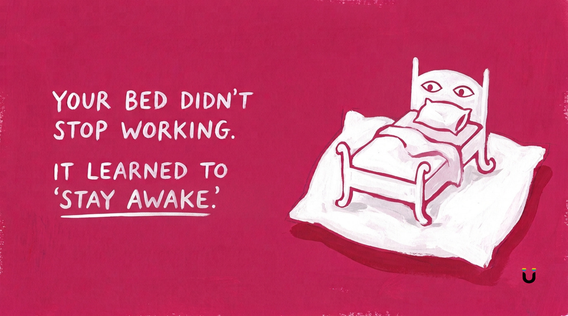
Sometimes overthinking doesn't stop after the conversation ends. Your body stays tense, your mind keeps rehearsing, and sleep becomes another place where the simulation keeps running.
Ground & Calm Essential Oils were created for those moments—when you need a small ritual that helps signal to your nervous system that the rehearsal can pause for a while.
Apply it before difficult conversations, while journaling, or as part of your evening wind-down.