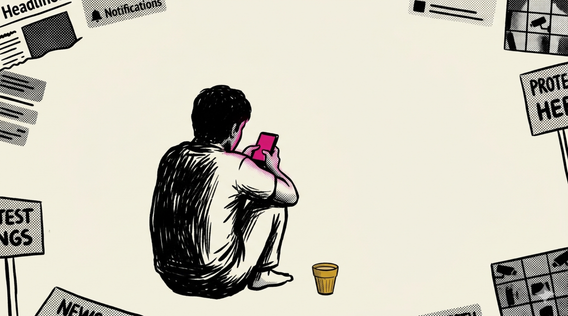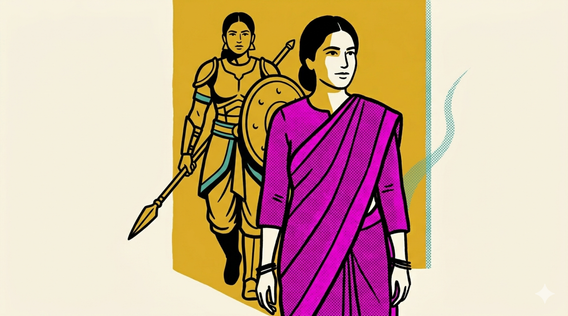
Ritika is 29, three years into a job she is good at, sitting in a review where a decision is being made that she knows will not work. She has the reason. She has watched it fail before. She says nothing, and afterwards, in the corridor, she tells a colleague exactly what she should have said. (Ritika is a composite. You have either been her or managed her.)
Yes, you can. Recent research finds that the effect of a hierarchical culture on employee silence runs almost entirely through a belief that speaking up will change nothing. Where people saw visible management commitment, they were less likely to stay silent regardless of how futile they felt speaking up was. The hierarchy is not the thing you have to dismantle.
Which is a more hopeful finding than the usual advice, and a more demanding one.
What Do We Actually Mean by Hierarchy Here?
Two different things, and the research separates them in a way ordinary conversation does not.
The first is a property of the workplace. A hierarchical culture, in the organisational literature, means a clear chain of command, respect for authority, and an emphasis on stability and control. That is a description of a structure, and plenty of Indian companies have it.
The second is a property of the person. Power distance orientation is how much a particular individual accepts unequal distributions of status and power. What matters is that researchers increasingly treat this as an individual orientation rather than a national characteristic. People inside the same country, the same city, the same office, differ.
In the study below, the two were not significantly correlated with each other. A person's own deference did not track their unit's hierarchy. That finding alone should retire the sentence "Indians will not speak up because Indian culture is hierarchical."
What Does the Research Actually Find?
That silence is not mainly about fear. It is about futility.
Seung Eun Lee and Jeong Won Lee surveyed 730 direct care nurses across 88 units in 34 hospitals in South Korea, published in the Journal of Nursing Management in 2024. They measured hierarchical unit culture, individual power distance orientation, perceived futility, and silence behaviour.
Futility here has a precise meaning: the belief that voicing a concern will not lead to any meaningful change.
Hierarchical culture predicted futility strongly. Power distance orientation predicted it too. Futility then predicted silence. And here is the part worth sitting with: once futility was accounted for, hierarchical culture no longer predicted silence at all. The effect ran entirely through the belief that it would not matter.
Then the finding that changes what a manager should do. Where nurses perceived strong management commitment to patient safety, they were less likely to stay silent, and this held regardless of how futile they believed speaking up to be. Visible commitment did not have to first cure the futility. It worked alongside it.
People are not staying silent because the hierarchy frightens them. They are staying silent because they have watched what happens to input, and they have drawn a conclusion. That conclusion is a piece of evidence they collected from you.
The honest caveats belong here rather than in a footnote. This was one cross sectional study in Korean hospitals, so it captures a moment and cannot prove causation. It relied on self report. The authors say all of this themselves. And nobody has run it in India, which is a sentence that has appeared in almost everything we have written about workplace mental health here.
Does Deference Always Damage Safety?
Not in the way the standard advice assumes, and the exceptions matter.
A 2025 study of 263 frontline construction workers across three Chinese cities looked at paternalistic leadership, meaning a style combining authority, benevolence and moral example. It found that this leadership improved workers' safety behaviour, partly through team safety climate and partly through psychological safety. The effect was stronger, not weaker, among workers with high power distance orientation.
Read that carefully before using it. It does not say authority is good. It says that in a setting where people expect authority, a leader who exercises it with visible care can produce safety rather than silence. The mechanism is the leader's behaviour, not the flatness of the chart.
This is what makes so much imported advice useless in an Indian office. Telling a company to flatten its hierarchy, remove titles and encourage everyone to challenge everyone is an intervention designed for a workplace that already has low deference. Applied here it tends to produce a meeting where the same three people talk and everyone else waits to see whether it is a trap.
What Does This Look Like in an Indian Workplace?
Like obligation more often than fear, which is the part Western material never names.
The manager who gave you the role when you needed it. The one who called when your father was in hospital. Contradicting that person in a meeting is not frightening in the way a bully is frightening. It feels ungrateful. Seniority in an Indian office frequently comes bundled with genuine personal generosity, and generosity creates a debt that silence goes on paying.
Then the practical arithmetic. A long notice period makes leaving expensive, which makes any risk to the relationship expensive. A reference matters for years. And log kya kahenge does not only run upward. Being the person who raises things carries a lateral cost among peers who have decided the thing is not worth raising.
None of this is a character flaw in Indian employees. It is a rational reading of the incentives, which is exactly what the futility finding describes. We have written before about why psychological safety matters at work, and about what an unsafe culture does to people over time.
So What Actually Changes It?
Evidence that input moves things. Repeatedly, visibly, and in public.
Close the loop out loud. When someone raises something, say what happened to it. Acted on, or not acted on and here is why. The second one is almost as good as the first, and infinitely better than silence, because both prove the input reached a person with authority.
Show the commitment before you ask for the input. The Korean finding is that visible management commitment reduced silence even among people who thought speaking up was pointless. Commitment first, survey second. Doing it the other way round asks people to take a risk on an organisation that has not yet shown its hand.
Ask people individually rather than in the room. If deference varies person to person rather than by nationality, then the group meeting systematically collects the views of whoever has the lowest power distance orientation. That is not a representative sample. It is a personality sample.
Let the senior person go last. Not a flattened hierarchy. Just a sequencing decision, which costs nothing and stops the first opinion in the room from being the only one that survives.
Notice who has stopped raising things. A person who used to bring problems and no longer does has not become agreeable. They have finished collecting evidence.
We build measurement and response programmes for Indian employers, so read that list knowing we sell the thing it points toward.
Ritika will be in another review next quarter. Whether she says the thing depends less on how senior the room is than on whether she has seen, at some point in the last year, somebody's inconvenient observation actually change a decision. If she has, the hierarchy will not stop her. If she has not, no amount of open door language will move her, and she will be right not to be moved.
Silence is a conclusion. People reach it with evidence, and the evidence is supplied by the organisation.
What Else Do People Ask About Hierarchy and Speaking Up?
Can you have psychological safety in a hierarchical organisation?
Yes. Research on 730 nurses across 34 South Korean hospitals found that the effect of hierarchical culture on silence ran entirely through perceived futility, meaning the belief that speaking up would not change anything. Once futility was accounted for, hierarchy itself no longer predicted silence. Visible management commitment reduced silence regardless of how futile people felt speaking up to be.
Is power distance a national characteristic?
Increasingly it is treated as an individual orientation rather than a fixed national trait. Power distance orientation measures how much a particular person accepts unequal distributions of status and power, and it varies within any country or workplace. In the Korean study, individual power distance orientation was not significantly correlated with the hierarchical culture of the unit people worked in.
Should we flatten our hierarchy to improve psychological safety?
The evidence does not require it. What predicted silence was futility rather than structure, and a 2025 study of Chinese construction workers found that leadership combining authority with visible care improved safety behaviour more strongly among workers with high power distance orientation. Changing what happens to input is better supported than changing the organisation chart.
Why do employees stop raising problems?
Usually because they have concluded it does not lead anywhere. Futility, defined as the belief that voicing concerns will not produce meaningful change, is a stronger predictor of silence than the hierarchy itself. A person who used to raise issues and has stopped has generally observed what happened to earlier input rather than become more agreeable.
Is there Indian research on psychological safety and hierarchy?
Not that we have found. The available evidence on hierarchy, power distance and silence comes largely from Korea, China, Europe and cross national safety culture studies. Applying it to Indian workplaces is a reasonable read across rather than a direct finding, and the specific dynamics of Indian workplaces, including obligation to a personally generous senior, remain largely unstudied.
This piece is for understanding, not diagnosis. If you feel close to harm, please reach out now. iCall: 9152987821 (Mon to Sat, 8am to 10pm). Tele-MANAS: 14416 (24 hours). If you would rather speak to someone privately, our therapists are here.
A note on the cover image
The image at the top of this piece was generated by AI, to a brief written by us. It is not a photograph and does not depict a real person or place.
Sources
Lee, S. E., & Lee, J. W. (2024). Effects of Hierarchical Unit Culture and Power Distance Orientation on Nurses' Silence Behavior: The Roles of Perceived Futility and Hospital Management Support for Patient Safety. Journal of Nursing Management, 2024:6564570. Open access, CC BY. 730 nurses, 88 units, 34 hospitals, South Korea; cross sectional and self report, as the authors state. Full text
On paternalistic leadership and power distance among construction workers in three Chinese cities, n=263, 2025. Full text
Edmondson, A. C. (1999). Psychological Safety and Learning Behavior in Work Teams. Administrative Science Quarterly, 44(2), 350-383. The origin of the team level construct discussed here. DOI, paywalled.
Both empirical studies cited above were conducted outside India. We have said so in the article rather than presenting them as Indian findings.