Overthinking a Text? Why You Can't Stop Reading the Same Message
I once read a two-word text, "cool, sure", forty-one times. I counted, because at some point the counting became the only thing I was doing that felt like control. Was the comma doing something? Was "sure" warm, or was it the thing you say to a colleague? I screenshotted it. I sent the screenshot to two friends, who disagreed with each other, which helped nobody. (I know. I do this for a living now.)
Overthinking a text happens because a message hands you almost no information, and your mind fills the gap with whatever you're most afraid of. There's no tone, no face, no timing you can trust. So the reading you finally settle on is rarely about the text at all. It's about what you already believe you deserve.
If you've read this far, it's probably because there's a text open in another tab right now. So let me be useful rather than wise, and tell you what those forty-one readings were actually doing, since I've had a few years and some training to work it out.
Why does one text feel like a verdict?
Because a text is the only evidence in the room, and the mind can't stand an empty room.
Face to face, you get eyebrows, a pause, a laugh you can actually hear. On WhatsApp you get the words, the timing, two blue ticks and the word "online", and that's the entire case file. Anxious thinking is very good at building a case from a thin file. Thomas Borkovec, whose 1983 work in Behaviour Research and Therapy is still the plainest description of worry we have, found that what most sets habitual worriers apart is that once the loop starts they cannot stop it, and that it points forward, at what the reply means for whatever happens next.
So the forty-one readings were never really about "cool, sure". They were about the date next Friday, the relationship I'd already half-built in my head, the version of the year in which this person turned out to be the one. Two words were carrying all of that. No two words can carry all of that.
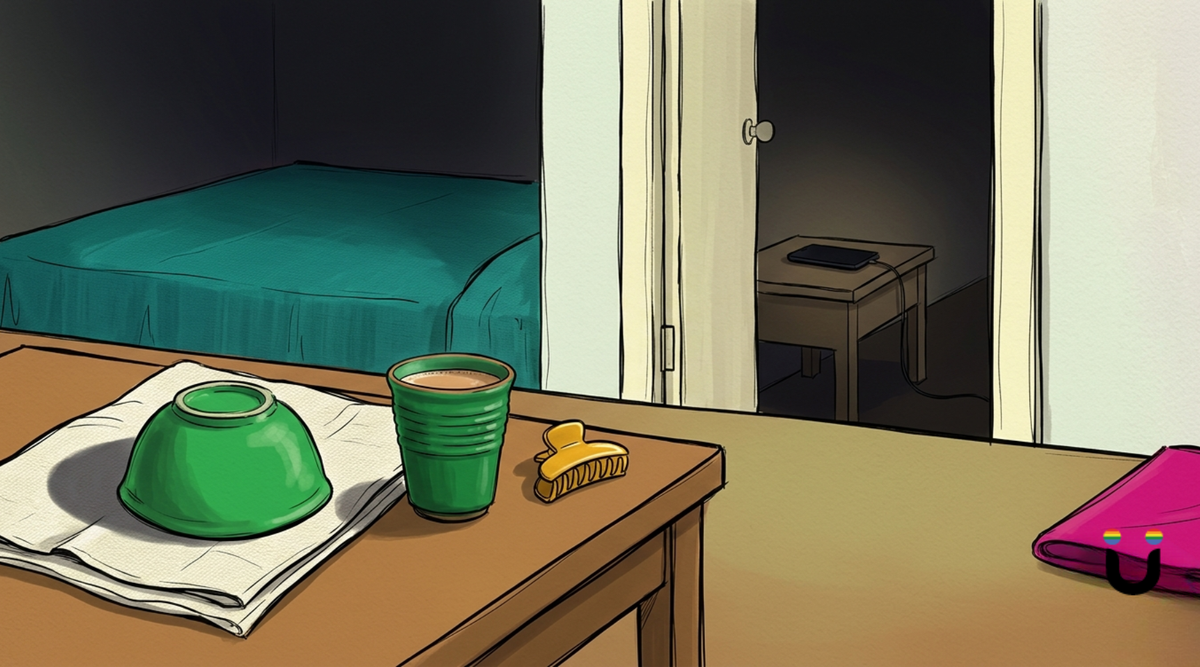
In an Indian context there's an extra load on the message. Most of us aren't from families where feelings get said out loud. We learned to read a room from the way someone set down a cup. So of course we read a text the same way: the punctuation is the cup. And a lot of us are dating in a city we moved to alone, where the person on the other end of the text is one of maybe four people who knows how our day went. That makes the text far bigger than it would be if we had a kitchen full of people to walk into instead.
What does "why hasn't he replied" actually mean?
Usually it means "am I safe to want this".
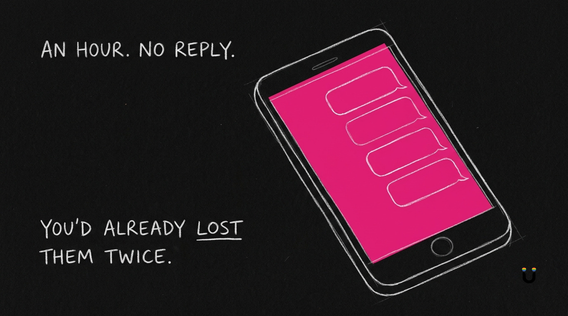
Waiting for a delivery doesn't hurt. Waiting for a reply hurts because somewhere in the wait a question has quietly attached itself: whether you were too much, whether you misread the last meeting, whether this is the opening move of the slow fade you've lived through before. Every refresh is an attempt to close the question. Every refresh reopens it. We wrote about the refresh itself in why you can't stop refreshing when the result won't change, and it applies to a reply as much as to a result.
If the wait always feels like this, with everyone, it may be worth reading about the signs of anxious attachment in Indian relationships, because the pattern of building a whole future on a thin signal and then panicking when the signal goes quiet has a name, and a history, and is not a personality flaw. It's a way of loving that learned early that attention could be taken away.
No two words can carry that much. The weight was never in the text.
Is it the text or is it you?
Both, and here's the part I'd have hated to hear at the time.
Some of those forty-one readings were reading the text accurately. "Cool, sure" is, in fact, a lukewarm reply, and a person who wanted to see me would probably have said more. The overthinking was refusing to let a small, real signal stay small. It kept trying to inflate a lukewarm reply into a catastrophe, or shrink it into a misunderstanding, because either of those was easier to hold than "this person is a little less keen than I am".
That's the honest complication, and I'm not going to soften it for you. Sometimes the text means exactly what you're afraid it means. What the loop lies about is the size of the signal, and about what you can survive. You can survive someone being a little less keen than you are. You have before.
What helps when you are overthinking a text?
Three things, from someone who's needed all of them.
First, put the phone in another room for thirty minutes and do something with your hands, because the loop runs on the refresh and starves without it. The body matters here. Dots To Ground You exists for exactly this half hour.
Second, write the fear out as a full sentence, not a feeling. "I'm afraid this person is losing interest and I'll be alone again." Written down, the sentence usually splits into two halves, and the second half is the one that's actually hurting.
Third, and this is the one I resisted for years: ask. "Are you mad at me" is a test. "I'd like to see you Friday, are you keen?" is a question a person can answer, and the answer, whatever it turns out to be, ends the loop. Silence ends nothing.
If asking feels impossible, that's worth noticing too. Interrogating a relationship in your head instead of in the room is one of the commonest patterns we see, and a conversation with a psychologist is often where people first practise the question they cannot send.
He did reply, eventually, to the "cool, sure" text. He said he'd been busy that week. He was, it turned out, a little less keen than I was. I was fine, after a while. And I still count sometimes, but I've got it down to about six.
What else do people ask about overthinking texts?
Why do I overthink every text I send?
Because a text carries almost no information about tone, and anxious thinking fills the gap with the worst case. The overthinking is usually about what the message means for the relationship, not about the words themselves. If it happens with every text and every person, the pattern is worth looking at with someone.
Why does waiting for a reply feel so bad?
Because a question has attached itself to the wait: whether you were too much, whether the person is losing interest. Each refresh tries to answer it and reopens it instead. Borkovec's research on worry found that the defining feature of habitual worry is that once started, it can't easily be stopped.
Should I just ask them what they meant?
Usually yes, as a real question rather than a test. "I'd like to see you Friday, are you keen?" can be answered. "Are you mad at me?" invites reassurance that lasts about an hour. A direct question ends the loop whatever the answer; silence keeps it running.
Is overthinking texts a sign of anxious attachment?
It can be, if it happens across relationships and comes with a pattern of building a future on small signals and panicking when they go quiet. Anxious attachment is a learned way of relating, not a flaw, and it responds well to therapy.
Sources
Borkovec TD, Robinson E, Pruzinsky T, DePree JA. Preliminary exploration of worry: some characteristics and processes. Behaviour Research and Therapy, 1983, 21(1), 9 to 16. US student samples. Abstract (ScienceDirect)
When your mind keeps returning to the same thought
Some thoughts don't disappear because you've understood them. They disappear because you've practised returning to yourself.
Our Affirmation Calendar was designed for exactly that: one small, grounded thought each day that interrupts the spiral before it becomes forty-one readings of the same message.