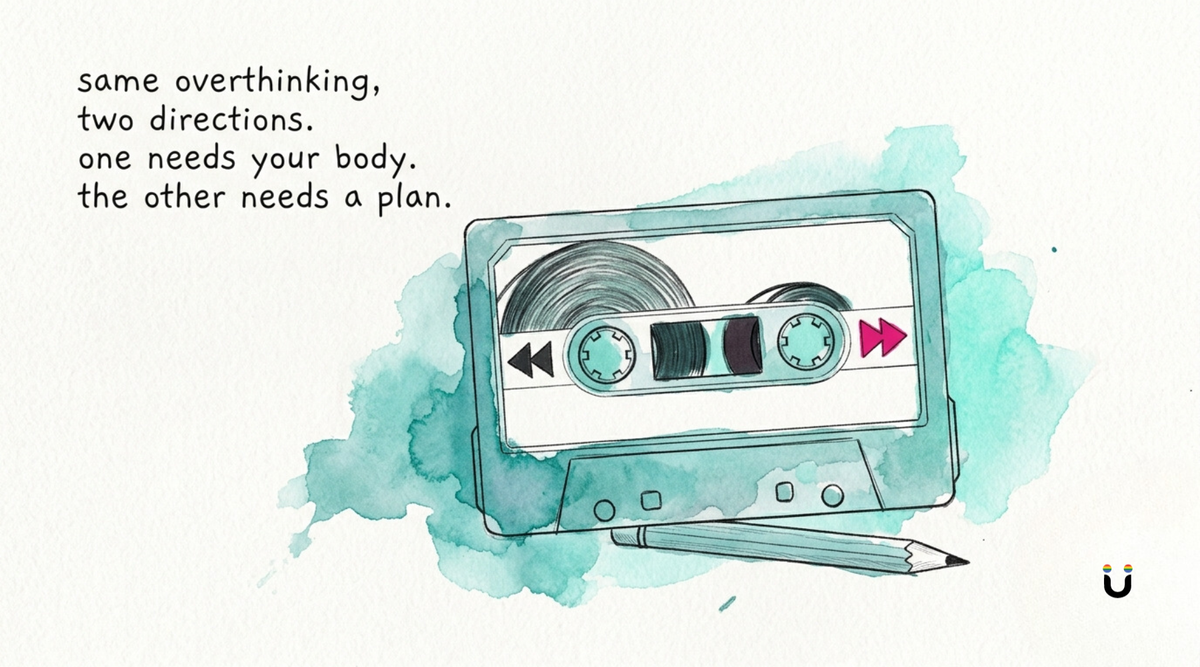
Two people can both say "I overthink" and mean opposite things. One is still stuck in the meeting from Tuesday, replaying the sentence that came out wrong. The other hasn't had the meeting yet and has already lost it four different ways. One looks backward. The other looks forward. Same word, different machinery, and the difference decides what will actually help.
Rumination is repetitive thinking about the past and about your own low mood: what went wrong, why, and what it says about you. Worry is repetitive thinking about the future: what might go wrong, and how to head it off. Overthinking is the everyday word that covers either one. Rumination sits closer to low mood. Worry sits closer to anxiety. Most people do a bit of both.
Clinicians care about the distinction because the two loops respond to completely different things. Someone who ruminates doesn't need more reassurance about tomorrow. Someone who worries doesn't need help grieving yesterday. The word "overthinking" hides which one you're doing, and the hiding costs you time. So here's the difference, plainly, with the Indian texture the Western explainers tend to skip.
What is rumination?
Rumination is the backward loop.
The psychologist Susan Nolen-Hoeksema, in a 1991 paper in the Journal of Abnormal Psychology, defined it as responding to a low mood by repetitively focusing on the mood itself, its causes and its consequences, instead of doing anything about it. Her research showed that people who respond this way stay low for longer. The loop feels like analysis. What it actually does is keep you sitting in the feeling without ever moving through it.
In Indian households, rumination often turns up wearing the costume of self-improvement. You're not brooding, you're learning from your mistakes. The comment your mother-in-law made at the wedding gets replayed as an effort to understand her, which keeps it respectable, and respectable loops are the hardest ones to interrupt. The tell is the question you keep circling back to. Rumination asks "why did this happen to me" and "what does this say about me". Neither one has an answer that ends the loop, which is precisely why the loop doesn't end.
If your overthinking is about a pause someone left in a conversation, or a thing you said back in 2019, you're ruminating. Our piece on why your mind keeps replaying that one pause is about this loop specifically.
What is worry?
Worry is the forward loop.
The clearest early description comes from Thomas Borkovec and colleagues, whose 1983 paper in Behaviour Research and Therapy described worry as aimed at future situations rather than past or present ones, arriving with tension and somatic cues like a tight stomach, and marked in self-described worriers by one feature above all: once it starts, they cannot stop it. Worry feels like preparation. What it actually does is rehearse a threat that may never turn up, and keep the body braced as though it already had.
The Indian costume for worry is responsibility. The anxiety gets renamed as thinking ahead. You're the one who checks the train times and keeps the backup. In a country where a great deal can go wrong and frequently does, worry can look a lot like competence, and now and then it genuinely is. The tell, again, is the question. Worry asks "what if", answers itself with the worst case, and then asks "what if" about the answer. Rehearsing conversations before they happen is worry in its most recognisable Indian form.
Rumination asks why it happened to you. Worry asks what if it happens again. Neither question has an answer that ends the loop.
Is overthinking the same as rumination?
Overthinking is the umbrella. Rumination and worry are the two things sheltering under it.
The clinical literature doesn't use "overthinking" as a term at all. Edward Watkins, in a 2008 review in Psychological Bulletin, used the phrase repetitive thought to cover both, and made a point that matters more than the labels do: repetitive thought isn't always harmful. Reflecting on a loss, or planning for a real deadline, is the same machinery pointed somewhere useful. What separated the useful version from the harmful one, in his review, was whether the thinking was concrete or abstract. Concrete thinking asks how, specifically, and then it moves. Abstract thinking asks why, in general, and then it circles.
This is the most practical thing on this page. The loop you can't stop is almost always the abstract one. "Why am I like this." "What if everything goes wrong." The way out is rarely to stop thinking, which nobody can do to order. It's to make the thought more specific, until it either resolves into an action or simply runs out of road. "Why am I like this" has no floor to it. "What exactly did I say, and what could I say next time" does.
Why does it matter which one you are doing?
Because the fixes are different, and applying the wrong one is what makes people decide that nothing works.
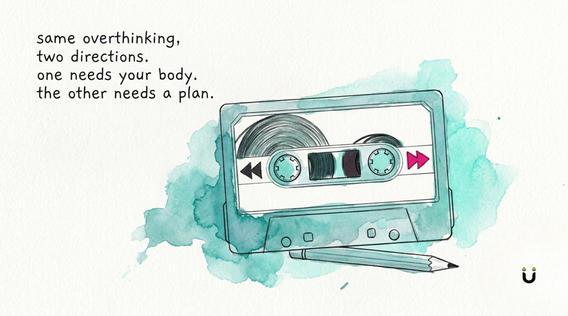
Rumination responds to getting out of the mood and into the body: movement, or a task that uses your hands. It responds badly to more analysis, which is exactly why talking it through with a friend for the fifth time so often makes it worse. Worry responds to bounded problem-solving: write the fear down and name the one thing you can do about it today, then set a time to think about the rest. It responds badly to reassurance, which the worrier soaks up and then needs again within the hour.
In the room we usually find both running in the same person. The one who worries about Thursday's presentation ruminates about Monday's. The loop changes direction depending on whether the event sits ahead of them or behind them. This is worth knowing about yourself. If your overthinking gets worse on Sunday night, it's mostly worry; we wrote about why Sunday feels worse in India. If it gets worse on the commute home, it is mostly rumination.
The honest complication is that naming the loop doesn't stop it. Knowing you're ruminating while you ruminate is a strange, layered kind of stuckness, and it can feel worse than the plain version, because now you're also failing at something you understand. That layer is normal. It's what the first few weeks of paying attention feel like, and it passes, though not on any schedule anyone can promise you.
What can you do with this distinction today?
Write the thought down and check its direction. If it points backward, do something physical before you do anything mental. Grounding prompts like the Ground Breaking cards exist for exactly that pause, when the point is to change state rather than to think harder. If it points forward, make it concrete: what, exactly, are you afraid of, and what's the one thing you could do about it before 6pm. A structured page helps here, because it forces the specific. The thought record is the standard clinical tool; the Explore journal was built on the same logic for people who want it on paper.
And if the loop has been running most days for months, in either direction, the distinction stops mattering, and the question becomes whether it's anxiety or low mood wearing the overthinking costume. Most of what looks like overthinking is unfinished feeling. The direction of the loop is a clue to which feeling it is. A psychologist can usually name in one session what's taken you months to circle, and that isn't a failure on your part. It's what the outside view is for.
What else do people ask about rumination and worry?
What is the difference between rumination and worry?
Rumination is repetitive thinking about the past and about your own mood, asking why things happened and what they mean about you. Worry is repetitive thinking about the future, asking what might go wrong. Rumination links more closely to low mood, worry to anxiety. Both are forms of what people call overthinking.
Is rumination a symptom of depression or anxiety?
Rumination is most strongly linked to depression: Nolen-Hoeksema's research showed it prolongs low mood. It also shows up in anxiety. Worry is the form of repetitive thought most linked to anxiety disorders. Many people experience both, with the direction of the loop shifting depending on whether the event sits ahead of or behind them.
Is all repetitive thinking harmful?
No. Watkins' 2008 review found repetitive thought can be constructive, for instance when you're recovering from a loss or planning for a real event. The harmful version tends to be abstract, asking why in general; the useful version is concrete, asking how specifically. Making a loop more specific is often the way out of it.
How do I stop ruminating?
Rumination responds better to a change in state than to more analysis: move, do something with your hands, change rooms. Then write the thought down and make it concrete. If it's been most days for more than a few months, speak to a psychologist; persistent rumination is often low mood that hasn't been named yet.
Sources
- Nolen-Hoeksema S. Responses to depression and their effects on the duration of depressive episodes. Journal of Abnormal Psychology, 1991, 100(4), 569–582. doi:10.1037/0021-843X.100.4.569
- Borkovec TD, Robinson E, Pruzinsky T, DePree JA. Preliminary exploration of worry: some characteristics and processes. Behaviour Research and Therapy, 1983, 21(1), 9–16. Two questionnaire studies and one experiment, US student samples. ScienceDirect
- Watkins ER. Constructive and unconstructive repetitive thought. Psychological Bulletin, 2008, 134(2), 163–206. Narrative review. Full text (APA PsycNet PDF)