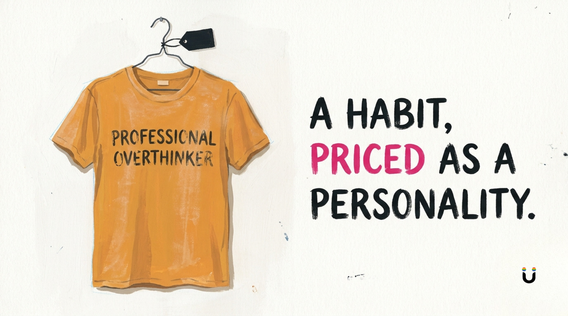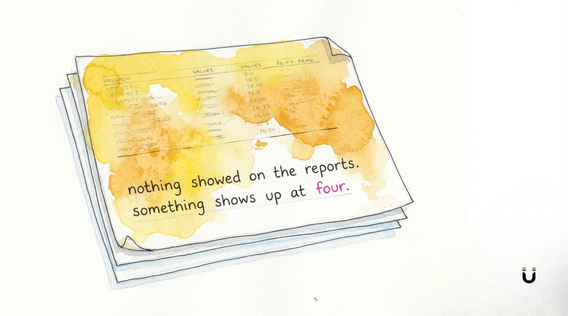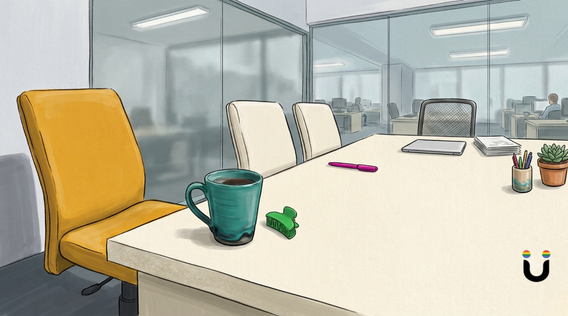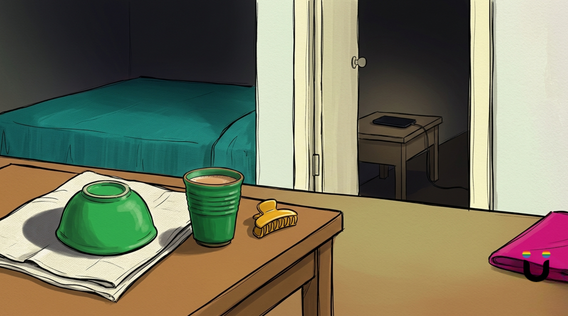
This one started in supervision, the hour our psychologists spend in a room telling each other what they got wrong that week. Someone said the word overthinking and the room laughed, because every one of us had heard it that week, from a client, from a parent, from the inside of our own heads at 2am. So we wrote it down.
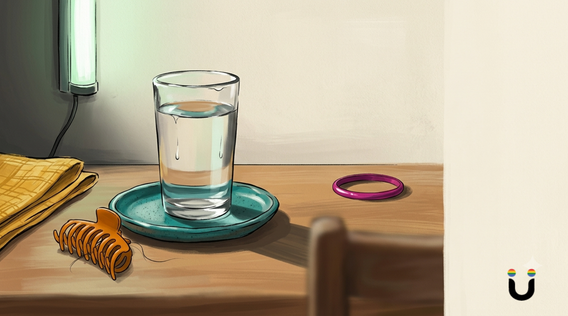
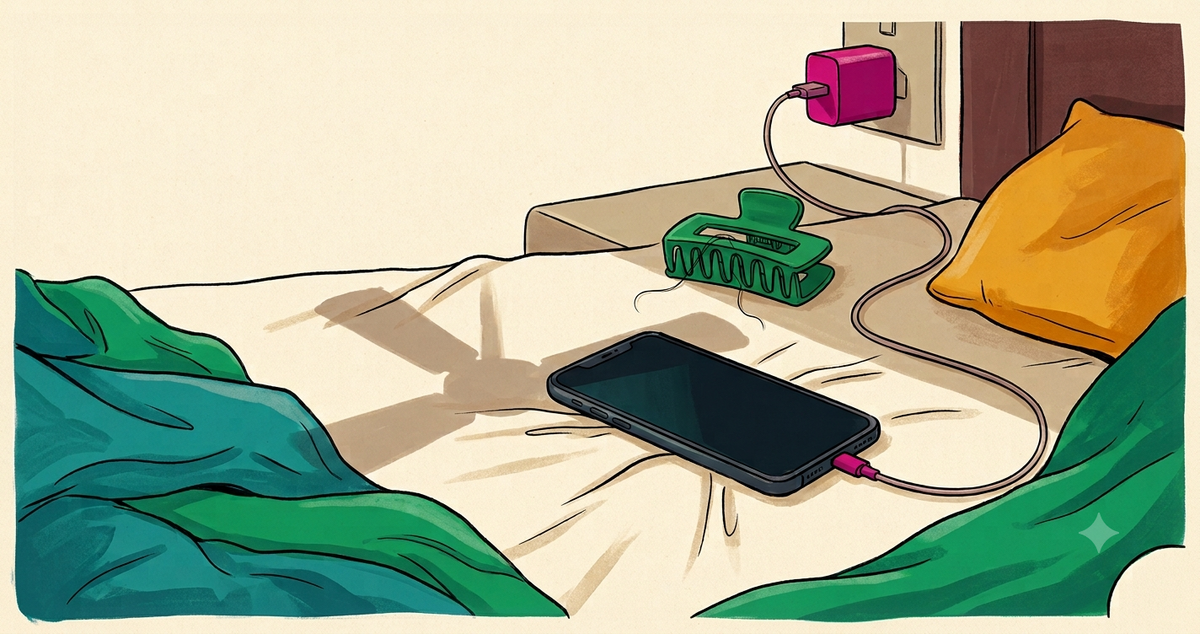
It is 2am and the ceiling fan is the only thing moving. You are replaying a message you sent at 4pm, reading your own words back in three different tones, and you have decided you sounded wrong in all of them. Somewhere in there you also plan tomorrow, rehearse a conversation that may never happen, and reopen a decision from 2019. If you have ever asked yourself, in that exact hour, why do I overthink everything, you know the loop. It does not feel like a choice. It feels like weather.
Overthinking, which psychologists call rumination, is the habit of circling the same thoughts about a problem without ever moving closer to solving it. The usual explanation is that your mind is too active. The one we keep arriving at, in the room and in supervision, is that a feeling underneath has nowhere to go, and the thinking is what it does instead.
An overthinker is someone whose mind keeps working a problem after the working has stopped helping. You replay what you said, rehearse what you will say, and reopen decisions you already made. It is a habit of mind rather than a diagnosis, and it feeds anxiety and low mood when it runs unchecked.
Call her Ananya. She is a composite, stitched together from many people several of us have sat across from: 29, a decent firm in Mumbai, the friend everyone describes as sorted. She does not look anxious. She looks capable, which is worse, because capable people get left alone. She also has not slept a full night in months, because the moment the lights go off her mind clocks in for its second shift.
What is overthinking, really?
Rumination is repetitively focusing on the causes and consequences of your distress rather than on anything you can actually do about it. Susan Nolen-Hoeksema, the psychologist who spent her career on this, drew the line cleanly. Solving a problem asks what can I do now. Rumination asks why did this happen to me, and then asks it again, and then once more in a slightly different voice, without ever letting you answer. One moves. The other only feels like it is moving. We have all mistaken the second for the first, usually about our own lives.
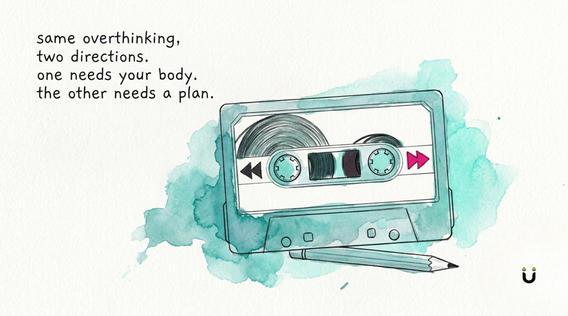
There is a useful distinction hiding inside the word. Rumination looks backwards, chewing on things that already happened: the message, the meeting, the thing you said at a wedding in 2021. Worry looks forward, rehearsing things that have not happened yet. Most people who overthink do both, switching so fast it sounds like one continuous noise. Naming which one you are doing is the first small crack of light, because they answer to different things.
The loop is not the problem. It is the symptom of something you have not let yourself feel yet.
What are the symptoms of overthinking?
Overthinking has symptoms you can name, even though it is not a diagnosis. The ones we hear most often, across every therapist on the team: replaying a conversation hours or days after it ended, rehearsing one that has not happened yet, reopening a decision you already made, reading a short text as a verdict, asking the same two people for the same reassurance, and lying awake with a problem you have already solved four times. Five, if you count the shower.
There is a physical side. The jaw that aches by evening. The stomach that will not settle before a meeting. The tiredness a full night of sleep does not touch. Those get their own piece on what overthinking does to your body, because in India they are often the first symptom anyone takes seriously, the overthinker included.
The sign we trust most is simpler than any list, and it came up in supervision as the one thing all of us actually use. Ask whether the last hour of thinking changed anything. If it did not, and the thinking has not stopped, that is overthinking. Problem solving ends. Rumination does not.
Why does my brain refuse to switch off?
Because at some point thinking became the safest thing you could do with a feeling. Rumination convinces you it is working. It wears the costume of solving a problem: if I just think about this one more time, from one more angle, I will find the version where nothing goes wrong. So you keep going, because stopping feels like leaving the door unlocked.
But the door was never the issue. Underneath most overthinking is an emotion the thinking is helping you avoid. Fear. Hurt. Shame. Anger you were not allowed to have, grief you never sat down with. The mind offers analysis because analysis feels productive and controllable, and the feeling underneath feels like neither. It is easier to spend three hours deciding whether your friend is upset with you than to sit with the plain, unglamorous fact that you feel lonely and are not sure you are wanted. The loop protects you from the feeling. It also keeps you from ever finishing it.
Why do so many Indians overthink instead of feel?
Because most of us were raised to think and taught to distrust feeling. In a lot of Indian homes a child who reasons is praised and a child who cries is asked to stop. We grew up on sochke bol, socho pehle, think before you speak, think it through, as though thinking harder were the cure for every discomfort. Feeling was rarely the cure for anything. It was the thing you managed so the house stayed calm.
So we got very good at the mental part and no practice at the other. The good daughter learned to read everyone's mood instead of naming her own. The son learned that a problem was something you solved alone and never something you admitted. Emotion in many of our households had no vocabulary and no room, so it went underground, and the only exit left open was the mind. Seen this way, overthinking stops looking like a personal flaw and starts looking like an inheritance: what a whole generation of feelings does when there was never anywhere safe to put them. This applies to the psychologists too. Ask any of us how our families talked about feelings and watch us change the subject.
The numbers show how private this stays. The National Mental Health Survey of India, run by NIMHANS across nearly 35,000 adults, found about 1 in 10 adults living with a mental disorder, and put the current prevalence of the group of conditions that includes anxiety at 3.7 percent. Nearly 150 million Indians live with a mental disorder of some kind, and the survey's overall treatment gap was 84.5 percent, which means fewer than one in six people who need care ever reach it. Most of that overthinking never becomes a sentence said out loud to another person. It just runs, at 2am, under the fan.
Is overthinking the same as anxiety?
No, but they feed each other. Overthinking is a habit of mind. Anxiety is a clinical condition with a body attached, one that stays braced for threat when nothing is wrong. Rumination is one of anxiety's most visible features and a well documented risk factor for both anxiety and depression: the more you loop, the deeper the groove, until what began as effort becomes reflex. This is why you cannot simply decide to stop. Willpower has nothing to do with it. You are running a pattern your brain has practised into automatic, the way you can drive home without remembering the drive.
There is a line worth knowing. Ordinary overthinking is exhausting but livable. When the loop starts eating your sleep or your appetite, or your ability to be in the room with the people you love, and when it comes with a body that will not settle, it has moved into territory where support helps. Asking for it is not a failure. That is what working with a therapist is for. The point of it is the feeling the thinking has been standing guard over, and reaching that is slower and stranger than thinking less.
Is overthinking a disease or a mental disorder?
No. Overthinking is not listed as a disease or a mental disorder in either of the two manuals clinicians diagnose from, the ICD-11 and the DSM-5. What they list are the conditions with rumination at their centre: generalised anxiety disorder, depression, social anxiety, and obsessive compulsive disorder. Overthinking is the process. Those are the conditions it can feed.
The question underneath is usually a different one: is mine bad enough to need help. In supervision we have one answer, and it is function. If the loop is costing you sleep most nights, or it has stopped you sending the email or taking the job, it has crossed from habit into something worth treating, whatever it is eventually called. In India the first door is usually a psychologist. Medication becomes a question only if sleep and appetite have been gone for weeks, and that conversation belongs with a psychiatrist. Nobody on our team will be offended if you end up needing both.
A two minute anxiety screen will not tell you whether you are an overthinker. It will tell you whether the anxiety underneath has grown large enough to name, which is the more useful thing to know.
What is the honest thing nobody says about overthinking?
The honest thing is that the loop has kept you safe, and you will not want to give it up. Overthinking earned its place. For some of us it caught real dangers, smoothed real conflicts, kept a volatile house from tipping over. Telling someone to just stop overthinking is like telling them to stop wearing the coat that got them through every winter. It sounds simple to the person who has never been that cold.
And when you do reach the feeling underneath, it is often worse before it is lighter. The grief you postponed is still grief. The anger you were never allowed is still anger, and it does not arrive polite. This is the part the tidy listicles skip, and the part we spend most of supervision on. Letting yourself feel the thing does not dissolve it in one clean evening. It just stops it having to disguise itself as a thought at 2am. Nobody would call that a cure. It is a change of address for the pain, and for a lot of people it is the first thing in years that has felt like relief.
How do I actually stop overthinking?
You do not stop overthinking by thinking your way out of thinking. Every one of us has tried. You interrupt the loop and, slowly, give the feeling somewhere else to go. None of this is a switch. These are places to begin, and they are the ones we actually use.
Name the feeling before the problem. When you catch the loop, stop asking what should I do and ask what am I actually feeling right now. Research on what psychologists call affect labelling, from Matthew Lieberman's team at UCLA, found that simply putting an emotion into words lowers the brain's alarm response. The feeling gets smaller the moment it has a name. The loop keeps it nameless on purpose.
Give the feeling a page. Writing the emotion down, as the raw thing itself and never as a task list, moves it from inside your body into language you can see. That is the whole argument for expressive writing, which has decades of research behind it. If a blank page feels like too much, and for most people it does, TTC's journaling prompts give you a smaller door in.
Come back into your body. Rumination lives in the head and thrives when the rest of you goes still. Standing up, walking to the kitchen, cold water on the face, one slow breath out that is longer than the breath in. None of it solves anything. All of it tells a nervous system that is braced for threat that the danger is not in the room. If you want the fuller version of why the body hijacks the mind like this, we wrote about what happens when your brain goes offline and how to bring it back.
Give the loop an appointment. If you cannot stop it, contain it. Set fifteen minutes in the evening as worry time, and when the loop starts outside that window, tell it you have booked it in for later. It sounds too small to work. It works more often than it has any right to, because it treats the loop as a visitor rather than a resident. The loop hates being scheduled.
Ananya still overthinks. She has not become a calm person who floats above her own mind. What changed is smaller and more useful than that. She catches the loop earlier, asks what it is covering for, and sometimes finds, under an hour of analysing a friendship, something as plain and as human as I am scared she will leave and I have never told her she matters. The thought could have run forever. The feeling, once she let herself have it, took about a minute.
Maybe that is the thing to sit with, the thing we sat with, a room full of psychologists who overthink for a living. When your mind will not switch off, it is holding something it was never taught how to hand over. The question was never how do I think less. It was always: what have I been refusing to feel. You do not have to answer it tonight. Most of us have not answered it fully either. You only have to stop mistaking the noise for the thing making it.
Frequently Asked Questions
Am I an overthinker or just careful?
Careful thinking ends when the decision is made. Overthinking keeps going after it. If you have already decided, already sent the message, already had the conversation, and the mind is still working the same ground an hour later, that is the overthinker's loop. Careful people also sleep.
How do I stop overthinking at night?
Night is when there is nothing left to distract the mind, so the loop gets the stage to itself. There is a longer piece on overthinking at night. Rather than fighting the thoughts, name the feeling underneath them, then get it out of your head and onto paper. A slow breath out that is longer than your breath in signals safety to the nervous system. If a specific worry keeps returning, write it down to deal with in the morning, which tells the mind it has been heard.
Why do I overthink everything even when nothing is wrong?
Because overthinking is often less about the present situation and more about an old emotion looking for somewhere to go. When there is no immediate problem, the mind will find one, because the pattern has become automatic. In many people this reflex was learned early, in homes where thinking was safe and feeling was not. The loop is not reacting to today. It is running on a much older setting.
Sources
Susan Nolen-Hoeksema, Blair E. Wisco and Sonja Lyubomirsky on rumination and the response styles theory, "Rethinking Rumination," in Perspectives on Psychological Science (2008). Read the paper.
M. S. Gautham, G. Gururaj and colleagues, "The National Mental Health Survey of India (2016): Prevalence, socio-demographic correlates and treatment gap of mental morbidity," in the International Journal of Social Psychiatry (2020). Read the paper.
Matthew D. Lieberman and colleagues on affect labelling, "Putting Feelings Into Words," in Psychological Science (2007). Read the paper.