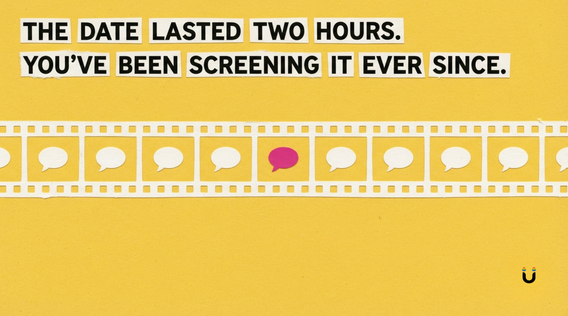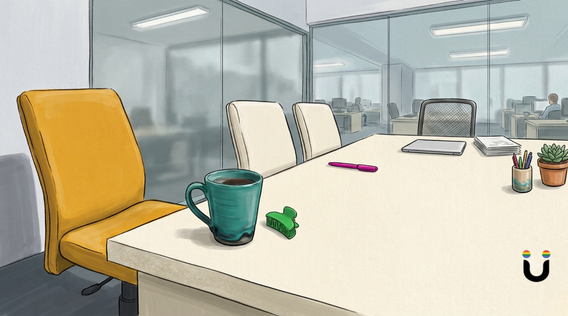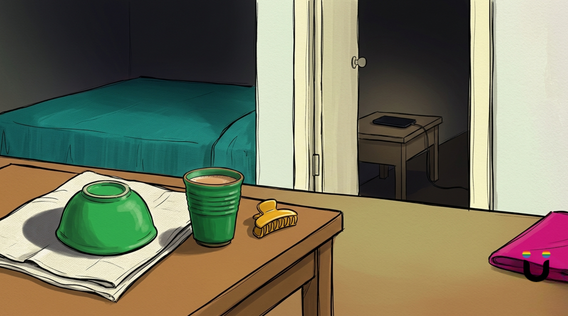
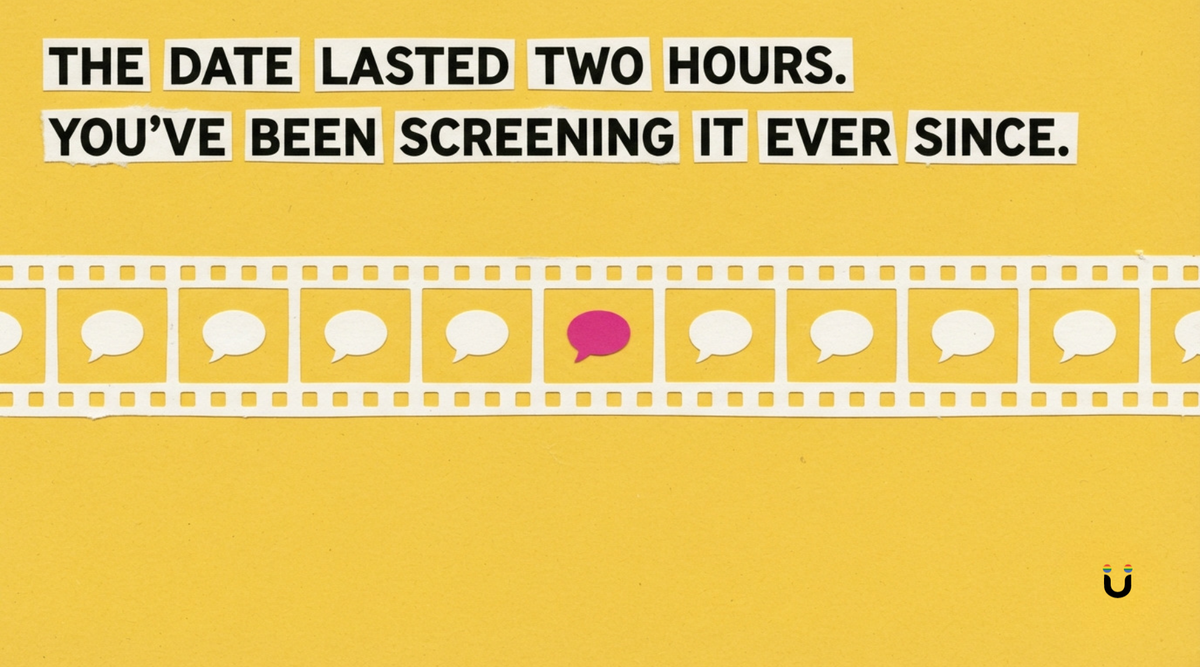
The date ended at 10.15 outside a bar in Lower Parel. It was, by any sane measure, fine. He laughed at the thing about your cousin's wedding. You split the bill without it getting weird. And by the time the cab had crossed the Sea Link, you'd replayed the moment you said "anyway" and changed the subject at least nine times, concluded you'd come across as either boring or intense, failed to decide which, and moved on to analysing why you couldn't decide.
Overthinking after a date happens because the evening threw off a lot of ambiguous information and no verdict. Your mind fills the gap by replaying the parts it can control, which are your own words, and reinterpreting them as mistakes. The loop is rarely about the date. It's about whether you're safe to want the next one.
If this sounds familiar, you're in good company, some of it the people who write these pieces. So let me tell you what the nine replays were doing, because once you can see the machinery, it gets a little harder for the machinery to run you.
Why does a good date turn into a bad night?
Because your mind treats "I don't know how that went" as an emergency, and it knows exactly one way to handle an emergency, which is to think harder.
Thomas Borkovec and colleagues, in a 1983 paper in Behaviour Research and Therapy, found that what most sets habitual worriers apart is that once the loop starts they cannot stop it, and that it points forward, at what might happen next. The replay of the date is worry wearing memory's clothes. You aren't really reviewing 8.40pm. You're trying to predict Thursday.
The material it works with is unfair. You remember everything you said and almost nothing he did, because you were watching yourself the entire time. So the replay has a full transcript of your side and about three frames of his. It fills the missing frames with the worst available reading, because the worst reading is the one you'd least like to be ambushed by later. It feels like caution. It's closer to pre-grieving a person you met four hours ago.
What is actually being decided at 11.40pm?
Something other than whether he liked you.
That question can't be answered from your side of the cab, and some part of you knows it. What's being decided is whether it's safe to hope. Hoping is expensive. If you hope and he doesn't text, you've lost something. If you conclude in advance that it went badly, you've got nothing left to lose, and his not texting will simply confirm what you'd already settled on. The replay is an insurance policy. The premium is your Tuesday night.
In an Indian context the premium runs higher, because the date rarely stays just a date. Somewhere in the replay there's a parent who's started asking, a friend group where you're the last one single, a birthday you didn't want to spend alone, the wedding where the aunt will ask. The date was two hours long. The things riding on it are years old. The people we are drawn to when we most need to be chosen are often the ones least likely to choose us, and the replay after a date with one of them is the loudest of the lot, because some part of you already knows that.
You aren't reviewing 8.40pm. You're trying to predict Thursday.
Is it him or is it you?
Usually a bit of both, and here's the part that took me the longest to accept.
Some of the nine replays were reading the evening correctly. There was a moment, somewhere around the second drink, when you caught him checking his phone and felt a small drop, and you've been replaying "anyway" ever since so that you don't have to think about the drop. The loop is a redirect. It keeps you busy with a sentence you said, so you don't have to sit with a signal you received.
That's the honest complication. Sometimes the date went fine and you're frightened of wanting it. Sometimes the date was fine and he was a little less interested than you were, and you knew it by 9pm, and the replay is what you're doing instead of knowing it. Only you can tell which. The way to tell is to ask what you felt, in your body, in the moment you've been steering around, and then to let the answer be smaller than the loop wants it to be.
What helps after a date you cannot stop replaying?
Three things, in order.
First, get out of the transcript. The replay runs on words, so give it none for half an hour: shower, walk to the end of the road, do something with your hands. Dots To Ground You was built for exactly this half hour, and the Ground Breaking mindfulness cards do the same job when you want a prompt to follow.
Second, write down the one moment you keep circling back to, and then write what you felt in that moment rather than what you said. The feeling is usually two words. The replay is usually two hundred.
Third, decide in advance what you'll do about Thursday, once, before bed, and then stop deciding. "I'll text on Wednesday if I still want to" is a plan. Reopening it every forty minutes is the loop.
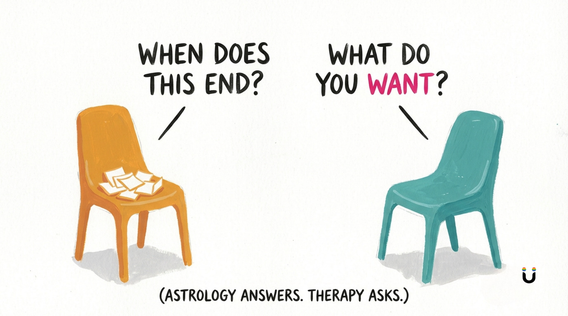
If the replay happens after every date, with everyone, regardless of how it went, it's worth reading about the signs of anxious attachment in Indian relationships, because the pattern of pre-grieving a person before they have had the chance to stay has a name and a history. It also has a treatment: a room in which someone watches you do it and asks what you are protecting. Interrogating a relationship in your head instead of in the room is the same move a few months later, and a conversation with a psychologist is usually where the interrogation finally gets a witness.
What do you do with the not knowing?
Carry it, badly, until Thursday.
There's no technique that turns a fine, ambiguous evening into a verdict, and the ones that claim to are the ones that produce the ninth replay. What changes with practice is how much of your week you let the uncertainty have.
He texted, in the end, on Wednesday. It was a fine text. The date after was also fine. It didn't become anything, and that was fine too, after a while. The replay, I noticed, was much quieter the second time. I'd like to say that was growth. It may just have been that I was tired.
What else do people ask about overthinking after a date?
Why do I overthink after a good date?
Because a good, ambiguous evening produces a lot of information and no verdict, and anxious thinking treats not knowing as an emergency. The replay usually lands on your own words, because they're the only part you can control. It's worry about what happens next, dressed up as memory.
Is overanalysing a date a red flag about the relationship?
Not by itself. Some overthinking after a date is ordinary. If the replay is loudest after dates with people who seem less interested than you, it may be tracking a real signal you'd rather not sit with. If it happens after every date regardless, it's about you rather than them, and worth looking at.
Should I text first after a date?
Decide once, in advance, then stop deciding. "I'll text on Wednesday if I still want to" is a plan that ends the loop. Reopening the decision every hour is the loop. Whether you text first matters far less than whether you can tolerate not knowing for two days.
Is overthinking after dates a sign of anxious attachment?
It can be, if it happens across relationships and comes with a pattern of concluding in advance that it went badly so that rejection can't take you by surprise. Anxious attachment is a learned way of relating, and it responds well to therapy.
Source: Borkovec TD, Robinson E, Pruzinsky T, DePree JA. Preliminary exploration of worry: some characteristics and processes. Behaviour Research and Therapy, 1983, 21(1), 9–16. Two questionnaire studies and one experiment, US university student samples. PubMed record · ScienceDirect abstract.