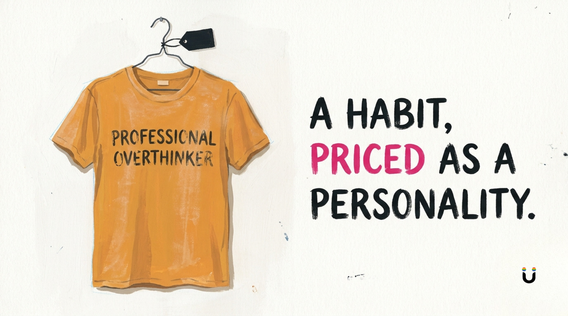
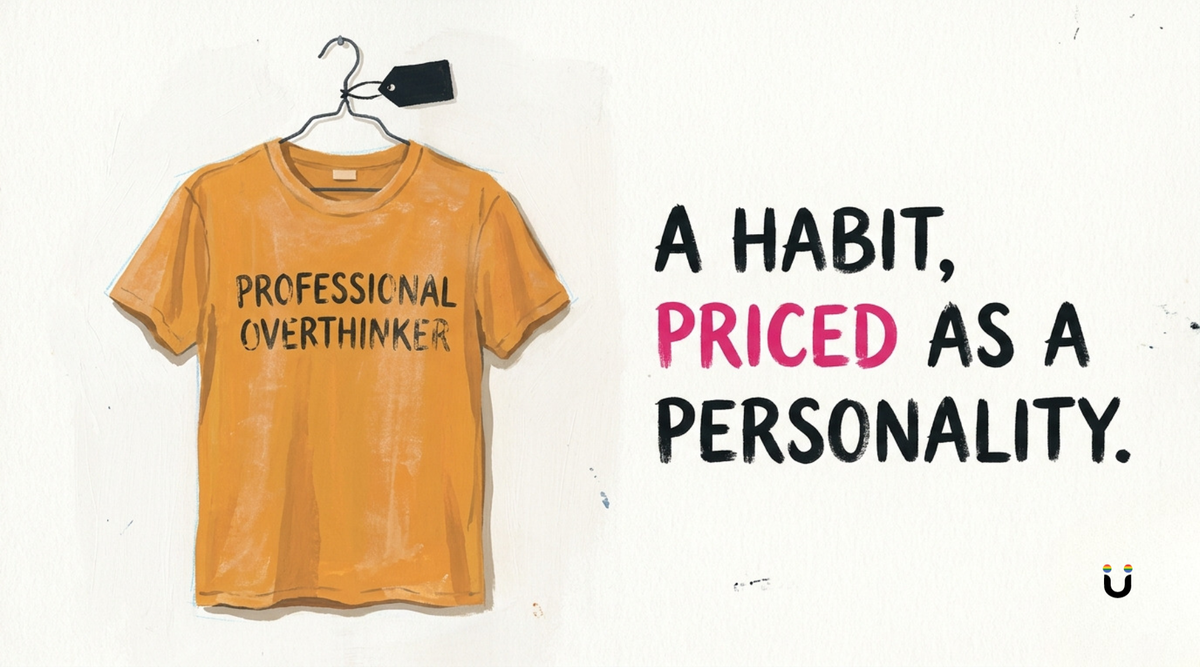
There is a T-shirt, easy to find on any Indian shopping site, that says "Professional Overthinker". There are mugs. There is a reel format, one you have almost certainly seen, in which a woman lies on her bed narrating the seventeen things she has considered since her friend said "we should catch up sometime". The overthinker has become a type, and like every type it arrives with a wardrobe and a sense of humour. Lately it has started to arrive with a sense of identity too.
Being an overthinker is a description of a habit, not a diagnosis and not a personality type. It means you have a habit of repetitive thought, usually rumination about the past or worry about the future, that runs on longer than is useful. The habit is common. It is learned, and it can be changed. Treating it as a fixed identity is what makes it harder to change.
Full disclosure: we have sold, in this practice, a fair amount of merchandise and content to people who describe themselves exactly this way, and we would like them to keep reading. So the argument that follows is aimed partly at ourselves.
What does "I'm an overthinker" actually claim?
It claims two things at once, and they pull in opposite directions.
The first is a complaint: my mind runs and I cannot stop it. The second is a credential: I am the person who thinks carefully, feels a great deal, notices what everyone else missed. The word carries both at the same time, which is why it is so satisfying to say and so hard to give up. Nobody wants to stop being the person who notices.
The clinical literature does not recognise the type. Edward Watkins, in a 2008 review in Psychological Bulletin, gathered the research on what he called repetitive thought, the umbrella that rumination and worry both sit under, and found it was not a trait people either had or lacked. It was a mode of processing, one anyone could be pushed into, that turned constructive or destructive depending on whether it ran concrete or abstract, and that responded to training. So the thing the T-shirt calls a personality is, on the evidence, a habit. Habits are less flattering than personalities. They are also a good deal easier to change.
Why did the overthinker become a personality?
Because the alternatives were worse.
For a generation of urban Indians raised in families with no vocabulary for anxiety, "overthinker" showed up as the first word that named the experience without pathologising it. You could say it at dinner. You could put it in a bio. It let you admit your mind was difficult while still being the interesting one at the table. For a lot of people it was the first self-description that was both true and safe, and it would be dishonest to pretend that was not a real gain.
Who claims it is telling, too. Susan Nolen-Hoeksema's 1991 work on rumination, in the Journal of Abnormal Psychology, proposed that women are more likely than men to respond to a low mood by ruminating, and used that to help explain why women are diagnosed with depression at roughly twice the rate. The National Mental Health Survey of India found neurotic and stress-related disorders, the group that includes anxiety, at nearly twice the rate in women. The "overthinker" of the reel is almost always a woman, and she is almost always funny about it. The humour is doing work. It makes a real and gendered burden bearable by turning it into a bit.
Habits are less flattering than personalities. They are also a good deal easier to change.
What does the identity leave out?
Here is the half the comfortable version does not say, and it implicates the people who write and read pieces exactly like this one.
Once overthinking is who you are, the loop has an alibi. You did not avoid the conversation; you are an overthinker. You did not ignore the message for three days; you are an overthinker. The identity converts a pattern that costs you, and other people, into a trait that merely describes you, and traits do not have to be worked on. They only have to be accepted, ideally by everyone around you.
The identity also picks a side in an old and unhelpful argument about the mind. It says thinking is the thing that is happening here. But most of what looks like overthinking is unfinished feeling, and calling yourself a thinker is one way of not being a feeler. The seventeen things considered since "we should catch up sometime" are the sound of a person frightened of being disliked, in a register that comes out sounding like intelligence. The identity keeps the fear dressed as thought, and thought, unlike fear, never has to be felt.
And there is a market. The T-shirts, the mugs, the reels, and yes, a few of our own products, all sell to a person who has been told her mind is a personality. A practice that makes money off that person has every reason to keep telling her so. We try to sell tools that end the loop rather than decorate it. We are not always sure we manage it.

If you are not an overthinker, what are you?
Someone with a habit of a particular style of thinking, which has a direction (backward or forward), a trigger (usually social) and a function (usually to sidestep a feeling).
That is less quotable than the T-shirt. It is also the description that arrives with instructions. A habit that runs in a direction can be turned around. If it has a trigger, you can learn to catch it there. And because it serves a function, you can hand that function to something that does the job better, which here usually means feeling the feeling, briefly, instead of thinking your way around it for a week.
The difference in practice is small and decisive. "I'm an overthinker" is the end of a sentence. "I'm ruminating about Tuesday because I felt small and didn't want to feel it" is the beginning of one. The thought record is the tool for the second sentence. The Explore journal is built around the same move on paper, and Night pages runs it as a series of nightly prompts that ends after twenty-one nights, for the hour when the loop is loudest.
What are you giving up if you drop the label?
Company, mostly.
The overthinker identity is a club, and a warm one at that. The reels are funny because they are recognised, and being recognised by a few million strangers is not nothing in a city where you might know four people. Dropping the label means losing the joke, and the joke was doing something real.
We are not going to pretend the trade is obviously worth it. Some people keep the label and do the work anyway, and that is fine. All we would ask is that the label stop working as an explanation. You are allowed to be the person who notices. You are not obliged to be the person who never stops. A psychologist will not take the T-shirt off you. She will ask, the first time you say "I'm an overthinker" in the room, what you were thinking about, and then what you were feeling, and the second question is the one the T-shirt was designed to duck.
The reel ends with the woman still on the bed. The friend has not replied about catching up. Seventeen things considered, one message unsent. The audience laughs, because they have been there, and the laugh is the last thing that happens before the next loop starts.
What else do people ask about being an overthinker?
Is being an overthinker a personality type?
No. It is not recognised in any clinical classification or validated personality model. Research on repetitive thought, including Watkins' 2008 review, treats rumination and worry as modes of processing anyone can enter and that respond to training, rather than as fixed traits.
What is the meaning of overthinker?
In everyday use, someone who habitually thinks about things longer and more repetitively than is useful, usually replaying the past or rehearsing the future. Clinically the closest terms are rumination and worry. The habit is common. It is learned, and it can be changed.
Are women more likely to be overthinkers?
Women report rumination at higher rates in Nolen-Hoeksema's research, and the National Mental Health Survey of India found neurotic and stress-related disorders, the group that includes anxiety, nearly twice as common in women. Whether that reflects biology, social load, or who is allowed to admit it is contested. The reel version of the overthinker is almost always a woman.
How do I stop identifying as an overthinker?
Replace the label with a description: which direction the thinking runs, what sets it off, and what feeling it is standing in for. That description comes with something to do. The label does not. You can keep the joke and still stop using it as an explanation.
Sources
Watkins ER. Constructive and unconstructive repetitive thought. Psychological Bulletin, 2008, 134(2), 163–206. Narrative review. Full text (APA PsycNet PDF)
Nolen-Hoeksema S. Responses to depression and their effects on the duration of depressive episodes. Journal of Abnormal Psychology, 1991, 100(4), 569–582. Theoretical paper. DOI:10.1037/0021-843X.100.4.569
Gururaj G, Varghese M, Benegal V et al. National Mental Health Survey of India, 2015–16: Summary. NIMHANS Publication No. 128, 2016. Figure cited: neurosis and stress-related disorders (F40–48, the group that includes anxiety) nearly twice as prevalent in females (p. 21). Full summary report (PDF)