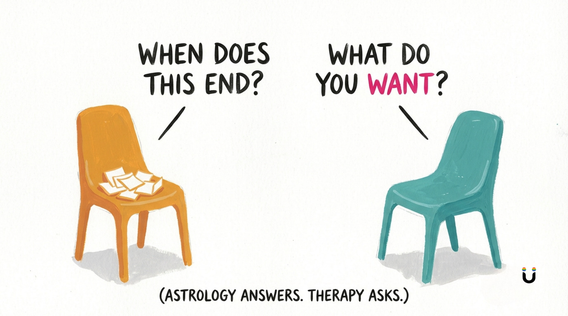
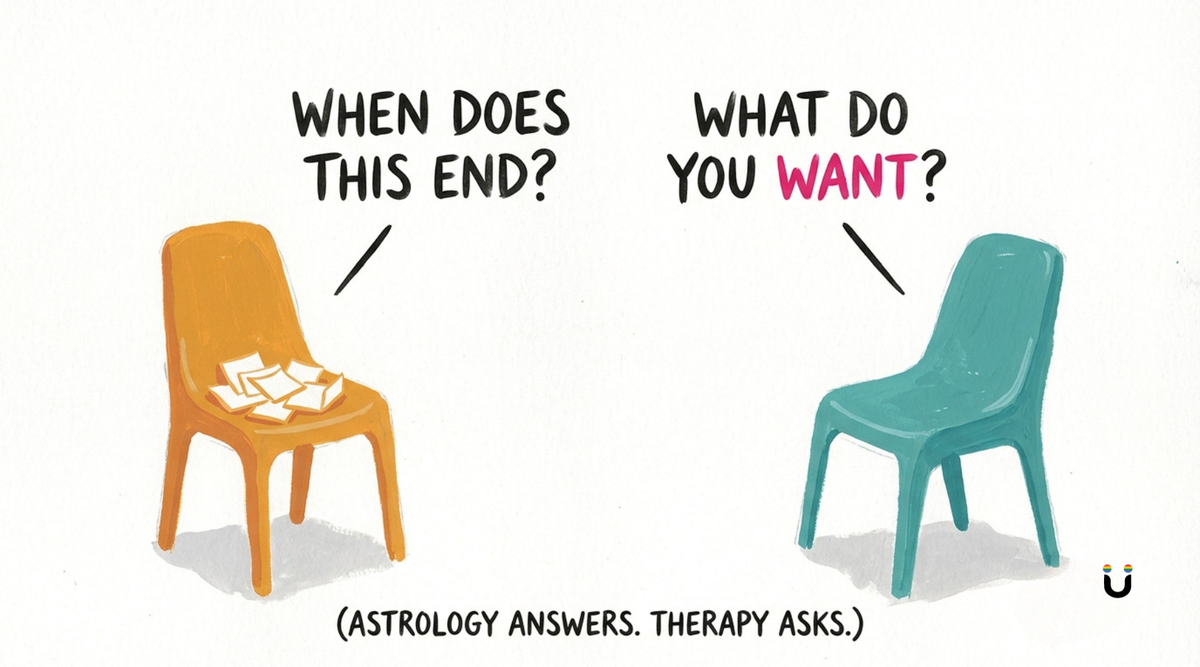
Astrology feels faster than therapy because it hands you a date and an answer within minutes, while therapy asks you to sit inside the uncertainty and work out what you actually want. Both can help. Astrology puts language to a feeling you already have; therapy tests whether that feeling should decide your next move.
At five in the morning I opened the office WhatsApp. It's a public number, which means anybody can write to it, and at that hour somebody usually has.
The message was from someone who has never sat across from any of the therapists on the team. She'd found the website, found the number, and written several paragraphs at dawn about a person who had hurt her. She wasn't asking for an appointment. She was asking whether it would stop.
I read it. Reread it. Read it again.
Somewhere in the second pass, I thought to myself: this will not stop, because the other person is currently getting everything they want out of it. I had never met either of them. I had one account, written at five in the morning, by someone who was not okay.
The polite phrase for what I'd just done is clinical intuition. The honest one is a guess.
So why do we go to astrologers when something hurts?
Because the question underneath most pain isn't the why. It's the ‘when does this end?’
Astrology answers that one out loud, with a date, which therapy will not do for you at any price. There's a word worth taking apart here. We say we went for a reading. Read comes from the Old English raedan: to advise, to counsel, to interpret, and also, cheerfully, to guess. Its German cousin raten still does both jobs today. We're the ones who promoted it to fortune-telling.
Call her Ira. Ira is thirty-four, has a job in ad sales, came to therapy about her job, the way most people come to therapy about a thing that isn't the thing. The astrology surfaced in session three, sideways, half apologised for before she'd finished the sentence.
She'd asked about March. Asked about June, when March went by. Asked about after Diwali, when June went by. Seven different readers, the same question, four months, and a note on her phone comparing what each one said, which is either very organised or very something else.
All seven were about one man and one question. Will he commit, and when.
(Ira is a composite. Details changed, more than one person, because this conversation happens often enough that it doesn't belong to a single client.)
What happens in the first five minutes of an astrology app?
An intake. That's what happens.
Open one of the big Indian astrology apps at two in the morning and watch the order of operations. Birth details, fine. Then: who is this about, how long has it been going on, what happened recently, what do you want to know? That's the first twenty minutes of a first therapy session, with better UX and a payment gateway that actually works.
The numbers back the scale of it. Astrotalk reported total income of about ₹1,214 crore for FY25, up roughly 85 per cent on the year before, with user engagement up 27 per cent and tier one cities doing most of the lifting. That's a company disclosure, not an independent audit. It still describes a very large number of Indians paying by the minute to be asked what's going on.
Then comes the part we don't do. The reading ends with an answer. A timeline. A yes, a no, an answer that waits for the transit to clear. You paid for the uncertainty to be lifted, and it was lifted, and for a few hours you let yourself regulate.
That relief is real. It's also short, which is why the second reading follows the first. Every one of Ira's dates arrived carrying relief and left without him.
Why does a reading feel so accurate?
Partly because of a very old, very stubborn quirk in how we hear ourselves described.
In 1948, a psychologist named Bertram Forer handed 39 students what he said were their individual personality profiles and asked them to rate the accuracy out of five. Average score: 4.26. Every student had received the identical text, which Forer had assembled from a newsstand astrology book.
The experiment has been repeated for decades since, and the average still lands close to that first score, which makes it one of the few findings in psychology that has never wobbled.
The rest is less mystical. The reader listened first. You told them the story, in your order, with your emphasis, and then they reflected it back to you. Of course it made sense. You wrote it.
She'd paid seven strangers to say it back to her, because hearing it from outside herself made it easier to look at.
So is astrology bad for you?
Mostly no. It goes wrong at one identifiable point.
It's doing its job when it gives language to something you already sensed. Plenty of people walk out of a reading having finally said the thing out loud, with the cards for permission. I've had my own chart pulled, both Western and Vedic. Genuinely interesting. Some of it is uncomfortably close. None of it told me anything I didn't already suspect about myself, which I suppose is the whole point of this piece, and also slightly annoying.
It goes wrong when the reading starts standing in for the decision. The same question every few weeks, hoping for a different card. Three readers until one of them softens. A choice you've already made, parked until a date an app handed you. Ira's note was a record of exactly that. Seven people, and she kept going until the wording felt comfortable enough to live with.
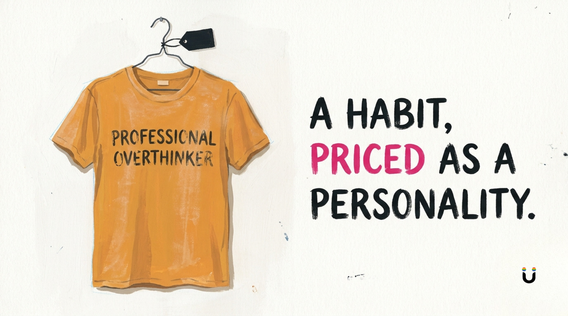
None of which makes her gullible. It makes her someone with a heavy load of uncertainty and somewhere cheap and immediate to set it down for a minute. That can become a habit.
And here's the part my profession doesn't enjoy. At five or twenty rupees a minute, at three in the morning, with no waitlist and no face to face, astrology is competing with a mental health system that for most Indians doesn't functionally exist. The National Mental Health Survey of 2015 to 2016 put the treatment gap for mental morbidity at 84.5 per cent, with an estimated 150 million people affected. Astrology isn't taking therapy's clients. It's picking up the ones we never got to.
What do you do when someone brings a reading into the room?
Talk about it, which surprises people who arrive braced for a lecture.
Ira brought hers in on her phone, turned slightly away from me. So the first thing I asked was that she read it out. All of it, including the parts she'd already decided were rubbish.
Then one question does most of the work. How much of that did you not already know?
She smiled, laughed a little. Then she said he'd never once used the word we about anything more than six weeks away. She'd known it since the second month. Nobody had told her. She'd paid seven strangers to say it back to her, because hearing it from outside herself made it easier to look at.
That's not silly. That's what externalising is for. Therapy runs the same mechanism on worse equipment and a longer timeline.
Dismissing the reading would have cost me the session, and probably the client. She believed it, she needed something to hold on to, and telling her the cards meant nothing tells her that the part of her that reached for them meant nothing either. So we keep the reading and swap the question. Not what will happen. Instead: what do you want to do about it, and what's the one thing inside you that would have to move.
So which one do you go to?
Go to an astrologer when you want words for something you already sense, or a ritual around a bad week, or an hour of being taken seriously by someone who won't bill you for six months. Those are all reasonable things to want. Go knowing you're buying a story, and set the ceiling before you open the app, in rupees and in frequency.
Go to a therapist when the same problem keeps showing up in different clothes. When you know what to do and can't make yourself do it. When the last reading's relief lasted a day and you're back for another. When it's eating your sleep, your work, your appetite, or your capacity to sit in a room with people you love. A two minute anxiety screen is a blunter instrument than a card, and a more honest one.
And now the bit I owe you, since I opened this by admitting I guessed.
Therapists guess too. We call it formulation and put it in a file, and it is a hypothesis assembled from what you tell us, what we were trained on, and whatever we are carrying in ourselves that week. The difference is not that we are right. It is that we say the guess out loud, in front of you, and then spend a month letting you take it apart. Therapy is slower and dearer, and sometimes it does not work. An astrologer's guess, by planets, is never wrong in a way you can check.
Ira is still with him. She's stopped asking when and started asking what she's willing to accept, which is a smaller question and a considerably worse one to sit with. She opened an app again in August. She told me about it afterwards, which is not nothing, and is not the same as stopping.
The woman who wrote at five in the morning already knew what she'd written. It was there in every paragraph, in order, with the pattern showing. She didn't need a prediction.
Most of us already know. But then again, knowing was never the expensive part.
What else do people ask about astrology and therapy?
Is going to an astrologer bad for your mental health?
Mostly, no. A reading does harm only at one point: when it replaces a decision instead of naming a feeling you already had. Asking the same question of reader after reader, waiting for a softer answer, is the sign it has stopped being a ritual and started being a loop.
Why do astrology readings feel more accurate than they should?
Partly the Forer effect. In a 1948 study, 39 students rated an identical, generic personality sketch as 4.26 out of 5 accurate, believing it was written for them alone. A reading works the same way: you supply the story first, in your own words, and the reader hands it back to you, which is why it feels so precisely true.
How do I know if I need therapy instead of a reading?
When the same problem keeps returning in different clothes, when you already know what to do and can't make yourself do it, or when a reading's relief lasts a day before you're back for another one. A short anxiety or mood screen is a blunter, more honest instrument than a card.
How big is the astrology industry in India right now?
Large and growing fast. Astrotalk, one of the bigger astrology apps, reported total income of roughly ₹1,214 crore for FY25, up about 85 per cent year on year. Meanwhile India's National Mental Health Survey (2015–16) put the treatment gap for mental morbidity at 84.5 per cent, meaning most people who need care never reach it. Astrology is filling a gap therapy has not closed, not stealing therapy's patients.