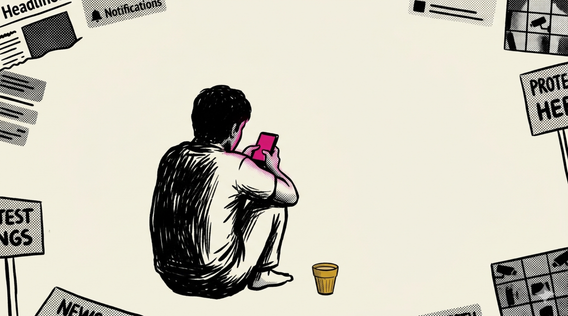
The most common undercurrent in my therapy room is loneliness. It is rarely the first thing a person names when they walk in. It is what surfaces, slowly, somewhere around the third or fourth session, once the louder symptoms have been described and there is space for the truer one. I have been in practice for over a decade now, and the longer I do this work, the more convinced I am that the loneliness epidemic in urban India is the public health story we are not telling.
Full disclosure: I have started this piece three times. Once as a research summary. Once as a list of solutions. Once as a polemic about why nobody is taking this seriously. None of those were the piece. The piece is closer to this: I am tired of watching people who are surrounded by other people sit on my couch and describe a kind of aloneness they cannot find a word for. I want to give them the word.
What is the loneliness epidemic in urban India actually about?
Loneliness, as researchers define it, is the gap between the relationships we have and the relationships we want. It is not the same as being alone. It is the experience of feeling unseen even when there are people in the room. In Indian cities, where most people live within touching distance of someone else for most of their lives, this is the part that makes it hard to talk about.
The numbers in India are now clear enough to take seriously. A 2022 study of household heads in Mumbai by Yadav, Chauhan and Patel, published in BMC Public Health, found that the structural shift of urban migration, nuclear family living, and shrinking civic engagement was producing measurable loneliness in city dwellers. A 2024 corporate workplace survey across 14 organisations reported that 56% of young employees admitted to feeling lonely, and another 23% experienced it but would not say so openly. An Indian Institute of Human Development study found that 37% of Bangaloreans feel lonely most of the time, well above the national average of 22%.
These are not numbers about elderly people in old age homes, although that crisis is real and deepening. These are numbers about working adults in their twenties and thirties living in the country's most aspirational cities, with friends in their phones and colleagues at the next desk. The epidemic is not at the margins. It is at the centre.
Why doesn't anyone admit they are lonely?
Because admitting it sounds like a confession of failure. In the room, clients describe loneliness the way they describe a secret. They lower their voice. They say, "I know this sounds silly, but..." They check my face for signs of pity. The shame is doing a lot of work here, and the shame has Indian fingerprints all over it.
If you grew up in an urban Indian family, you were probably taught that loneliness is what happens to other people. To people who left. To people whose marriages did not work out. To the unmarried aunt nobody wanted to sit next to at weddings. You were not taught that it could happen to a person with a partner, two children, a flat in a building of thirty other families, and a WhatsApp group of college friends who still meet on birthdays.
So when it does happen, the person assumes the problem is them. They assume it means they are unlikeable, or unlovable, or that they are doing something wrong. They keep the feeling private. The shame builds around the secret, and the secret becomes the second loneliness on top of the first one. This is the mechanism I keep watching repeat itself, and it is one of the reasons the epidemic stays invisible. You cannot count something nobody is reporting.
What does the research say about why loneliness is dangerous?
Julianne Holt-Lunstad and her colleagues conducted a meta-analysis of 148 studies, published in PLOS Medicine in 2010, examining the relationship between social connection and mortality. They found that people with stronger social relationships had a 50% increased likelihood of survival over the follow-up period compared to those with weaker connections. The effect was comparable in size to quitting smoking, and exceeded the protective effects of obesity prevention or physical activity. Read that line again. Social connection is more protective than going to the gym.
And yet, no fitness app has ever told me how many minutes of meaningful conversation I need each week to stay healthy. There is a body of research telling us that loneliness elevates the risk of cardiovascular disease, dementia, depression, and early death. There is no equivalent body of public health messaging in India treating it as a clinical priority. The diet pyramid exists. The exercise minimum exists. The social connection minimum does not.
The gap is not because the science is missing. It is because we have culturally agreed to pretend that connection is something that should arrive on its own, and that needing it is a kind of weakness.
What are the three types of loneliness Indian adults are experiencing?
Vivek Murthy, in his book Together: The Healing Power of Human Connection in a Sometimes Lonely World, names three forms of loneliness that I find clinically useful. They map onto what I see in the room more cleanly than most frameworks I have used.
The first is collective loneliness. This is the loneliness of not belonging to a shared community or identity. For urban Indians who have moved away from their hometowns, or whose relationship to religion has shifted, or who do not see themselves in the dominant narratives around them, this is often the underlying ache. It is what produces the feeling of being from nowhere.
The second is relational loneliness. This is the absence of a friend group. The people you would call to come over on a Sunday with no agenda. The people who would take a half-day off work for your wedding. In urban India, this is the type that has become structurally hardest to maintain. Adults change cities, change jobs, change life stages on different timelines. Friendships that survived college do not always survive the first child or the first divorce or the move to a different sector.
The third is intimate loneliness. This is the absence of one person who knows the texture of your inner life. Not your partner, necessarily. Sometimes a sibling, sometimes a therapist, sometimes a friend who has been there since you were nineteen. This is the loneliness people most often arrive at therapy with, even if they cannot name it. They will say their marriage is fine but they feel alone in it. They will say they have many friends but no one they can really call.
You can have one or two of these and not the others. You can have a partner and still be intimately lonely. You can have ten close friends and still be collectively lonely. The mistake is treating connection as a single category that you either have or do not. It is three categories, and most people are missing at least one.
Why is adult friendship in India so hard to maintain?
Because nobody told us it would require active effort. The model we grew up with was friendship-as-luck. Friendships happened to you. They formed in school, in college, in your first office, and you assumed they would persist by default. This is the fallacy I correct most often in the room.
Research on friendship formation, including work by Marisa G. Franco published in 2022, suggests that adults who believe friendship requires deliberate effort end up less lonely than adults who believe friendship is luck-based. The intentionality is the variable. The effort is what protects you. And most urban Indians I work with have never been told this, because the cultural script never required them to learn it. The earlier script assumed that family, neighbours, marriage, and community would carry the weight. The script no longer holds, but the assumption that it does has not been updated.
This produces the specific kind of urban Indian loneliness I see often. The person who shows up at a house party and then spends the evening on their phone. The person who joins a yoga class and leaves the moment it ends. The person who has had three coffees with a potential friend and is waiting for the friendship to "click" without doing anything to make it click. These are not character flaws. They are skill gaps in a culture that did not teach the skill.
What does the loneliness underneath the loneliness look like?
Here is the part I keep coming back to. Most of the people I see for loneliness do not actually need more people in their lives. They need to be more honest with the people who are already there.
Voluntary vulnerability is the term researchers use for the willingness to share something true about your inner life with someone, without the guarantee of how they will respond. It is the act that builds intimacy. And in the urban Indian friendship landscape, it is the move most people are skipping. We have learned to be charming. We have learned to be reliable. We have learned to be the friend who shows up with the right gift and remembers the birthday. We have not learned to say, "I am not okay this week, and I do not know why."
This is the loneliness that feels worst, in my experience. The loneliness of the person who has people but cannot let any of them see what is underneath. The shame around vulnerability is doing the same work as the shame around loneliness itself. Both keep the truth small and private. Both make the problem worse. And both are produced by a cultural context that praises the appearance of being fine and treats need as a personality flaw.
I will say this directly. If your friendships have not been through one honest conversation about something hard, they are not the friendships you think they are. They are the friendships you hope they are. The conversation is what makes the difference.
What actually helps with loneliness in urban India?
Not what you have been told. Not "put yourself out there." Not "join a class." Not "be more social." These are not wrong, exactly, but they treat the symptom and ignore the mechanism.
What helps, in the room, looks more like this. First, naming the loneliness without shame, including to yourself. The honesty matters. The minute a person stops calling it "being a bit off" and starts calling it loneliness, something shifts. Second, taking inventory of which of the three types you are missing. Collective, relational, intimate. You probably know already. Third, identifying one specific person, in the existing landscape of your life, with whom you could try one honest conversation. Not a stranger. Someone already there.
Fourth, accepting that the discomfort of reaching out is the cost of the connection. Most adults I see have made discomfort the reason to avoid trying. The discomfort is the price. It does not go away. The friendship that forms on the other side of it is the only thing that does.
And fifth, being a beautiful mess at someone, on purpose, once. Not as a performance. As a deliberate experiment. Tell one person you trust that you are struggling, without offering a tidy explanation or a solution. See what happens. The research and a decade of clinical practice both suggest the same thing. People do not connect with our perfection. They connect with our permission to be human in front of them.
What I keep coming back to
The loneliness epidemic in urban India is not going to be solved by an app, a wellness retreat, or a workplace mental health initiative, although all of those have their place. It is going to be solved one honest conversation at a time, in living rooms and over phone calls, between people who decide that the cost of being seen is worth less than the cost of staying hidden.
I keep returning to a sentence I find myself saying often in the room. You cannot be known by people you do not let close. You cannot let people close without showing them the parts you would rather they did not see. The loneliness is the absence of being known. The cure is the willingness to risk being known.
That is harder than it sounds. And that, I think, is why we are still where we are.
If the conversation feels harder than the loneliness itself, that is information. Sometimes the first honest conversation is easier with someone trained to hold it. Book a session with one of our psychologists.
Frequently Asked Questions
Why is loneliness so common in urban India despite high population density?
Loneliness is not the same as being alone. Urban Indians often live in physically dense environments but with weak emotional infrastructure: long working hours, migration away from hometown communities, nuclear family setups, and limited time for unstructured socialising. Population density does not produce connection. Shared time and emotional honesty do, and those are precisely what urban schedules erode. This is supported by 2022 research from Yadav, Chauhan and Patel on Mumbai household heads.
What are the three types of loneliness?
Vivek Murthy, in his book Together, names three forms. Collective loneliness is the absence of belonging to a larger community or identity. Relational loneliness is the absence of close friendships. Intimate loneliness is the absence of one person who knows your inner life. You can have one form without the others, which is why someone with a partner can still feel intimately lonely, and someone with many friends can still feel collectively unmoored. Read more on the loneliness of high-functioning adults.
Is loneliness actually bad for your physical health?
Yes. Julianne Holt-Lunstad's 2010 meta-analysis of 148 studies found that people with stronger social relationships had a 50% higher likelihood of survival over the follow-up period. The protective effect was comparable to quitting smoking and greater than the effects of physical activity or healthy weight. Chronic loneliness is associated with elevated risk of cardiovascular disease, dementia, depression, and early mortality.
How do I make new friends as an adult in India?
Stop treating friendship as something that happens to you. Treat it as a skill that requires deliberate effort. Identify one existing acquaintance you find interesting, not someone new. Suggest a specific second meeting, not a vague "let's catch up." Show up with one honest thing about yourself, not your most polished self. Research by Marisa G. Franco shows that adults who believe friendship requires effort are significantly less lonely than those who treat it as luck. More on the texture of adult Indian loneliness here.