
Image Source: AI Generated
A few weeks ago, I was sitting in a sharing circle, and we got onto the topic of safety. Someone asked what it actually feels like to feel safe right now, in the world as it currently is.
It took me a moment to answer.
Every time I open Instagram or a news app, I brace myself. A bombing. A woman was assaulted. A protest turning violent. It doesn't shock me the way it used to, and that scares me more than the news itself. At some point, you stop watching as a distant observer. You start inserting yourself into it: your own city, your own family, your own body in those situations. The line between their reality and your reality starts feeling frighteningly thin.
This kind of imagination creates its own paralysis. The mind begins rehearsing possibilities without consciously trying to. What would I have done? Would I have survived? Who would I have called? It is the nervous system trying to prepare for a danger it hasn't experienced, but no longer believes is impossible. And instead of producing a sense of control, it leaves the body carrying fear for things that haven't happened yet. A quiet, ongoing rehearsal of catastrophe.
Eventually, the fear stops being only about personal safety. It becomes about the kind of world we are collectively learning to live in, and what the people who come after us will inherit. Some days, that question feels genuinely hopeless.
What struck me most in the sharing circle was not the fear itself, but how shared it was. Almost everyone described the same undercurrent of anxiety. A low-grade vigilance that doesn't fully switch off. A feeling of watching the world unravel in real time. Some spoke about the helplessness of witnessing suffering at a distance, wanting to do something but not knowing what. The overwhelm of too much pain and too few clear pathways toward it.
Some spoke about losing friendships over political differences. About being trolled for expressing opinions. About gradually choosing silence over authenticity because speaking felt like it came with consequences. And one participant said something that stayed in the room long after they said it. They had witnessed a man being beaten at a train station. In that moment, fear and shock took over, and instead of stepping in, they instinctively moved away.
Afterwards, they couldn't stop questioning themselves. "I think I've become inhuman," they said. That sentence is worth sitting with, because I think a lot of people recognise it.
What repeated exposure does
From a clinical perspective, what this group was describing maps onto things we understand fairly well, even if the scale of it feels new.
There's desensitisation: when repeated exposure to distressing events reduces our emotional responsiveness over time. When violence becomes a constant in our feeds, the nervous system cannot stay in a state of alarm indefinitely. It adapts. It becomes quieter in response to things that should still land hard.
There's compassion fatigue, a term most often used for caregivers but increasingly relevant for anyone living in a hyperconnected world. When we are constantly exposed to suffering through news, social media, and short-form video, our capacity to emotionally respond can simply become exhausted.
And there's the bystander effect, a well-researched phenomenon in which individuals are less likely to intervene in an emergency when others are present. Responsibility diffuses. We assume someone else will step in. Add fear, shock, and a nervous system in freeze mode, and inaction becomes more understandable, even when it remains painful.
When the body perceives a threat, it doesn't always choose fight or flight. It can also freeze. And the freeze response often looks, from the outside, like doing nothing, because survival responses tend to arrive before conscious thought does. That isn't inhumanity. It's a nervous system doing exactly what nervous systems are designed to do when they're overwhelmed.
Knowing the science, though, doesn't automatically resolve the discomfort. If anything, it raises a harder question: what does safety mean when the world feels consistently unsafe?
Safety turned out to be relational
When the conversation in the sharing circle came back to this question, something shifted. Most people didn't say laws, or governments, or systems, when asked what makes them feel safe. They said, people.
We feel safest around those we trust. Around friends who hold our opinions without weaponising them. Around family members who make room for disagreement. Around partners who don't use vulnerability against us. Safety, for most people in that room, was fundamentally relational.
But several people named how even that has become complicated.
What happens when the very relationships that are supposed to feel safe become strained by political opinions, by social issues, by values that feel too important to set aside? Disagreements that start as differences in perspective can begin to feel like a dismissal of your fears, your sense of reality, your basic humanity. With friendships, distance can come quietly: conversations reduce, and the relationship gradually fades. With family or partners, it is rarely that clean. You still share space, routines, history, and love. The disagreement tends to stay inside the relationship, turning slowly into resentment that runs beneath everyday life.
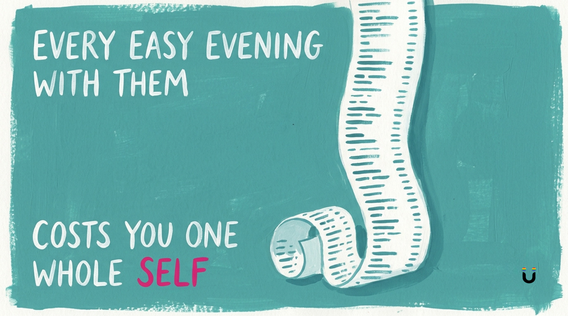
Some participants said they avoid certain conversations not because the topics don't matter, but because they matter too much. They know emotions will flood the room. That it won't stay respectful. That the relationship might not survive it. Avoidance becomes a way of preserving connection. But when something feels genuinely important to you, silence also carries a cost: it can start to feel like a quiet betrayal of yourself.
This is the tension I sit with, both personally and professionally. We want to stand by what we believe. We also want to protect our relationships. And sometimes those two things pull in opposite directions.
What safety can look like
From a clinical standpoint, safety in a difficult conversation doesn't require agreement. It requires regulation: noticing when your nervous system is activated, recognising when a conversation has stopped being productive, being able to say "this topic matters to me and I want to talk about it when we're both able to listen." It means setting limits around how disagreements are expressed, even when the disagreement itself can't be resolved.
It also means accepting that not every relationship can hold every version of you. That is a genuinely hard truth. Sometimes safety means choosing depth with fewer people, redefining what closeness looks like, and grieving the version of a relationship that once felt simpler. It means moving toward people who can hold differences without contempt, who make room for conversation rather than punishment, around whom you don't have to constantly defend your perspective or soften your feelings to maintain the connection.
The world may not feel stable right now. The news cycle is relentless, and violence is visible in ways it has never been before. But safety doesn't have to start at a global level.
It can begin in a sharing circle where feelings can be named without needing to be fixed or compared. A dinner table where disagreement is allowed but disrespect isn't. A friendship where someone says, "I don't see it the same way, but I want to understand you." It can look like logging off when your nervous system is flooded, or choosing one cause to support rather than drowning in all of them at once, letting care become focused and sustainable rather than scattered into exhaustion.
Safety, right now, may not be the absence of fear. It may simply be the presence of people around whom you can exhale. And protecting those spaces, small and ordinary as they are, is how we hold on to our empathy when everything around us is pushing us toward shutting down.