Image Source: AI Generated
Neha sat in my office and said, almost apologetically: 'I know I'm angry. I just don't know why I can't stop being so angry.' She'd said 'I'm sorry' twice before she'd finished the sentence. That detail matters.
"I know I'm angry. I just don't know why I can't stop being so angry."
A client said this to me recently, and apologised twice before she finished the sentence.
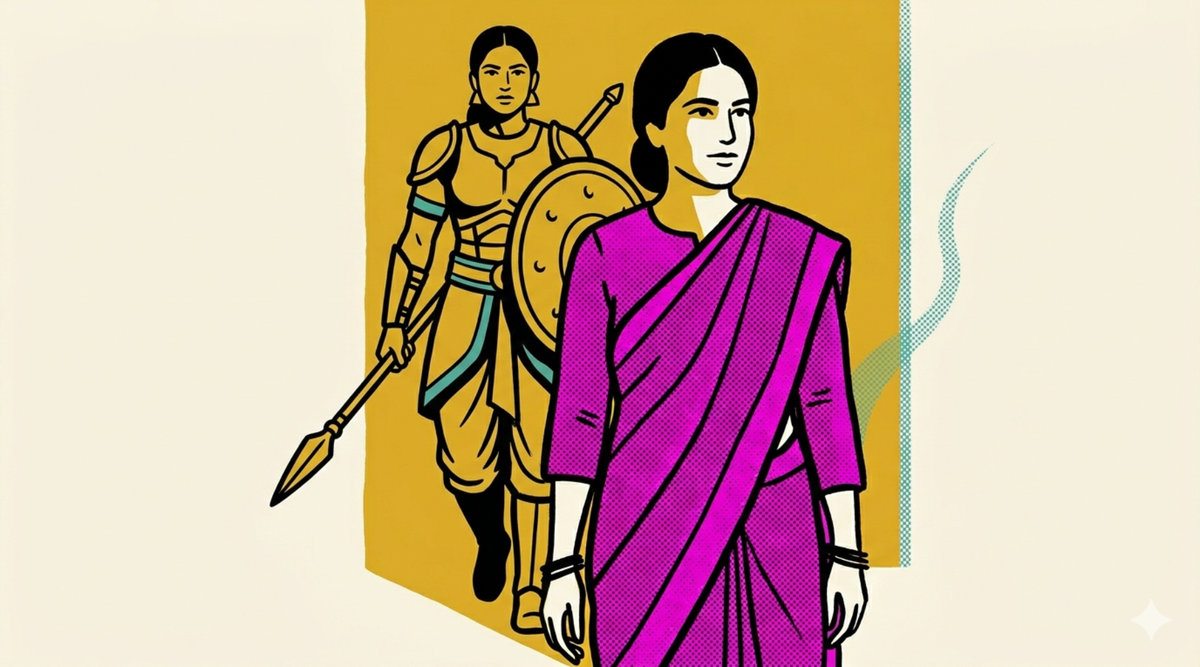
That apology is not unusual. In my practice, anger is one of the most common presenting concerns I see, and one of the most misunderstood. What I've noticed over years of sitting with it is that we cannot take anger at face value. It rarely arrives alone. Anger tends to be a guard, protecting something softer and more vulnerable underneath that hasn't yet found a way to speak.
The particular difficulty, for many women in India, is that anger is the one emotion we've been most thoroughly taught to distrust. The fear of coming across as too sensitive, too emotional, too demanding, too difficult, runs deep enough that the anger often gets managed before it's even fully felt. Apologised for it before it's expressed. Swallowed before it becomes a sentence.
The problem with swallowed feelings is that they don't dissolve. They go somewhere. And figuring out where, and what they're actually protecting, is usually where the real work begins.
What the research says about anger and what it's made of
Emotion-focused therapy, developed by psychologist Les Greenberg, tells us the difference between primary and secondary emotions. A primary emotion is the emotion we feel first, as a direct response to a situation — it is often something vulnerable like fear, grief, shame, or hurt. A secondary emotion is the one that covers it. For many people, anger is secondary. (Greenberg, L.S., 2002, Emotion-Focused Therapy)
Just because anger is secondary, it doesn't mean the anger isn't real or isn't valid. It is. But if we only work with anger, we are not really getting to the root of the issue, what the anger is guarding. The anger will keep coming back till what is underneath it gets acknowledged.
What's more, a 2013 study published in Psychosomatic Medicine found that suppressing negative emotions — including anger — is associated with increased cardiovascular reactivity, higher cortisol levels, and greater psychological distress over time. The body registers what the mind tries to push down. (Gross & Levenson, 1993)
The particular forms this takes for women in India
I want to be specific about the cultural context, because it shapes how this is presented in the room.
In India, most women grow up following an invisible social contract. I have experienced this myself, this unseen pressure to “keep things smooth”. We become the designated emotional shock absorbers in our families; we manage the emotional temperature of the family, keenly observing and meeting the needs of the people around us. What's more is that we don’t show the absorbing we do. We are sometimes meant to quietly understand and hold irate family members, careless spouses, demanding in-laws, and irresponsible parents.
This quality is not a personality trait; women are not inherently quiet stalwarts who keep tending to others. This is a trained response, reinforced by every room that rewards quiet suppression and punishes vocalising needs.
And the result?
We are praised for being the “Nice Lady”. In her book The Dance of Anger, psychologist Harriet Lerner describes this 'nice lady' pattern: women who have learned to be so accommodating that they are alienated from their own emotional realities.
It doesn’t sound so nice, does it?
Women who don't know what they want. Women who struggle to identify what bothers them. Women who have no clue that they have needs and those needs are not being met. And when the anger does break through — at a pitch that seems disproportionate to the trigger — they feel ashamed of it, which confirms the original belief that their feelings are too much. (Lerner, H., 1985, The Dance of Anger)
In my practice, I see this very specifically: the client who apologises for being upset. The client who qualifies every feeling — 'I know it's probably not a big deal, but...' The client can articulate exactly why her anger is unreasonable before she's even told me what she's angry about.
She has already done the work of dismissing herself. She has internalised the voice that tells her she is too much. And the first therapeutic task is simply to slow that down long enough to ask: what if the anger is pointing at something real?
"She has already done the work of dismissing herself. And the first therapeutic task is simply to slow that down long enough to ask: what if the anger is pointing at something real?"
What's actually underneath — and why it matters to find it
In my experience, the emotions most commonly underneath women's anger are these: grief (for the self she had to give up, for the relationship that didn't turn out to be what she needed), fear (of being left, of not being enough, of what happens if she asks for what she wants), shame (the belief that she is fundamentally too difficult, too demanding, too much), and a profound unmet need for recognition — to be seen in her difficulty, not managed around it.
None of these is a weakness. All of them are human. But they cannot be heard or held as long as the anger is doing the job of protecting them from view.
The clinical work is not to extinguish the anger. It is to make it safe enough for the softer thing to speak. When that happens — when a client moves from 'I am furious at him' to 'I am so hurt, and I am terrified he doesn't actually see me' — something shifts. The fury doesn't disappear. But it becomes more specific. More useful. Less like a fire burning everything and more like a signal pointing at something that needs attention.
A few things that might help
I want to offer these carefully, because the last thing someone whose anger has been dismissed all her life needs is another list of ways to manage it more neatly.
Get curious before you get controlled.
When your anger arrives, stop! Before you decide to manage optics and mask it, ask: What is this actually protecting? What is underneath it that I haven't let myself feel yet?
Remember, anger is not the main character here; it is mainly the bodyguard for another shy feeling(hurt, fear, disappointment), afraid to step out. So you might not always get the answer quickly. But in asking the question, you will stop vilifying the emotion, and that will help you change your relationship to the feeling.
Stop apologising for it.
YES, anger IS messy, it is mis timed and comes with the nuance and subtlety of a brick. But feeling angry is not something you need to apologise for. Feelings are data, not defects.
When you notice yourself minimising or brushing off your emotional reality rather than being curious towards it, you might want to ask yourself why you feel the need to do that.
Find someone who can hold it without flinching.
A fire bender! This might be a therapist, a friend, a partner — someone who can witness your anger without:
a) turning it into a bigger fire
b) quietly backing away like you’ve become unstable
c) suggesting a cup of tea will fix everything
The experience of having your anger witnessed without the other person either escalating or withdrawing is, for many women, genuinely new. It changes something.
Work backwards from the anger.
Do some digging, journal if that helps. Or simply sit with the question: before I was angry, what did I feel? Often, you'll find hurt, disappointment, fear, or longing that has nowhere to go. The anger was doing its job — making sure something was noticed. The question is what it was trying to point at.
Neha, by the end of our work together, had stopped apologising so profusely for her anger, before she'd finished her sentences. And yes, she still got angry. But now she knew, more often, what the anger was about. And she'd started hearing what it was saying and seeing herself. She started giving herself the small, significant permission of saying: I am not too much. I am a person with feelings, and the feelings are telling me something.
That is not a small thing. For a woman who has spent years managing herself out of her own emotional reality, it is actually quite large.