Why Your Mind Keeps Replaying That One Pause
Have you ever gone over the same five minutes of a conversation so many times that you could recite it? What you said, what they said back, the half-second pause before they answered. The conversation ended hours ago, maybe days ago. You are still in the room.
I did this for three days once, over a five-minute exchange with a client's mother. I said something about her son's medication and she went quiet. I could not tell if it was a "that makes sense" quiet or a "why would you say that" quiet. I know how small that sounds, three days lost to a single silence. It did not feel small at the time.
Replaying a conversation on a loop is usually rumination, a pattern the psychologist Susan Nolen-Hoeksema named in 1991: repeatedly dwelling on the causes and meaning of a distressing moment instead of moving past it. It is rarely about the conversation itself. Far more often, it is the mind trying to buy back a sense of control.
Why Does My Mind Keep Going Back To That Conversation?
Because the loop feels productive. Each replay convinces you that one more pass will finally reveal what happened, or turn up the version where you said it better. Nolen-Hoeksema's work, which she called response styles theory, found the opposite. People who ruminate after a difficult moment do not arrive at clarity. They arrive at more distress, and the distress makes the next replay feel even more urgent. The loop manufactures its own fuel.
There is a simpler reason underneath that one. Uncertainty is uncomfortable, and a conversation that ends without a clean signal, no agreement, no smile, no clear "we are good," leaves your mind with an open file. Closing that file matters more to some of us than to others. In my experience, it matters most to people who learned early to read a room for a living, gauging a parent's mood before asking for something, sensing when a teacher's silence meant disappointment rather than patience. If missing a cue once carried consequences, of course you are still scanning for cues now.
Is This Reflection, Or Is This Overthinking?
Reflection has an end point. You think something through, notice what you would do differently, and the thought settles. Overthinking has no end point. You go over the same conversation without landing anywhere new, and each pass leaves you more anxious rather than better informed.
Researchers studying social anxiety, Clark and Wells, gave the compulsive version of this a name in 1995: post-event processing, a detailed mental review of a social situation that keeps running long after the situation itself has ended. You do not need a diagnosis for this to apply to you. Most people run a milder version after any conversation that feels even slightly uncertain.
Here is a useful test. Ask whether this replay has taught you anything you did not already know ten minutes ago. If yes, you are reflecting. If the answer is no and you are still going, you have crossed into the loop, and the part of you running it is not malfunctioning. Your emotional mind is doing exactly what it evolved to do, which is scan for threat before it scans for accuracy.
Why Do Old Conversations Still Run The Show?
Because the mind does not file conversations by date. It files them by feeling. A silence from your manager today can land in the same place as a silence from a parent twenty years ago, and your body will answer both with the same urgency, even though only one of them is happening right now.
I see this constantly with the young women I work with in Mumbai. A boss frowns in a meeting, and by evening she is convinced she is about to lose her job, not because the frown proved anything, but because somewhere earlier in her life, someone's disapproval genuinely came with consequences. The frown is not really what she is replaying that night. Underneath it sits every earlier time a silence meant something was wrong, and that is the thing keeping her awake.
Understanding why you replay conversations does not make the replaying stop. You can know exactly why your mind keeps returning to that pause and still find yourself back there at midnight. Insight and relief are not the same thing, whatever the wellness pages promise. Knowing the mechanism does not disable it. It only makes the loop a little less mysterious, and a little less lonely.
What Actually Helps When The Loop Will Not Stop?
A few things have genuinely helped, in the therapy room and outside it, though none of them is a switch you can flip.
Naming the loop interrupts it. Telling yourself "this is rumination, not new information" takes some of the urgency out of the replay, because you stop treating it as productive work.
Understanding why you replay conversations does not make the replaying stop. Insight and relief are not the same thing, whatever the wellness pages promise.
Giving the thought a time limit works better than trying to suppress it. Tell yourself you can think about the conversation for ten minutes tonight, on paper if that helps, and then the ten minutes are done. This is closer to Socratic questioning than to distraction: you are examining the thought on purpose, inside a boundary, instead of letting it examine you all night.
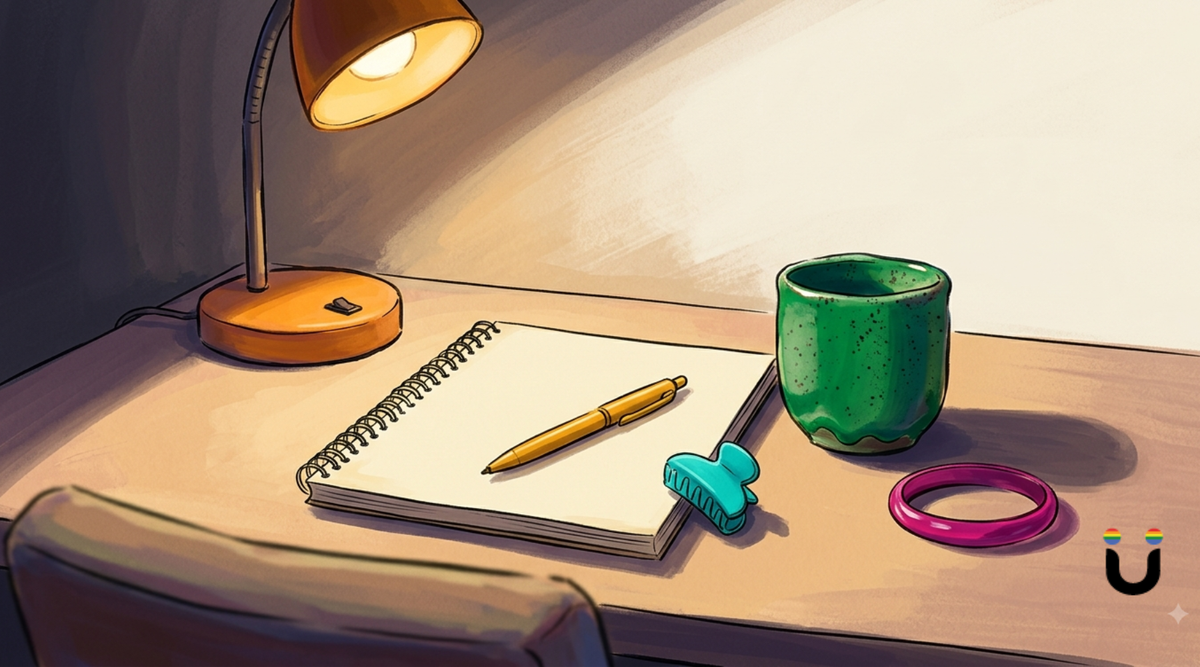
Writing it down does something that thinking cannot. A loop stays a loop while it only lives in your head. On paper it becomes a sentence you can look at directly, and that is often the first moment you notice how much smaller the conversation was than the story you built around it. A journal helps precisely because it forces the loop into a shape you can close.
And sometimes the loop points past any single conversation to a pattern old enough that it deserves more than a bedtime workaround, which is usually where a therapist helps more than another tip.
The conversation you are replaying tonight probably ended fine. The five minutes, the pause, the silence, most of it was never the verdict you are treating it as. What has not ended is the older story running underneath it, the one about whether you are allowed to get something wrong and still be safe.
That story is worth your attention.
The conversation was not.
Frequently Asked Questions
Q. Is replaying conversations in my head a sign of anxiety?
It can be, though not always. Replaying the occasional unusual or emotionally loaded conversation is common and not a symptom on its own. It earns attention when it happens after most interactions, interferes with sleep or concentration, or comes paired with constant reassurance seeking. A therapist can help tell the difference between a habit and an anxiety pattern that needs support.
Q. How long is it normal to keep thinking about a conversation?
There is no fixed number, but a useful marker is whether the thinking is still producing anything new. A few hours of turning something over, especially after a hard or high-stakes conversation, is ordinary. Days of the same loop with no new insight usually points to rumination rather than reflection.
Q. Why do I only replay awkward moments, not the good ones?
This is negativity bias at work, a documented tendency for the mind to weight negative experiences more heavily than positive ones, because spotting a threat historically mattered more for survival than remembering a compliment. None of this reflects a personal flaw. It is just a very old default setting, doing what it was built to do.
A Gentle Next Step: The Replay Workshop
If this article felt uncomfortably familiar, if you have ever spent hours analysing a pause, a text, a tone, or a conversation that everyone else has already forgotten, you might find The Replay helpful.
This workshop is designed for people who get stuck in mental loops after social interactions and want practical, psychologically grounded ways to stop rehearsing the same moment over and over.
Explore The Replay workshop here.
References
Nolen-Hoeksema, S. (1991). Responses to depression and their effects on the duration of depressive episodes. Journal of Abnormal Psychology, 100(4), 569-582. https://pubmed.ncbi.nlm.nih.gov/1757671/
Clark, D. M., & Wells, A. (1995). A cognitive model of social phobia. In R. Heimberg, M. Liebowitz, D. A. Hope, & F. R. Schneier (Eds.), Social Phobia: Diagnosis, Assessment and Treatment (pp. 69-93). Guilford Press.