On the Four Words I Hear Most in the Therapy Room
Image Source: AI Generated
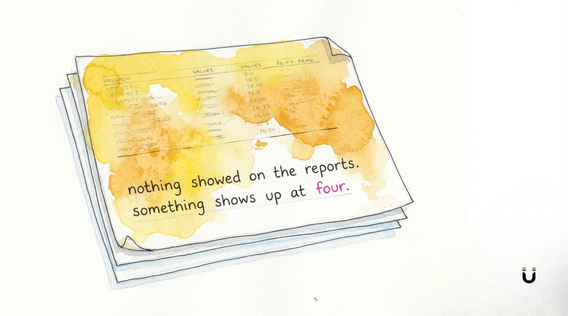
I want to talk about a sentence. Four words, and probably the most common one in the therapy room: I am not enough.
It's almost never said that plainly. What people actually say is: I always feel like I'm the problem. I don't know why anyone puts up with me. I work hard and still feel like a fraud. I've always been the weird one. What was wrong with me that he didn't choose me? That last one tends to linger in the room long after the session ends.
The belief stays the same. The costume changes every time.
Often it arrives as a feeling before it arrives as a thought. A tightness in the chest before you speak up in a meeting. Heat in your face when someone looks at you a beat too long. A heaviness in your stomach on Sunday evening, before the week starts. For some people it settles into a low-grade vigilance, part of their attention permanently assigned to the same questions. Am I doing this right? Do they notice? What am I missing? The belief doesn't present itself as an opinion. It feels like a truth your body already knows.
Then the voice catches up. I'm too much and not enough at the same time. Everyone else seems to know what they're doing. I'm faking it and eventually people will see. If they really knew me, they wouldn't stay. I should just be easier. There's something fundamentally wrong with me that I can't quite name.
What It Feels Like to Live Inside It
Living with this belief produces a very particular exhaustion.
There's the tiredness of constant self-monitoring, always tracking how you're coming across and whether you said the right thing. There's the tiredness of over-functioning, working harder than the task requires, giving more than you have, stretching thin so nobody ends up disappointed. And there's the tiredness of being lonely in a full room, because the person everyone is responding to is a version of you built to be acceptable. A thin barrier sits between who you are and what you're showing.
For some people this turns into desperate striving. A constant reach for the next achievement, as if success might finally serve as evidence and make the feeling stop. There's a logic to it, even a flawed one. If the core belief is that you have to earn your place, achievement looks like the obvious currency. It's proof you can hold in your hand: a title, a degree, a number in a bank account, a room full of people telling you that you did well. So you chase it, certain this one will settle the question.
But the belief was never running on evidence. It wasn't built by logic, which means logic can't take it apart. Hand it the promotion, the praise, the perfect review, and it will move the goalpost or find a reason the win doesn't count. The striving never lands because you're trying to answer an emotional question with a logistical solution. The cycle just resets. You hit the milestone, the relief holds for a few days, maybe a week, and then the old feeling seeps back and you go looking for the next thing to prove it with.
For others it produces the opposite. A quiet withdrawal. Why try when you'll fail anyway, why put yourself out there when rejection is coming regardless? The belief becomes a permission slip to stay small, because small feels safer than being seen and turned down.
It also has its triggers. Someone doesn't reply to a text quickly, and instantly: I've annoyed them, I always do this. You make an ordinary mistake at work and it lands as confirmation. Someone is quiet and you read it as withdrawal, as proof they've finally seen who you really are. A relationship ends, and the belief steps in with its explanation, the one it's been waiting years to deliver. Each time, the body follows: a low, familiar distress, the sense that you've done something wrong and it's only a matter of time before everyone knows it.
Where the Thought Comes From
This belief is rarely born from one big thing. It gets built slowly, through repetition.
Often it starts with a parent who was critical in a way that never looked harmful from the outside, but carried a steady message that improvement was always required. You could do better. You're smart, you just need to apply yourself. Why can't you be more like your brother? Nothing abusive. Just a consistent signal that you were almost acceptable and not quite there. Sometimes, it's a parent who was simply distant, and the child arrived at the only explanation available to a child: there must be something about me that's hard to love. Sometimes affection was conditional, arriving with achievement, with performance, with being useful, and the lesson landed early. I have to earn my place. My worth is something I prove.
Sometimes it grows out of a relationship that felt transactional rather than loving. A parent or a partner who tolerated you rather than delighted in you. Who helped, but with a sigh. Who was present, and still managed to make you feel like a burden. You learned to read disappointment in silences, to apologise for taking up space, to understand love as something you got by being less of yourself.
Sometimes it comes from being different. The sensitive kid in a tough family, the quiet one among the loud, the artistic one in a practical house or the practical one in an artistic one. The message rarely got spoken out loud, but it was legible enough: you don't quite fit.
And it isn't always a parent, or even childhood. Sometimes it's a school that sorts children into bright and not-bright a little too publicly. A body that didn't suit the room it was in. A marriage that taught you your needs were an inconvenience. A community with a fixed idea of what a good daughter or a good son or a good employee looks like, and years of being measured against it. None of these need to be dramatic. Most are entirely ordinary. The nervous system doesn't require catastrophe to build a belief. It requires repetition.
Once the belief is in place, it becomes a remarkably efficient filter. It registers everything that confirms it and quietly skips whatever doesn't. A compliment bounces off. A criticism lands and stays. Do that for twenty years and it stops feeling like a thought at all. It starts feeling like a fact about you.
I think about two people I've worked with. Call them Rohan and Muskaan. Rohan is successful by every external measure, and still carries a low, constant urgency to do more, fix more, be more, as though stopping would confirm something he'd rather not have confirmed. His achievements work as a shield. However well he does, it doesn't register. His success can't reach the belief, let alone alter it. Muskaan pours herself into everyone around her, gives more than she can afford to, and still somehow ends up feeling invisible, because the giving was never going to fill that particular gap.
Both of them work incredibly hard at being enough. Neither of them quite believes they are.
Enough for What, Exactly?
I've been sitting with the word enough lately.
Enough doesn't mean exceptional. It doesn't promise impressive or outstanding or more-than. It means sufficient. Adequate. Present and whole in the most basic sense.
So: I am not enough. Enough for what?
That question, asked at the right moment in the right session, tends to stop people mid-sentence. The belief has never once had to answer it. It's simply been accepted, for years, as settled.
Enough is a quieter ambition than we're used to. We live in a culture fluent in more: more achievement, more productivity, more visible evidence of worth. Enough asks for something plainer. To occupy your own life without constantly questioning your right to be in it. That turns out to be both simpler and harder than anything the belief has ever demanded of you. And it's what most people are really after. Not extraordinary. Just the end of having to justify their existence.
Why Knowing Better Doesn't Help
This is the part I want to slow down on, because it's where I see the most frustration, in clients and honestly in myself.
People who carry this belief are often the most self-aware people I work with. They can tell you exactly where it came from, trace it to a specific parent, a specific relationship, a specific moment. They know, intellectually, that it isn't rational. And it makes no difference at all to how they feel.
That's what happens with a belief this old. It stopped being a thought a long time ago and became an identity. You can't simply decide to stop being yourself.
I know this from the inside as well as the chair. Knowing something isn't factually true and feeling it anyway is a real gap, an uncomfortable one, and I don't think we discuss it honestly enough.
Here's the simplest way I can put it. The belief has a job, and the job is to be right. So it reads every piece of incoming information in whatever way keeps it right. You succeed at something, and it wasn't skill, you got lucky, or the task was easier than it looked, or someone else did the real work. Someone is kind to you, and it has nothing to do with you, they're kind to everyone, or being polite, or they don't know you well enough yet to see through the act. Someone loves you, and the explanation is what you do for them, or their own need to be needed, or the simple fact that they haven't discovered the real you. Every reinterpretation is so plausible, so reasonable-sounding, that it feels less like denial and more like being realistic.
What knowing does give you is a starting point. A direction, if not a solution. Because the work was never about defeating the thought. It's about changing your relationship to it.
I also want to name how much shame lives inside this belief, and not only in the belief itself. In the having of it. People carrying "I am not enough" often feel an additional shame about carrying it, because they feel they shouldn't, because they know better, because they can see it doesn't hold up. So there's a double weight: the belief, and then the judgement of the belief. Part of what therapy offers is a place to say it out loud without that second layer arriving right behind it. That alone is worth something.
What Actually Shifts, and How Slowly
There are two moments I watch for in this work.
The first is when someone can notice the thought instead of being it. Not I am not enough, but oh, there it is again. That thought. The small distance between a person and their thought, the ability to observe it rather than live inside it, is genuinely significant. It sounds minor. It isn't.
The second is simpler than it sounds: doing the thing anyway.
Say the thought turns up right before you speak in a meeting. Don't. You'll sound stupid. They'll realise you don't belong here. Most people wait for the voice to stop before they act. Once I feel confident, I'll say it. That moment of feeling ready almost never arrives, so they stay quiet again.
What creates change is speaking while the voice is still talking. Not after it stops, not once you believe you deserve to be heard, but with the doubt still right there in your ear. The aim isn't to drown the voice out. The aim is to tolerate it, to sit with discomfort while you act. There's a specific kind of courage in that, because you're proceeding without certainty.
This is different from willpower. Willpower is forcing yourself through something you don't want to do, like making yourself go to the gym. This is doing something you genuinely want, something that matters to you, while a frightened voice narrates the whole thing from the background. You're not trying to silence it. You're only declining to let it decide what you do.
And each time you do it, send the email, say the thing, ask for what you need, you're not proving the thought wrong. Thoughts like this don't really respond to proof. What you're doing is showing yourself that you can act with awareness and exercise choice on a day when part of you still doesn't believe it. You go anyway, and each time you go you collect a little of the information the belief has spent years filtering out. Evidence that you can live differently while the belief is still in the room.
I want to say this plainly, because it usually gets left out. It takes longer than people expect. Some clients I've worked with for years are still catching this thought in real time, still deciding deliberately what to do with it rather than following its instructions. That isn't failure. That's precisely what the work looks like. The aim was never for the thought to vanish. The aim is for it to lose its authority over what you do next.
The belief is efficient. It has had years to build its case and it's very good at explaining away anything new. So counter-evidence doesn't land cleanly. What clients tend to tell me, months or years in, is rarely that the thought has gone quiet. It's that the gap between the thought and their next action has widened. The thought shows up, and now there's a beat before they follow it.
That beat is the whole thing.
Therapy for a belief like this is slow, and it isn't linear. The thought doesn't usually disappear. Over time it becomes something you can see rather than something you automatically are. You don't have to work out where it came from on your own, and you certainly don't have to wait until it gets bad enough before you talk to someone about it.
Keep Exploring What Lies Beneath
If this article felt familiar, it may be because the belief "I'm not enough" doesn't disappear after you've recognised it. It softens through reflection, repetition and giving yourself space to notice what's happening underneath the surface.
That's exactly why we created the Explore Journal. Designed by psychologists, it helps you untangle recurring thoughts, understand emotional patterns and build a more compassionate relationship with yourself—one page at a time.
Whether you're in therapy, considering it, or simply wanting to understand yourself better, it's a gentle place to begin.