You're fine. You've been fine all week. Deadline handled, group chat replied to, dishes done, that argument with your mother patched over with the emotional equivalent of cellotape.
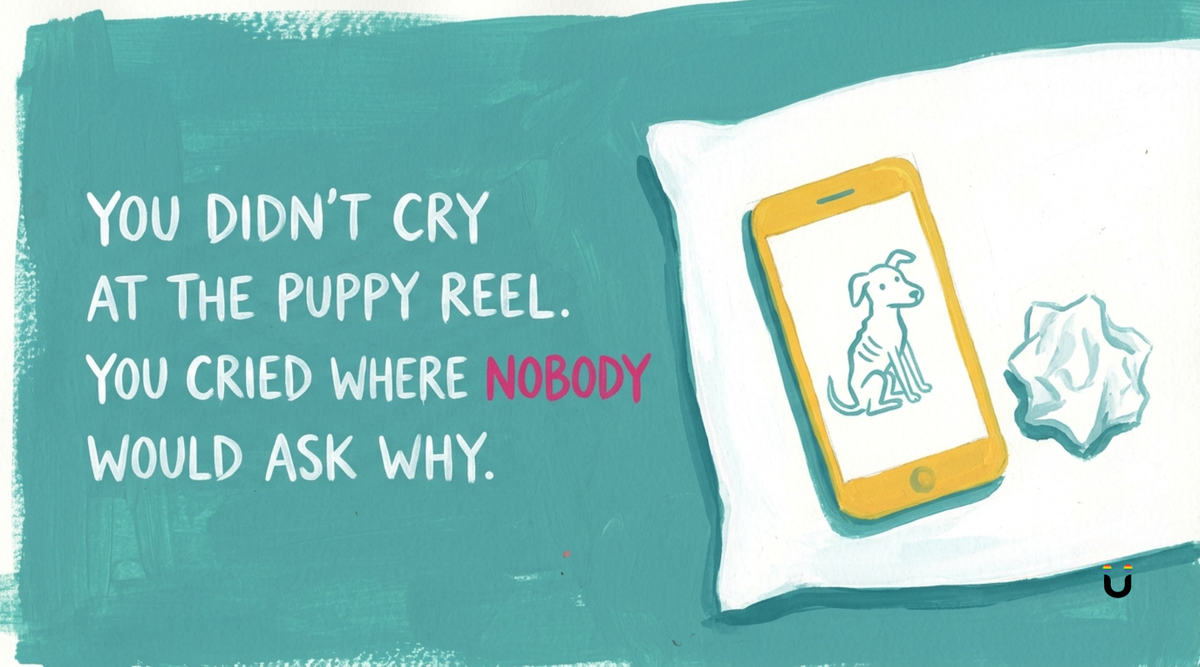
Then it's midnight, you're doomscrolling in bed, and a fifteen-second reel of a starving puppy getting fed for the first time slides onto the screen. Or an old man eating alone in a restaurant. Or a toddler with a cleft palate hearing clearly for the first time through a new hearing aid. And you're sobbing. Not one dignified tear. Full-body, can't-catch-your-breath, mascara-in-your-ears sobbing, over a dog you will never meet.
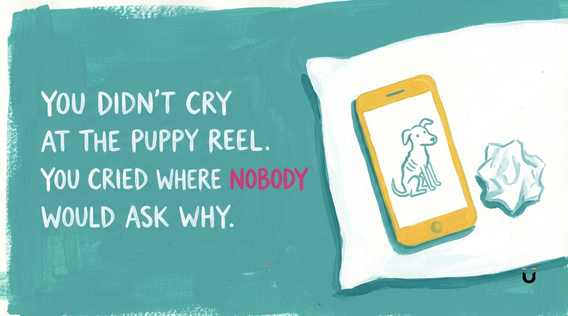
You didn't cry when your life fell apart a little last month. You cried at a golden retriever.
You're not dramatic, and your algorithm isn't being unusually cruel that night either. There's a real explanation, and the puppy is barely part of it.
The Reel Is Not the Point
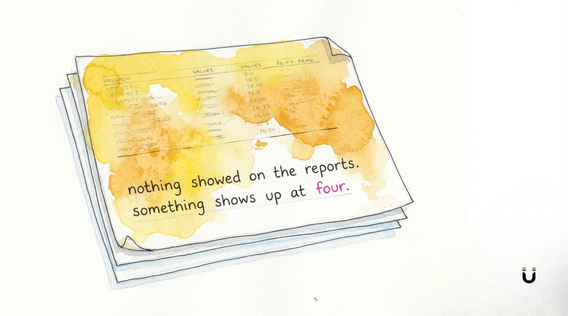
The annoying part is that the sadness was already there. It didn't start with the video. It started weeks ago, in the version of you that decided this was not the week to fall apart, so you filed everything under "later" and kept moving. That's the trouble with emotion you don't process: it doesn't clock out just because you stopped paying attention to it. It sits. It waits. And eventually it cashes itself out somewhere, as anxiety, as irritability, as a stomach that's been off for no reason, as a crying jag that seems to come from nowhere at 11 p.m. over a stranger's dog.
Except it wasn't nowhere. It was everywhere you'd been too busy to feel it, all those small moments this month where you swallowed something instead of saying it out loud. None of it disappeared. It just waited in different corners of you until there was enough to land all at once. The puppy barely figures into that wave. It rose up out of you, out of everything you hadn't had the time to feel. The video didn't create sadness. It just gave it somewhere to go.
Why That and Not Your Own Problems
So why does it take a stranger's forty-second clip to crack you open, and not therapy, or a long drive, or your best friend asking "so how are you, really"? If the sadness could leak out anywhere, you'd expect it to show up there first. Somewhere safe. Somewhere built for exactly this.
Instead it waits for a stranger. Here's why, speaking as someone who watches this happen in a therapy room all the time: crying about your own life means admitting your life is, at least a little, not okay. It means someone might ask a follow-up question you don't have an answer to yet. Even alone, even with nobody watching, that kind of honesty feels risky, and most people flinch from it on instinct, the same way you'd pull your hand back from something hot, because some part of the brain has decided that feeling the real thing is more dangerous than just being fine.
This is close to something called displacement, a defense mechanism where emotion gets rerouted off the thing that actually caused it and onto something unrelated and much lower-stakes. Your brain does this constantly, and mostly without asking your permission. It's the same reason you snap at your partner over a dish left in the sink when the real culprit is a comment your boss made three days ago. The dish is safe. The boss is not. The old man eating alone is safe. Your own loneliness is not. There's nothing broken about this. Your wiring is doing exactly what it evolved to do, which is to find the emotional exit with the least resistance. A stranger's ordinary Tuesday doesn't matter more to you than your own life. It's just that the stranger will never ask you a single follow-up question, and that is precisely why he gets to be the one who breaks you open.
The stranger will never ask you a single follow-up question, and that is precisely why he gets to be the one who breaks you open.
Why the Sweet Ones Get You Too
It isn't only the sad content. The sweet ones land just as hard: someone feeding the homeless, a kid getting adopted, a soldier's dog recognizing him after a year away. That tracks, because what pulls the tears out of you is rarely the plot itself. The video is just a delivery system for something older. Tenderness. Relief. The sight of someone finally being taken care of.
If you've spent this stretch of your life holding everything together, being the reliable one, the one who handles it, then watching a stranger get gently looked after presses on a bruise you've mostly learned to walk around. The bruise is usually some version of this: you can't remember the last time someone did that for you. Not fixing your problem, not handing you advice, just noticed you were tired and took something off your plate before you had to ask.
You can't will that bruise away, and you don't need to diagnose it into oblivion either. But you can do one small, concrete thing: let a single person in this week. Tell a friend about the week you actually had instead of the summary version. Ask for help with something you'd normally just absorb. The bruise doesn't heal because you understood it. It heals a little every time you let someone take care of you for real, instead of admiring the idea of it from a safe distance.
You're Not an Emotional Mess
None of this means you're secretly falling apart, or that you've been lying to everyone about being fine, or that you need to start crying on command to prove you have feelings. Everyone stores things for a while, and sometimes that's the right call. You don't always have the bandwidth to feel a hard week in the middle of living it, and putting it off isn't the same as pretending it never happened. Your body isn't punishing you for coping. It's just built to catch up eventually, whether you're ready or not, and it does tend to pick the worst possible moment to do it, over something small and soft and completely unrelated.
The only real problem is if the reels are the one place it ever comes out. If a sappy video is the sole occasion your body lets itself feel anything, that's worth paying attention to, because whatever you've been sitting on deserves more room than a ‘For You’ page can give it.
So the next time you're wrecked over some thirty-second reel, you don't need to explain it to anyone, least of all yourself. Your body just found the door. It might be worth asking it, gently, what it's been trying to get out.