Image Source: AI Generated
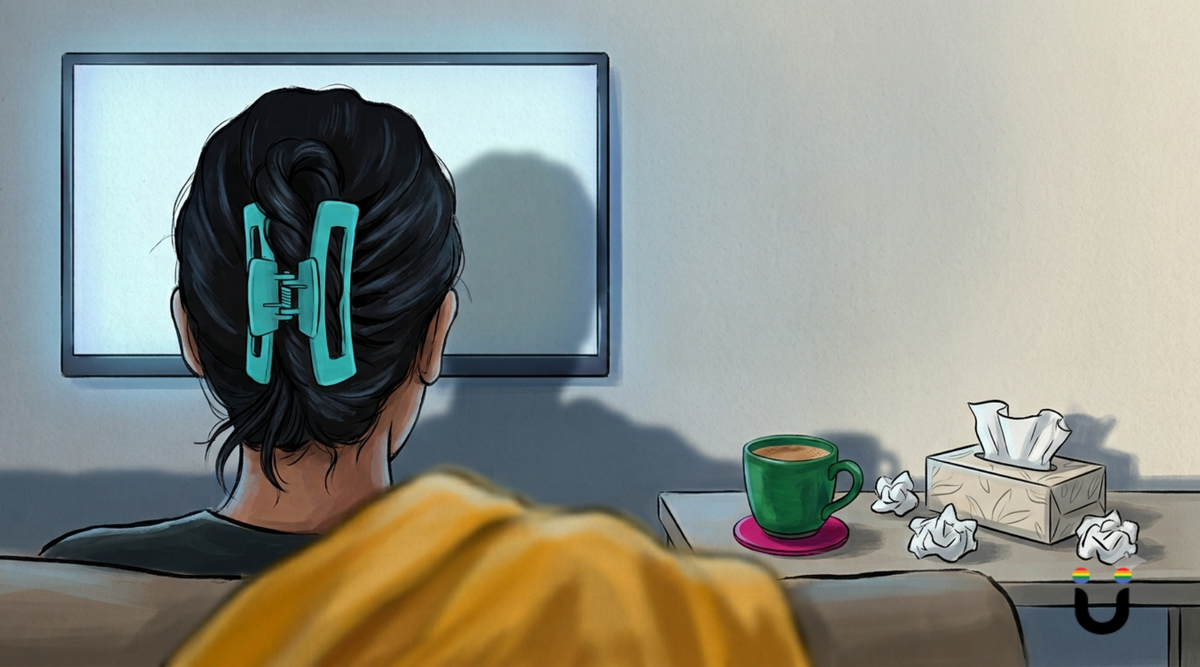
I was watching Voicemails for Isabelle on Netflix. If you've seen it, you know it doesn't save its feelings for the ending. Grief and love, tangled into each other, from the very first scene. It makes you feel things you didn't sign up to feel on a Tuesday night. If you haven't seen it, keep tissues nearby and don't go in expecting to stay composed.
I didn't stay composed. Somewhere in the last stretch, I was properly crying. Tears streaming, contorted face, the whole thing. And I wasn't crying because I'd watched someone battle a terminal illness. I don't even have a sister. I've never sat beside anyone waiting for a goodbye. None of that mattered. What moved through me wasn't about the specifics. It was longing, friendship, love, in a shape so universal it didn't need my life to match theirs to feel real. I didn't need to make sense of it. I just needed to let it be what it was. For a few minutes I wasn't a therapist, I wasn't analysing anything, I was a person on her couch crying at something beautiful and sad, the way you're supposed to.
That lasted maybe four seconds. Then, almost in the same breath, I did the thing. Why am I crying? What exactly is this about? Is it the film, or is it something the film just happened to poke. What does this mean to me?
The tears hadn't finished their job before my brain pulled up a chair and started taking notes. I noticed it for a second, half-amused, half-unsettled. Because I spend my working life asking people to do the exact opposite. I ask them to notice a feeling and stay with it. Don't solve it, don't source it, don't analyse it. Let it be there. And here I was, running textbook analysis on myself before the credits rolled.
Why Can't I Just Switch It Off?
Call it an occupational hazard. Though I suspect a lot more of us are doing it than would admit to it. Therapists are trained to notice, name, and make meaning of emotion. Years go into being able to sit across from someone and think, there's the anger under the anxiety, there's the grief the anger is guarding. It's a skill. It also doesn't come with an off switch. It isn't a cap I get to wear from nine to five and hang up after. Curiosity becomes the default lens, and I can't quite take it off. I'll name every emotion, hunt for every underlying belief, trace a pattern through every conversation, and that isn't always fun.
That same machinery doesn't clock out when the client leaves. It turns up when I'm crying at a film, mid-tear, asking me to explain myself to myself. There's a word for this: intellectualization, a defense mechanism where your mind steps in to explain a feeling instead of letting you have it. It turns something raw into something understandable, because understood feels safer than felt. It turns something raw into something understandable, because understood feels a lot safer than felt. There's nothing fake or cold about it. It's a genuinely sophisticated way of shielding yourself from something too big to just sit inside.
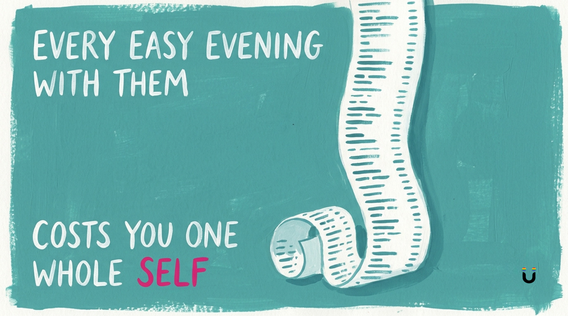
And it gets bigger when you're a therapist, because the whole job is basically trained intellectualisation. You learn to take a person's rawest, messiest feeling and turn it into something you can both name and work with. You build that skill on purpose, for years, so you can hand people clarity and compassion. The trouble is I've lost track of the line between doing it for a client and doing it to myself. The same reflex that makes someone else's pain explainable makes mine explainable too, and somewhere along the way that became my private evidence that I'm good at my job. A measure of whether I'm in control, capable enough, therapist enough. Which is where this stopped being about movie night.
When Did Awareness Turn Into Surveillance?
Self-awareness is supposed to be the whole point, isn't it? Know your patterns, know your triggers, know why you react the way you do. It's the thing therapy hands you, the thing we hand our clients, the thing that's supposed to make life feel less like it's happening to you.
But somewhere along the way, for a lot of us, awareness curdled into surveillance. There's a real difference between noticing you're sad and auditing whether you're allowed to be. One is presence. The other is a performance review where you're running on your own emotions in real time, while the feeling is still trying to happen.
Awareness feels productive. Sitting in raw feeling doesn't. Not knowing what the feeling is, or when it plans to end, is deeply uncomfortable. An explanation hands it edges. The second you can say I'm crying because X, the feeling stops being this open-ended, unpredictable thing and becomes something with a shape, something you can trace to a source. And a source implies a cure.
The audit, then, is about control. Staying on top of your emotions passes for maturity, but underneath I suspect it's a discomfort with feeling too much, dressed up as diligence, plus a quiet hope that explaining the thing is what finally makes it go.
Am I The Only One Doing This?
I see it in the room, too. Clients arrive almost apologetic, telling me they felt something enormous, something that moved clean through them, and they have no idea why. They worry it means therapy isn't working, that they're doing it wrong, that they were meant to show up with the explanation already clipped to the feeling. It makes them feel like a project waiting to be fixed, and step one is always to define the emotion.
And just as often, I see the reverse. Clients who can narrate their sadness fluently, where it started, which relationship it traces to, which childhood pattern it echoes, and who have, somewhere in all that fluency, stopped feeling sad at all. The emotion has left the building. They understand their pain beautifully and hold it at arm's length. I don't think this is a therapist problem. I don't think it's about therapy at all.
We are, all of us, drowning in explanation. Naming has quietly replaced experiencing. A person who can explain their sadness cleanly looks more together than one just sitting there, baffled by the why of it.
Feeling something and not being able to say why can feel almost embarrassing now. So we skip ahead. We go straight to explaining, because explaining feels like control and the feeling itself, wordless and physical and unbossed, doesn't. Naming it makes us feel armed, prepared, a little more equipped to manage the thing. Not knowing can tip into something closer to panic, or even shame.
I'm not about to tell you insight is the enemy. It isn't. I've built a career on the belief that understanding yourself changes things. Here's the line, though. Awareness is meant to be the bridge back into a feeling. Too often it becomes the detour around it. Insight that earns its keep sounds more like this: oh, I'm reacting this way because of what happened with my father, which is exactly why I need to let myself feel the full weight of it instead of quietly managing it away.
I did eventually let myself just cry about the film. No audit, no tracing back, no working theory. The tears, it turned out, never needed my explanation. They only needed to happen. Most days I still believe the noticing is worth it, that an examined life beats the alternative. I've just started to think some of us, me (very much) included, could stand to notice a little less at the exact moment we're meant to be feeling something. There's time to understand it later. If this pattern is getting in the way of your day-to-day, or if you want to work through it with someone rather than just read about it. A therapist in Mumbai can help you find that balance.
Though for the record, I caught myself at it again last week, mid-scene in Student of the Year, dissecting Rohan and Abhi's opposite upbringings and why each of them turned out the way he did. Old habits, apparently, don't care how silly the movie is.
Ready to Go Beyond Understanding and Actually Feel?
Insight is powerful. But sometimes the next step isn't another explanation—it's making space for the emotion itself.
Explore: Unpack & Unravel is a guided therapeutic journal designed to help you move beyond overthinking and gently reconnect with your inner world through reflective prompts, evidence-based exercises, and compassionate self-inquiry.