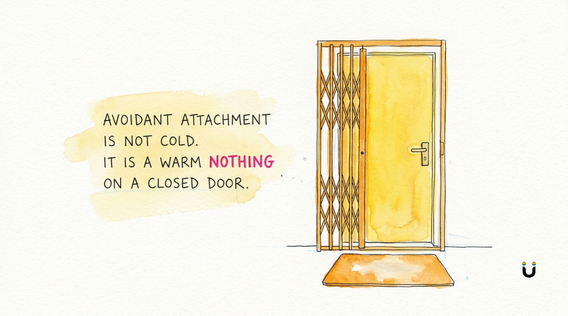
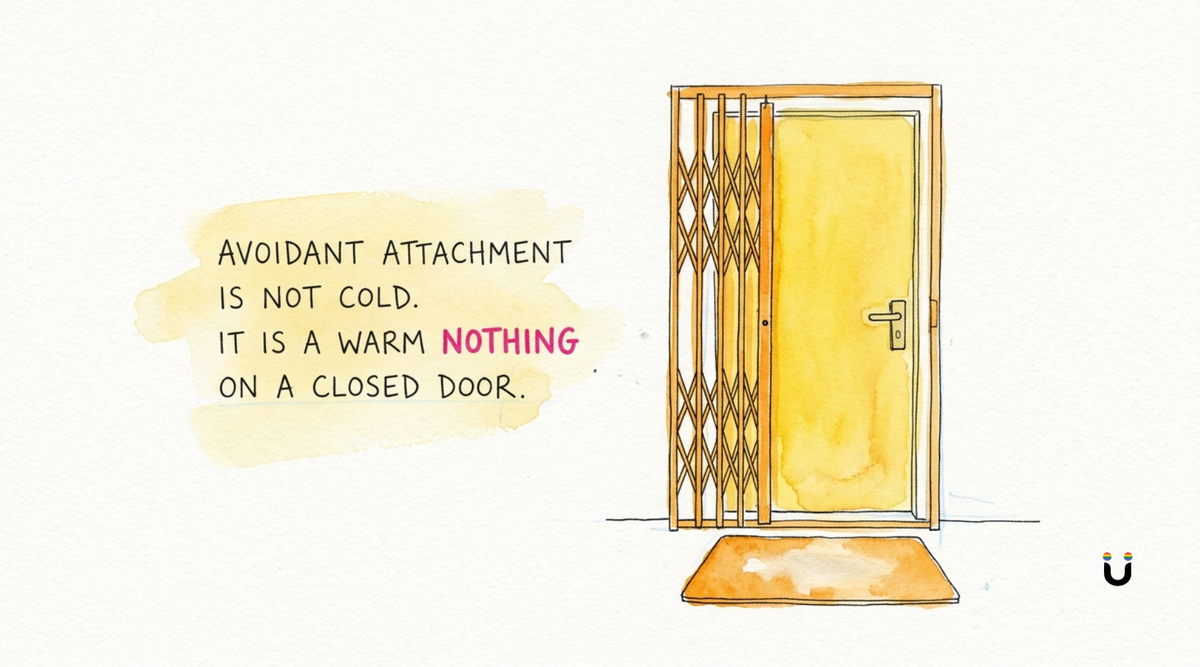
Your partner asks, "What are you thinking?" You say, "Nothing." You say it warmly. You say it with a small smile, the way a lot of us learned to say it early. It isn't a lie exactly. It's a closed door with a nice doormat.
If you're the partner of someone like this, read the piece and then please don't forward it with the subject line "See?" It won't go well. It never goes well.
Avoidant attachment is a relationship pattern where closeness feels risky, so a person pulls away, plays down their own needs, and prizes independence over leaning on anyone. The signs of avoidant attachment are quieter than people expect: going silent during conflict, dodging labels, feeling smothered by affection. If you recognise the avoidant attachment style in yourself, it helps to know upfront what this piece is and isn't. It's a learned habit of self-protection, not a diagnosis, and it can change.
What does avoidant attachment look like in everyday life?
It looks like eleven unread messages, all affectionate, all answered in your head and none of them on the phone. It looks like "I need space" arriving at the exact moment things get warm. It looks like a perfectly good plan that quietly cancels itself, and a small flicker of relief you don't mention to anyone.
It looks like being very good at helping and very bad at being helped. You'll drive across the city to fix a friend's problem. You won't tell that same friend you're having a terrible week. Independence is your best quality and also your alibi.
It looks like "I'm just not a feelings person." Often that sentence is true in the moment and a little untrue underneath it. The feelings are there. The route to them has been closed so long that everyone's stopped asking for directions.
Where does avoidant attachment come from?
Mostly from something that once worked. If closeness was met early on with criticism, absence, or an exhausting amount of drama, a child learns a sensible lesson. Need less. Ask less. Handle it yourself.
A lot of Indian homes show love in a particular language. A plate left out on the table. School fees paid without a word about it. A parent awake until you're home. That's real love, and we don't want to flatten it into a failing. But a child can grow up fluent in provision and short on the vocabulary for "I missed you," and then walk into a relationship where that exact vocabulary is what's expected.
Attachment theory, which grew out of the work of John Bowlby and others, holds that patterns like this form early and then travel with us. They tend to stay out of sight for years. They surface at the first real argument, usually around midnight.
Why do avoidant and anxious partners keep finding each other?
Because each one confirms the other's oldest guess about love. The anxious partner reaches. The avoidant partner withdraws. The withdrawal makes the anxious partner reach harder, and the harder reach makes the avoidant partner withdraw faster. It's a very efficient little machine.
We have written about the other side of that dance in the signs of anxious attachment and in why you keep choosing people who don't choose you. If you're the one on this side of the machine, those two are worth an evening.
Does being avoidant mean you don't care?
No. Caring and the ability to show it are two different skills, and avoidance lives in the gap between them. You can love someone deeply and still feel a pull to leave the room the second they cry.
Your partner's needs are real even when yours stays quiet. "That's just how I am" is a fine way to open a conversation. It can't be the thing that ends one. Leaving someone alone with their questions for three days costs them something, even when you never meant it to.
And not everyone who wants space is avoidant. Introverts need space. Grief needs space. A brutal quarter at work needs space. The label earns its keep only when it explains a pattern running across many relationships, rather than one rough month.
What helps if you recognise yourself?
Start smaller than you think you need to. Swap "I'm fine" for "I'm overwhelmed, give me an hour." That single sentence lets the other person know the door is closing, not locking.
Share one small true thing a week. Not a confession. Something the size of a Tuesday. "That meeting bothered me more than I let on." Then notice what your body does once you've said it. For most people the answer turns out to be: nothing terrible happens.
And if the pattern is older than this relationship, a therapist can be a good place to practise staying in the room. Our overview of attachment styles and relationships is a gentle place to start reading.
Nobody's asking you to become a person who narrates every feeling by Friday. One true sentence a week is a start.
Independence is your best quality and also your alibi.
Frequently asked questions
What are the signs of avoidant attachment?
Common signs are discomfort with emotional closeness, a strong pull toward independence, going quiet or leaving during conflict, dodging labels or commitment, feeling smothered by affection, and real difficulty asking for help. One sign on its own proves little. The pattern across relationships is the thing that matters.
Can an avoidant person change?
Yes. Attachment patterns are learned habits rather than fixed traits. Change tends to arrive through small repeated experiences of staying present, either in therapy or inside a safe relationship, rather than through one big decision.
Is avoidant attachment a mental illness?
No. It's a way of relating, not a diagnosis. It can sit alongside conditions like anxiety or depression, but on its own it simply describes a pattern of protecting yourself from closeness.