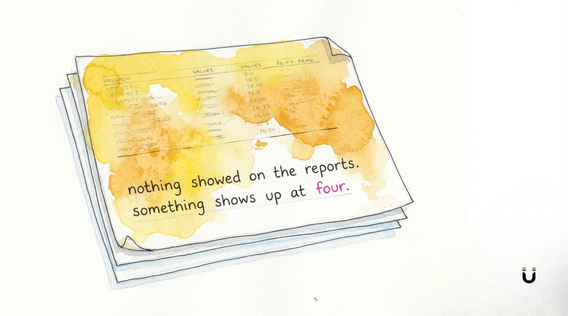
In May 2022, Sugar Cosmetics was valued at about ₹3,000 crore. On 1 September 2026, its board approved a new funding round. That round values the company at ₹550 to ₹755 crore, depending on which publication did the maths. Either way, it is about a fifth of the peak. In the four years between, Sugar ran four brands. Its core revenue fell 20 per cent in a single year.
Productive procrastination is doing useful, visible work to avoid the one task that is uncomfortable. In organisations it looks like launching a brand, a product or an AI initiative while the core business shrinks. The launch gets praised and the old problem stays unnamed. In clinical terms it is a form of experiential avoidance, rewarded by everyone around you.
A caveat first. I have read the reporting. I do not know what happened inside Sugar. Nobody outside its rooms does. What follows is a hypothesis built on public information. I am offering it because founders learn from each other's arcs, and because this arc is a clear picture of something I watch up close in much smaller companies. Sugar is the metaphor. The pattern is the point.
The pattern is this. Adding is the socially rewarded form of avoidance. Nobody praises you for sitting with a broken thing. Everybody praises a launch.
Why does adding feel so much better than fixing?
The new thing has no history. Nobody has failed at it yet, including you. The first six weeks of a launch produce motion and congratulations. None of it requires you to touch the thing that has been hurting. The old thing offers the opposite. Months with nothing to announce. Meetings where the honest number sits on the table and everyone looks at their laptop.
Nobody puts "closed the Pune store" on a slide. Nobody's mother forwards that to the family group. Nobody gets a podcast for the quarter they stopped bleeding.
The new thing has one more advantage. It lets you be busy and blameless at the same time. If the core shrinks while you are launching, you were building. If it shrinks while you are sitting with it, you were failing. Same numbers. Different verb.
What is productive procrastination?
Productive procrastination is secondary work that looks like work. You do it to avoid the primary task that feels like risk. It is procrastination with an alibi. The engine underneath has a clinical name: experiential avoidance. Steven Hayes and his colleagues defined it in 1996, in the Journal of Consulting and Clinical Psychology. A person is unwilling to stay in contact with a private experience, so they take steps to be in contact with it less. Their paper is theoretical and American. But watching your core fall 20 per cent is a private experience. A launch is a well dressed step away from it.
The version I see most now is AI. A company's core is trailing. Everyone can name the leaks in private. Then the company announces an AI initiative, and the founder is visibly lighter for about a month. There is finally something to be excited about that nobody can call a failure yet. Sometimes the pivot is right. I am not making business recommendations. It is not my place. What I can speak to is what the avoided conversation does to the person avoiding it. Their vision goes murky. They stop being able to say why the company exists. The why lived in the core, and the core is the thing they have stopped looking at.
The new thing lets you be busy and blameless at the same time. That is the real prize.
What does the launch do to the people who work for you?
This is the half of the story that gets left out. The founder's fear is private. The launch is public. The employees sit between the two. A founder avoiding a conversation does not become calm. They become moody, then erratic. Enthusiastic on Monday, cutting on Wednesday. The twelve people in the founder's office learn to read the weather instead of doing their jobs. Nobody has told them the core is in trouble. Everybody knows. The result is a team that is stretched, anxious and overwhelmed by a fear that is not even theirs. They are working on a launch that half of them suspect is a bandage.
That is a culture, whether or not anyone designed it. We have written about why founders do not tell their investors they are struggling. The same silence runs downward, and employees cannot ask. In India the shame of a failure is owed to people. "She has started something new" works at a wedding. "She shut it down" does not. So the launch relieves the founder of the feeling. It relieves the family of explaining the founder. The team pays for both.
How do you tell avoidance from strategy?
Not by whether you added. A second brand can be the right answer to a first one that has hit its ceiling. The real test is whether the old problem has been said out loud. By name. In a room. To the people who can act on it. Not in a deck, and not as "headwinds." A sentence with a number in it, followed by a silence that is allowed to sit. Strategy survives that sentence. Avoidance cannot, because that sentence is the thing it exists to prevent.
Here is the contrast from the same industry. Minimalist was founded in Jaipur in 2020. It stayed one brand. It was profitable from its first year. In January 2025 it sold 90.5 per cent to HUL at an enterprise value of ₹2,955 crore. That is roughly Sugar's peak number. It is not the whole story of either company. It is a part of it.
So the tool is one question, and it is not a clever one. What is the sentence about this that nobody in the room has said out loud yet? Ask it with the person who most needs to hear it present. Then do the hard part: do not fill the silence with a plan. The launch takes a year and a crore. The conversation takes forty minutes and a room. A good employee care programme, when it is not decorative, is somewhere for that sentence to be said before it costs a year. The same question works on you. On the version of you that cannot switch off and starts a fourth project at 11pm, because burnout looks like productivity right up until it does not.
Sugar will report FY26 eventually. What was said in its rooms, none of us knows. The question travels anyway. What are you not looking at? And who in your building already knows, and has not been asked?
What else do people ask about productive procrastination?
Is productive procrastination bad?
It becomes a problem when the task you are avoiding is the one that decides everything else. Clearing email instead of having a difficult conversation costs you a day. Launching a brand instead of examining a shrinking core can cost you a company. The test is whether the avoided thing is load bearing. If it is, the useful work you are doing instead is the avoidance.
Why do I start things and never finish them?
Because the start carries the reward and the middle carries the discomfort. A new project has no history of failure, so it feels clean, and the praise arrives early. Finishing means staying in contact with what is not working. Each unfinished thing then becomes another unnamed problem, which is easiest to escape by starting the next one.
How do I stop avoiding a problem at work?
Name it, specifically, out loud, to someone with the power to act on it. Avoidance survives on vagueness: "headwinds," "still figuring it out." A sentence with a number in it, said in a room, removes the vagueness. If saying it feels impossible, that feeling is the information. Take it to someone whose job is to hear it, whether a manager you trust, a peer, or a therapist.
Sources
- Inc42, "SUGAR Cosmetics Raises ₹145 Cr From A91 At A Near 80% Valuation Cut," 4 September 2026, reported from Ministry of Corporate Affairs filings. Valuation, FY24 and FY25 revenue, and the four brands. inc42.com
- Entrackr, "Sugar Cosmetics raises Rs 144 Cr at Rs 755 Cr valuation," 5 September 2026, for the alternative valuation estimate, the share count, and the 2022 peak. entrackr.com
- Business Today, "SUGAR Cosmetics parent acquires natural skin, haircare brand, ENN Beauty," 13 January 2022. businesstoday.in
- Inc42, "Kareena Kapoor Khan Partners SUGAR Cofounders To Launch K-Beauty Brand Quench Botanics," 16 October 2023. inc42.com
- Hayes, S. C., Wilson, K. G., Gifford, E. V., Follette, V. M., and Strosahl, K. (1996). Experiential avoidance and behavioral disorders: A functional dimensional approach to diagnosis and treatment. Journal of Consulting and Clinical Psychology, 64(6), 1152 to 1168. Definition at p. 1154. Full text (PDF)
- TechCrunch, "Hindustan Unilever to acquire Peak XV-backed Minimalist for over $340M," 22 January 2025, reporting HUL's stock exchange filing: 90.5 per cent stake, founded 2020, profitable since inception. techcrunch.com
- Business Standard (PTI), "HUL gets CCI approval to acquire Minimalist in Rs 2,670 crore deal," 17 March 2025, for the ₹2,955 crore enterprise valuation. business-standard.com