Burnout has become the word Indian professionals reach for when they mean something is wrong with work and they do not have a better term. It arrives sounding medical. It carries the weight of a diagnosis. Almost nobody who uses it has read what it officially means, and what it officially means is stranger and more useful than the way we use it.
Burnout and failing to recover are different states. The World Health Organization defines burnout as a syndrome "resulting from chronic workplace stress that has not been successfully managed", and does not classify it as a medical condition. Failing to recover is earlier and narrower: your ability to detach from work between working days has broken down.
The distinction matters because the two words send you to different places for a solution.
What Does the World Health Organization Actually Say About Burnout?
Three things, and the first one surprises most people. Burnout is in the eleventh revision of the International Classification of Diseases, which is why you often hear that the WHO has recognised it as a condition. It has not. The WHO stated on 28 May 2019 that burnout is an occupational phenomenon and is specifically not classified as a medical condition. It sits in the chapter covering reasons people contact health services that are not themselves illnesses.
Second, the definition has three parts: feeling depleted of energy, feeling mentally distant from or cynical about your job, and a drop in how effective you feel at it. All three are about your relationship to work.
Third, and this is the part that gets left out of almost every article that cites it, the WHO says the term applies only to the occupational context and should not be used for other areas of life. So the friend who says she is burnt out from her marriage, or from caring for her father, is describing something real that this word was not built to hold. That is not pedantry. Words determine which door you knock on.
Who Exactly Was Supposed to Manage It?
Read the WHO phrasing again, slowly. Chronic workplace stress that has not been successfully managed. It is written in the passive voice, and the passive voice has a job, which is to remove the person doing the action from the sentence.
Managed by whom? The definition does not say. And into that gap, an entire industry has walked, and it has answered: managed by you.
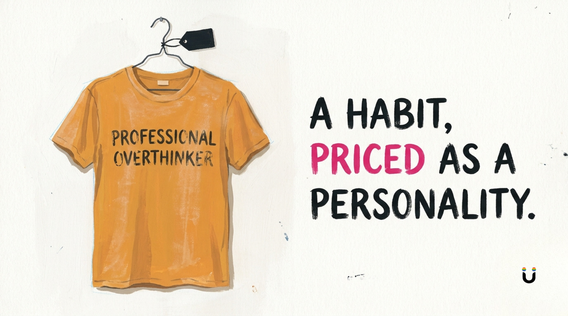
This is how a term describing a workplace failure became a description of personal fragility. The stress is chronic and located at work. The management of it has been reassigned to the individual without anyone saying so, who is then sold a course in managing it better. The word does the reassigning so smoothly that most people never notice it happened.
Nobody is ever told their company has burnout. It is always the person who has it, carries it, and is expected to recover from it on their own time.
What Is the Thing That Breaks Before Burnout?
Recovery, and it has a research literature of its own that almost never makes it into HR conversations. Sabine Sonnentag and Charlotte Fritz call the relevant capacity psychological detachment, meaning refraining from work thoughts and work tasks during time off. In their 2015 review in the Journal of Organizational Behavior, they set out a consistent finding across diary, longitudinal and cross sectional studies: job stressors, workload most of all, predict low detachment, and low detachment then predicts strain, exhaustion and lower wellbeing.
Notice the order. Load first. Failure to detach second. Exhaustion third. Burnout, if it arrives, arrives at the end of that sequence, and by then it is the most expensive point at which to intervene.
Detachment is also measurable, which burnout in practice is not, because it has no agreed diagnostic criteria. You can ask a team every month whether they wake rested, whether the worry switches off, whether they are drained by the end of the day, and you will get numbers that move. We have written separately about why switching off is so much harder than it sounds, and about what burnout looks like once it has arrived.
Could It Be Depression Instead?
Possibly, and this is the complication that the workplace conversation almost entirely avoids. There is a serious ongoing dispute among researchers about whether burnout is a distinct thing at all. In 2021, Renzo Bianchi and colleagues published a study in Clinical Psychological Science pooling 14 samples across several countries and occupations, 12,417 people in total. They found that exhaustion, the core of burnout, tracks more closely with depressive symptoms than with burnout's own other dimensions. The correlation between exhaustion and depression came out at .80, which they described as "problematically strong from a discriminant validity standpoint".
Their conclusion is not that people are imagining it. It is that the label may be sorting things badly. And a badly sorted label has consequences in both directions. A workplace problem gets treated as a personal illness. A depression gets treated as a workload issue and goes untreated for a year because everyone at the office, including the person, has agreed to call it burnout.
If what you are carrying has spread beyond work, if it has taken your sleep and your appetite and your interest in people you love, the word burnout is doing you a disservice. That is worth taking to a mental health professional who can actually assess it, rather than to a manager or a wellness portal.
Why Does the Distinction Change What Anyone Should Do?
Because each word implies a different owner and a different intervention.
If the problem is called burnout, the person is the site of it, and the response is individual: counselling access, resilience training, an app, leave. Some of that helps a person in front of you and none of it touches the cause. The largest study of these offerings, Fleming (2024), compared 46,336 workers and found participants no better off than people who did not take part. We have written about that evidence and its limits at more length.
If the problem is called a failure to recover, the working pattern is the site of it, and the questions change. When does the last message of the day go out. Whose meetings push real work past 7pm. What happens to a person here who does not reply at 11pm. Those are answerable, and they belong to whoever designs the week.
Neither framing is a comfort. The first tells you to fix yourself. The second tells you the thing that needs fixing may not be in your control at all, which is honest and not much use at midnight on a Tuesday.
What the second framing does give you is an earlier warning and a fairer distribution of the blame. Recovery breaks before people do. It also comes back faster, if anyone with authority over the calendar decides it should.
What Else Do People Ask About Burnout and Recovery?
Is burnout a medical diagnosis?
No. The World Health Organization includes burnout in ICD-11 as an occupational phenomenon and states explicitly that it is not classified as a medical condition. It appears in the chapter covering reasons people contact health services that are not themselves illnesses. A doctor in India cannot diagnose you with burnout in the way they can diagnose depression or an anxiety disorder.
What is the difference between burnout and exhaustion?
Exhaustion is one of the three dimensions of burnout in the WHO definition, alongside mental distance or cynicism about your job and reduced professional efficacy. Exhaustion on its own is more common and more reversible. Burnout describes the fuller pattern, arrived at after chronic workplace stress has gone unaddressed for a long period.
Can you be burnt out from something other than work?
Not by the official definition. The WHO states that the term refers specifically to the occupational context and should not be applied to experiences in other areas of life. Exhaustion from caregiving, parenting or a difficult relationship is real, but it sits outside this definition, and treating it as burnout can point you toward the wrong kind of help.
Is burnout the same as depression?
Researchers disagree, and the disagreement is substantial. Bianchi and colleagues (2021), pooling 14 samples and 12,417 people, found exhaustion correlates with depressive symptoms at .80, which is strong enough to question whether the two are distinguishable. If low mood, sleep changes and loss of interest extend beyond work, it is worth being assessed by a mental health professional rather than assuming it is a work problem.
How do you measure whether a team is recovering?
By asking directly and repeatedly about recovery rather than engagement. Questions about waking rested, being able to stop thinking about work in the evening, and feeling drained by the end of the day produce numbers that move within weeks. Engagement surveys run annually and measure something different, which is how people feel about the employer.
A note on the cover image
The image at the top of this piece was generated by AI, to a brief written by us. It is not a photograph and does not depict a real person or place.
Sources
World Health Organization (28 May 2019). Burn-out an occupational phenomenon: International Classification of Diseases. WHO newsroom
Sonnentag, S., & Fritz, C. (2015). Recovery from job stress: The stressor-detachment model as an integrative framework. Journal of Organizational Behavior, 36, S72-S103. Full text
Bianchi, R., Verkuilen, J., Schonfeld, I. S., Hakanen, J. J., Jansson-Fröjmark, M., Manzano-García, G., Laurent, E., & Meier, L. L. (2021). Is Burnout a Depressive Condition? A 14-Sample Meta-Analytic and Bifactor Analytic Study. Clinical Psychological Science. N = 12,417. Association for Psychological Science and SAGE
Fleming, W. J. (2024). Employee well-being outcomes from individual-level mental health interventions: Cross-sectional evidence from the United Kingdom. Industrial Relations Journal, 55, 162-182. UK sample. Wellbeing Research Centre, University of Oxford