Stop Interrogating Your Relationship. Here's What's Actually Happening.
Image Source:AI Generated
"Do I love my partner?" "Am I attracted to them?" "What if they're not the one and I find someone better later?" "Am I a good enough partner for them?" "What if they're cheating on me right now?"
If you've fired these at anyone willing to sit still long enough to answer, you're not alone. You've probably already tried to pin it on your attachment style. Anxious, avoidant, disorganised, you've taken the quizzes and read the results, and none of them quite explain why you can't stop interrogating your relationship. So let me introduce you to ROCD, or Relationship OCD. Stay with me, this one might explain a lot.
Quick clarification: ROCD isn't a standalone diagnosis. It's better understood as a form of obsessive-compulsive disorder, according to the Cleveland Clinic. OCD, basically, pointed at your relationship instead of germs or symmetry or house fires. And since "OCD" gets tossed around online to mean "I like my desk tidy," let's be precise. What's happening here goes well past ordinary doubts about your relationship. It's your brain locking onto uncertainty about your partner and flatly refusing to let go.
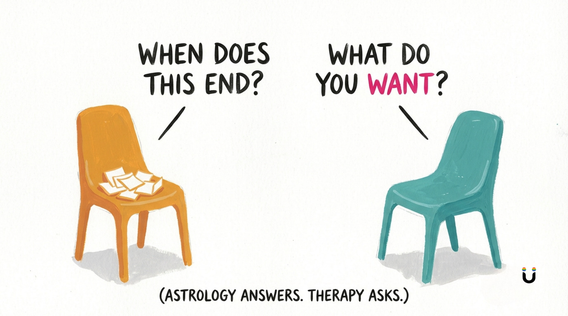
The result is an exhausting loop. Seek reassurance, feel better for a few hours, then get ambushed by a fresh doubt (or the same one in a new outfit), and start over. It can leave you feeling like you're "too much" for anyone to deal with.
Put simply: the obsession is the doubt itself, and the compulsion is whatever you do to make the doubt stop. Testing your partner. Googling. Replaying a conversation from Tuesday like it holds a hidden verdict. It feels less like a choice and more like an itch you have to scratch, except the itch is "do I actually love this person," and scratching never quite gets there.
Okay, So What Does This Look Like?
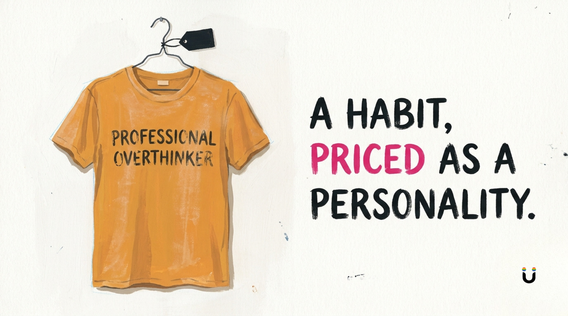
Part of why ROCD blindsides people is that films and shows sell us instant, permanent, doubt-free love. Count how many rom-coms treat "the spark" as something you simply have or don't. So when real love turns up messier than advertised, with off days and moments where your partner chews too loud, ROCD reads it as proof something's wrong.
It usually shows up in two flavours, and most people get a mix of both.
Relationship-focused ROCD is the "is this even the right relationship" flavour. You lie awake wondering whether the spark's gone, whether you settled, whether there's someone better out there. You might replay a mediocre date from three years ago like it's fresh evidence.
Partner-focused ROCD zooms in tighter. Their laugh is too loud. Their nose looks odd from this one specific angle. They said something slightly awkward at dinner and now you're spiralling over whether you're even attracted to them. Less "is this the right relationship," more "did I somehow miss something seriously wrong with this person." Very Chandler Bing, who dumped a girlfriend because he decided her nostrils were too big, then spent the rest of the episode convinced he'd die alone.
Neither flavour is really about your partner, or the relationship. Both are about a brain that can't sit still with uncertainty.
The Compulsions Are the Sneaky Part
Everyone doubts their relationship sometimes. Normal. What sets ROCD apart is what you do with the doubt.
You'd assume that testing your partner, Googling "how do I know if I love him," or polling your friends on whether you two actually work would calm things down. It sort of does, for about ten minutes, and that's the trap. The relief is real but tiny, and it quietly teaches your brain that checking works, so it asks you to check again. And again. It's closer to feeding a slot machine that pays out just enough to keep you sitting there than to solving anything.
The checking never settles it for long. If anything, hunting for flaws tends to manufacture them. Stare at anyone's nose long enough and it starts to look strange. That's just what hours of scrutiny do to something perfectly ordinary.
Common versions of the loop:
- Mentally lining your partner up against exes, celebrities, or a stranger you once clocked on the metro
- Asking for reassurance on repeat, from your partner, the group chat, or Reddit
- Confessing every intrusive thought in the name of "honesty," which mostly just hands your anxiety to them
- Replaying old arguments hunting for a red flag you missed
- Stalling on milestones like moving in or meeting the parents, because you're not "100 percent sure"
That "100 percent sure" bit is the tell. Nobody gets that. Not even people in genuinely wonderful relationships. Certainty was never on the menu, and ROCD is basically the person at the restaurant refusing to eat because the kitchen won't guarantee the meal will be perfect.
This Isn't Just Normal Relationship Doubt
Everyone questions their relationship now and then. Healthy, even. Thinking critically about your own life is a good thing.
What's different here is the volume and the persistence. Remember Ross's infamous list about Rachel? Chubby ankles, too into her looks, spoiled. Deep down he knew he loved her, and by the end he regretted writing it, because none of it actually mattered. ROCD is that list, except it never makes it to the bin. It just gets turned over and over, long after it should have stopped mattering.
The doubt doesn't fade after reassurance. It doesn't fade after your partner does something genuinely lovely. It doesn't fade even when you know, logically, that the relationship is solid. It just keeps asking for more proof.
To be clear, nobody's telling you to ignore real red flags. If something is genuinely wrong, that's its own conversation, and you deserve to be with someone you actually like. But doubt that keeps demanding certainty after you've already reflected, resolved, and been reassured a hundred times over usually isn't your gut talking anymore.
If You Think This Might Be You
If the doubt is loud enough to swallow your days, drain the relationship, or leave you feeling permanently on trial, it's worth talking to a therapist. You're not broken. You're not "too much." Your brain has just latched onto one of the most emotionally loaded parts of your life and turned it into static. That's a hard thing to live with, and it's also very treatable, and it says nothing about how much you love your partner or how good a partner you are.
The real work is building a tolerance for uncertainty. Right now, a doubt shows up and you check, ask, confess, replay. The aim is to let the doubt just sit there, uncomfortable, and pass on its own, without turning it into a text, a search bar, or a confession. A good therapist can help you build exactly that muscle.
And in the meantime: next time you catch yourself opening a new tab to ask the internet whether you love your partner, maybe just close it. You already know how that ends. Another loop, and no real answer.
___________________________________________________________________________What Happens Over Chai
If this piece felt uncomfortably familiar, if you've spent nights replaying conversations, seeking reassurance, or wondering why love feels more like an investigation than a connection, you might not need another quiz. You might need a gentler space to understand what your mind is doing.
What Happens Over Chai is a therapist-led conversation space created for exactly these moments: the ones where you're tired of spiralling alone. No performance, no pressure to have the perfect relationship, just honest reflection, emotional insight, and the kind of conversations that make uncertainty feel a little less frightening.
Come as you are. Bring the questions you keep asking everyone else. Sometimes clarity begins when the interrogation finally stops.