Image source: AI Generated
Full disclosure: I have watched a lot of women cut their hair in the week after their life came apart, and for a long time I read it the way most people read it. As a symptom. As the thing a woman does right before she does something she regrets.
I was wrong about it, and I want to tell you why. When women cut their hair after a breakup, a divorce, a diagnosis, a death, they are usually not losing the plot. They are doing one of the few things still available to them, which is reaching for the single variable in the whole situation that will actually obey.
Ananya (name changed, shared with permission) came to a session with a blunt bob. The last time I had seen her, her hair reached the middle of her back, the way it had for the entire eleven years of her marriage. She sat down, touched the back of her neck as if to check it was still there, and said, "My mother cried. My husband's mother called it a phase. Nobody asked me if I liked it."
She liked it. That was somehow the one thing nobody wanted to discuss.
There is a meme that does the rounds, some version of "new hair, new man, she's gone forever." We treat a woman's haircut as a weather warning, a sign that she is unstable, unavailable, about to detonate her own life. Very rarely do we treat it as the thing it most often is, which is a decision.
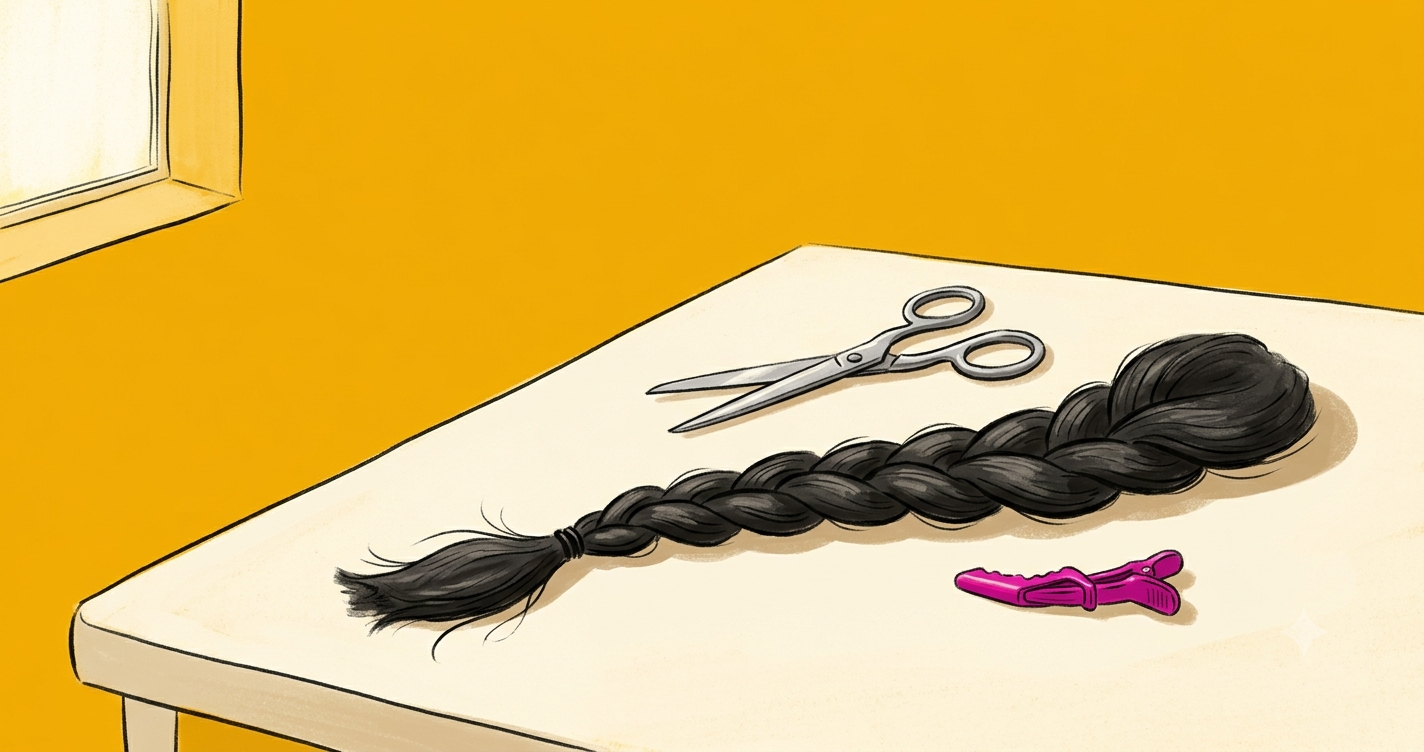
"The scissors are not medicine. They are a sentence you finally get to finish yourself."
Why does the urge arrive the moment everything else falls apart?
Because a haircut is controllable, and in a crisis almost nothing else is. When a relationship ends or a life reorganises without asking your permission, most of what is happening sits outside your hands. Your hair does not. Psychologists call the felt sense of how much you can shape your own circumstances your locus of control, an idea the psychologist Julian Rotter set out in 1966.
Rotter's point was plain. Some of us tend to feel that outcomes follow from what we do. Others feel outcomes arrive from luck, fate, or other people. In any real crisis, that sense of control collapses for nearly everyone. You did not choose the ending. You cannot choose whether he comes back, whether the biopsy is clean, whether your mother approves. What you can choose, at eight in the evening with a pair of kitchen scissors or an appointment you booked in a heat you barely understand, is the length of your own hair.
I want to be careful here, because this is the point where the internet gets loud and the evidence gets thin. There is no solid body of research showing that cutting your hair mends a broken heart. I went looking for it. What exists is a scatter of small studies on hair and self image, and a great deal of confident writing that has decided the science is settled. It is not. What the better work suggests is narrower and more interesting: that doing something deliberate to your own body, at the exact moment you feel you have no say in anything, hands a little authorship back to you.
What is your hair actually carrying?
More than you ever agreed to carry. Hair is one of the first surfaces a culture writes its instructions on about who a woman is meant to be, and it carries those instructions whether or not she signed off on them.
Long, thick, oiled, obedient. If you grew up as a girl in most Indian households, you learned this grammar without anyone teaching it to you. Long hair was not a preference. It was evidence. Evidence of health, of discipline, of being the sort of girl a family could present at a wedding without a single aunty raising an eyebrow. Old Bollywood understood the code perfectly and used it as shorthand: open, flowing hair for the heroine, the crop for the vamp, the rebel, the woman who had stopped asking for permission.
So when the hair comes off, it is never only hair coming off. It is the length someone else admired. The plait a mother oiled every Sunday morning while you squirmed. The version of you that read as legible to everyone, that answered correctly when the world asked what type of woman you were. Cutting it becomes a way of saying, out loud and in public, that the answer has changed and you are not going to wait around for a vote on it.
Why does an Indian family treat a haircut like a small death?
Because in this part of the world, a woman's hair has almost never fully belonged to her. It has belonged to her marriageability, to her family's standing, and going back far enough, to whether her husband was alive.
This is worth saying without softening it. For generations, a Hindu widow in India had her head shaved, her hair taken from her to mark that her womanhood had ended the moment her husband's life did. Her hair was tied to his existence, not her own. The tonsure was something done to her. It was subtraction as punishment, a way of lifting a woman out of the category of people who are allowed to be looked at.
Hold that history next to a woman today walking into a salon and choosing the cut for herself, and something turns over. The same act once used to erase her becomes, in her own hands, the exact reverse. When Kerala's ASHA workers cut off their hair during a protest in 2025, and when the politician Lathika Subhash tonsured her own head outside her party office in 2021 after being denied a seat, they were not in mourning. They were picking up the most loaded thing a woman can do to her appearance in India and turning it into a statement nobody could look away from.
This is why the reactions run so far past the size of the event. The crying mother, the aunties multiplying on the family WhatsApp, the husband's mother filing it under "phase." They are not reacting to a hairstyle. They are reacting to a woman taking back ownership of a thing the culture had assigned to everyone except her. If you have ever felt your own body was public property, open for comment at any family gathering, you already know this feeling in a slightly different key. I have written before about how our hair gets loaded with meaning we never once agreed to, and the weight lands the same way whether the fight is about length or curl.
Is it liberation, or a story you are telling yourself?
Sometimes it is both, sometimes it is neither, and the honest answer is that a haircut cannot do the work on its own. This is the part the empowering version leaves out.
A cut can be real agency, the outside of your life finally catching up to a decision you already made on the inside. It can also be a way of performing a change you have not actually made yet, a visible gesture standing in for the slower, unglamorous work that has no before and after photograph. Both look identical in the mirror. Both feel like relief on the day itself. Only one of them holds by March.
Ananya's cut held, though not because of the scissors. It held because she had spent two hard years in that marriage learning to have a preference and then say it aloud, and the hair was simply the last and most visible place she practised. The cut was not the change. It was the receipt. Real change tends to feel less like a makeover montage and more like friction, something a colleague of mine has written about the difference between change and the feeling of change with more honesty than most of us manage.
So what is a haircut actually for?
It is for the moment you need the outside of your life to admit that the inside has already moved. Not every woman who cuts her hair is walking out of something. But a great many of them are walking toward the plain fact of themselves, and they have picked the fastest, cheapest, most reversible way to make it real.
Hair grows back. That is the mercy built into it. You can announce a whole new life with your entire head and still change your mind by winter, and nobody gets to stop you, because it was always yours to decide in the first place.
I keep coming back to Ananya touching the back of her neck, checking the new shape was still there. Not regret. Recognition. The small shock of catching up with a decision your own body had made a beat before the rest of you found the words for it.
If a woman in your life comes home shorter than she left, you do not have to understand it. You could try simply asking her whether she likes it. She has probably been waiting a long time for someone to.
If something has ended and you are standing in the after of it, trying to work out what you want now that the noise has cleared, that is worth saying out loud to someone whose whole job is to listen well.
Find a therapist who understands the afterFrequently Asked Questions
Why do I suddenly want to cut my hair?
A sudden urge to cut your hair usually shows up when life feels out of your control, after a breakup, a loss, or a big change you did not choose. Your hair is one of the few things you can change instantly and by yourself, so the impulse is often a bid for a sense of authorship, not a sign that something is wrong with you.
Is cutting your hair after a breakup a red flag?
Usually not. For most people it is a normal, even healthy way of marking that a chapter has closed and taking back a small amount of control. It is only worth a closer look if it arrives alongside other signs of distress, such as trouble sleeping or eating or several impulsive decisions at once. The haircut itself is rarely the problem.
What does cutting your hair mean psychologically?
Psychologically, cutting your hair is often about identity and control. Hair carries a lot of meaning about who we are and how we are seen, so changing it can be a way of signalling, to yourself and to others, that you are no longer the person you were. It puts an internal shift on the outside and returns a feeling of agency when life feels unmanageable.
Why do Indian families react so strongly when women cut their hair?
In India, long hair has long been tied to a woman's marriageability, her family's image, and older traditions where a woman's hair was linked to her husband and even shaved in widowhood. A haircut can therefore be read, consciously or not, as a woman claiming ownership of something the culture treated as belonging to everyone but her. The strong reaction is usually about that shift in control, not the hairstyle.
Sources
Rotter, J. B. (1966). Generalized expectancies for internal versus external control of reinforcement. Psychological Monographs: General and Applied, 80(1). The foundational paper on locus of control.
Ellis-Hervey, N., et al. (2016). African American Personal Presentation: Psychology of Hair and Self-Perception. Journal of Black Studies. One of the few empirical studies linking hair choices to self-esteem and locus of control, and a useful marker of how thin the direct evidence base actually is.
Behanbox (2026). For Women, a Shaved Head Is Often a Mark of Protest, Both Political and Personal. Reporting on Kerala's ASHA workers and the wider use of tonsure as protest by Indian women, including Lathika Subhash's public tonsure in 2021.
Historical practice of widow tonsure in India is documented across social history and anthropological accounts of widowhood and its ritual removal of a woman from public visibility.