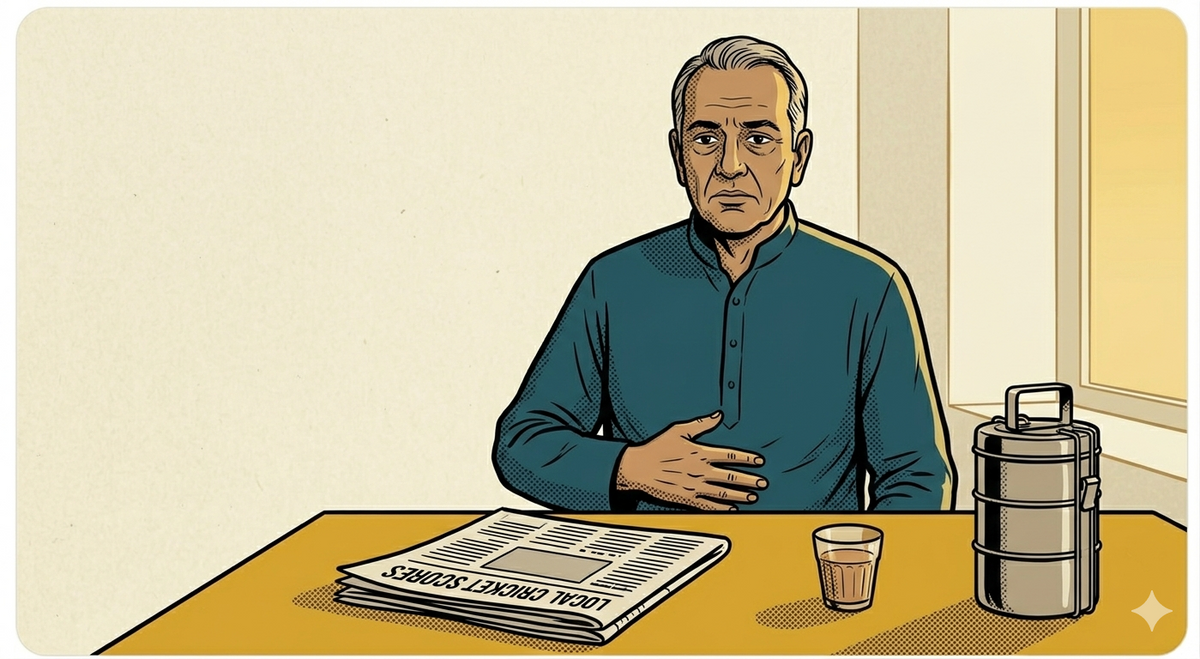
When Aditi's father was told the cancer had spread to his liver, he nodded once, asked the oncologist how many cycles, and on the drive home asked her to stop at the sabzi mandi because the house was out of bhindi. He did not cry. He did not go blank the way grief goes blank. He moved to the next practical thing, the way he had moved to the next practical thing his whole life. Aditi (name changed; shared with consent) was the one who fell apart, three weeks later, in my therapy room, undone less by the diagnosis than by his calm.
It is one of the most common bewilderments I meet in younger clients: the way the older Indians in their family meet pain. The generation that raised us does not talk about emotional pain. Not because they are cold, and not because nothing happened to them. They were taught, early and thoroughly, that endurance was the same thing as strength, and that a feeling you did not name was a feeling that could not unmake you.
And so they carried it. They carried it so well that their children, raised in cooled flats with therapy apps on their phones, now sit across from people like me asking the same question in a hundred forms. Why won't he just say what he feels? The honest answer is harder than the question. He may not have the words. But that was never the same as not having the feeling.
"Their silence was never the absence of the feeling. It was the only safe place they had to put it."
Why does an entire generation go silent when the subject is pain?
Older Indians often go silent around emotional pain because silence was, for most of their lives, the most adaptive response available to them. Naming distress did not solve it and could make it worse, by inviting shame, gossip, or a loss of standing the family could not afford. Silence was not avoidance. It was strategy.
The world they came up in did not reward feeling out loud. It rewarded function. Many of them grew up inside scarcity, in large families where one income stretched across six people and three rooms, where the line between coping and collapse was thin and watched by neighbours. Log kya kahenge was not a cliche to them. It was a real social cost with real consequences, attached to marriages, jobs, reputations. In a house like that, the luxury of sitting with your sadness was exactly that. A luxury. You felt it on the way to work and you left it at the door.
Aditi's father was the eldest of five. His own father died when he was nineteen, and that month he became the income. Nobody asked him how he felt about it. There was a younger sister's school fee due, and a mother who could not be seen to crumble in front of the children. He learned, at nineteen, that strength was the thing you did instead of the thing you felt.
What were older Indians actually taught about feeling?
They were taught that endurance is the highest form of strength, and that composure under suffering is a moral achievement. The emotional vocabulary they inherited is a vocabulary of bearing things, not of processing them: sehnshakti, adjust kar lo, sab theek ho jayega, chalta hai. These are not phrases for understanding a feeling. They are instructions for surviving past it.
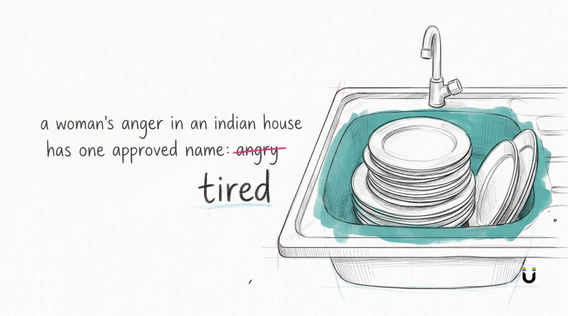
Look closely and each one is a command. Adjust kar lo: accommodate, do not assert your need. Sab theek ho jayega: the feeling is a weather system, wait it out, do not examine it. Chalta hai: lower the bar, expect less, harden. The ideal man of that era provided and did not emote. The venerated woman sacrificed and did not complain. Affection in many Indian homes of that generation arrived as a plate of cut mango placed on your desk while you studied, not as the words I love you. Love was expressed as labour, and labour does not require you to open your mouth about your heart.
It is the same emotional grammar that still makes family gatherings so loaded for so many of us, where presence is performed in a full room and feeling is the one thing nobody discusses. If that ache is familiar, you may recognise it in why family festivals can feel lonely even when the house is full of people.
Where does the feeling go if it was never spoken?
The feeling does not disappear when it goes unspoken. It relocates to the body. Psychiatrists call this somatization, and in collectivist cultures it works as what the medical anthropologist Arthur Kleinman named an idiom of distress: when there are no safe words for psychological suffering, the body becomes the language the suffering is allowed to speak.
This is not a vague idea. In a well known study at NIMHANS in Bangalore, R. Raguram and colleagues found that Indian patients living with depression expressed their suffering far more often through the body, through fatigue, aches, weakness, pressure in the head, than through the language of sadness. More tellingly, bodily complaints carried less social stigma than emotional ones. The body was permitted to be unwell in a way the mind was not. The same pattern showed up when the World Health Organization studied depression across fourteen countries, Bangalore among them. There is even a clinical word for having no words for one's own feelings. Alexithymia. Literally, no language for emotion. But the feeling underneath is still there, fully loaded, running like a current with no wire to carry it.
This is what the family missed about Aditi's father. When her mother died, he never said he was grieving. He developed an acidity that no antacid touched. His blood pressure climbed. He began sitting alone in the dark living room at four in the morning, which the family filed under insomnia. A cardiologist cleared his chest of anything cardiac. The grief had nowhere to go in words, so it went where it was allowed to go. Into the body that had spent seventy years being the only honest witness he permitted himself.
Is their silence the same thing as not feeling?
No. And this is the part that is hard to sit with. The silence of the older generation is not emptiness, and treating it as a defect to be corrected misses what it actually was: competence at a task we are lucky enough not to have to perform.
We want them to open up, and that want is real and legitimate. But it is worth being honest that it is partly ours. We want them to speak so we can finally feel close to them, so we can stop guessing, so we can repair something before it is too late. Some of them will never speak this language. Some will die without it, and we will be left holding a grief that has no conversation waiting at the end of it. That is its own loss, and it deserves to be named rather than fixed.
There is a harder admission underneath it. Calling their endurance repression flattens what it also was. The endurance worked. It built the security their children now have the room to feel everything inside. It is uncomfortable to sit with the fact that the very thing we now diagnose was also the thing that fed us, schooled us, and got us to the therapy room in the first place. We mistake their composure for absence the same way we misread the most composed people around us, the ones described in why the people who look the most fine are often carrying the most. And sometimes, when you do finally reach an older parent, what comes out is not relief but a flood with no container, and you understand that the silence was also protecting them from a pain they were never equipped to survive in the open.
How do you reach a parent who has no words for this?
You reach them by lowering the bar from conversation to presence, and by learning to read the language they do speak instead of demanding the one they do not. You are not extracting a feeling from them. You are learning to translate one.
Start with facts, not feelings, as the doorway. Ask your father what the house was like the year his own father died, who cooked, what he had to give up, what the fee was that month. The story carries the feeling in through the back door. You do not have to make him name it for it to be felt in the room. Then learn to read the somatic register as real communication, because for him it is. When your mother says her knees are bad today and her voice has gone somewhere far away, that is often a sentence about something else entirely. You can sit with the knees. You do not have to translate it out loud to honour it.
Meet love in the grammar they actually have, not the grammar you wish they had. A cut fruit, a phone call about nothing, sitting in the same room with the cricket on. And lower the stakes to almost nothing, because one sentence is enough. Saying "that must have been a lot to carry at nineteen" is more than most of them ever heard in their entire lives. You are not running a session. You are leaving a door open in a house where the door was always painted shut. If words come more easily to you on paper than out loud, a guided journal can be a low stakes place to put the words your family never could, including the ones you are still afraid to inherit.
None of this guarantees he will walk through the door. That is not the point. The point is that the door is open, and that you have stopped waiting for him to speak a language that was taken from him before he could learn it.
Aditi never got the conversation she wanted. What she got, near the end, was her father reaching for her hand across the hospital bed and holding it without a word, which from a man who had spent seventy years not reaching was its own complete sentence. She understood it. She had finally learned to read him in the language he actually spoke. The generation that was taught endurance is strength did not lose the feeling. They put it somewhere safe and they lost the key, and some of us are spending our adult lives learning to pick the lock. Not to prove they were wrong to bury it. To make sure the feeling was witnessed by someone before it goes.
If you are trying to understand a parent you cannot quite reach, or trying not to hand the same silence down to the people who come after you, it helps to have someone in your corner who speaks both languages.
Book a session with a TTC psychologist who works with emotional inheritance.
Frequently Asked Questions
Why don't older Indian parents talk about their feelings?
Most older Indians were raised in conditions of scarcity and high social scrutiny, where naming emotional pain risked shame and gossip rather than relief. They learned that endurance was strength and that composure under suffering was a moral achievement. Silence became a survival strategy, not a sign of coldness or an absence of feeling.
What is somatization and why is it common in India?
Somatization is the expression of emotional distress through physical symptoms such as fatigue, body aches, acidity, or pressure in the head, with no medical cause that fully explains them. In India it is common because bodily complaints have historically carried far less stigma than emotional ones, so distress travels into the body, which is allowed to be unwell when the mind is not. Research at NIMHANS in Bangalore documented this pattern clearly in patients with depression.
Does my parent's silence mean they don't love me or don't feel pain?
No. Silence around emotional pain is usually the opposite of absence. The feeling is fully present but has no permitted channel in words, so it shows up as endurance, as physical symptoms, or as acts of care rather than statements of emotion. A cut fruit, a phone call, a hand held without speaking can be the entire sentence.
How can I get my elderly parent to open up emotionally?
Lower the bar from conversation to presence, and read the language they already speak instead of demanding the one they do not. Ask about facts and stories rather than feelings, treat physical complaints as real communication, and meet affection in their grammar of care. One acknowledging sentence is often more than they have ever received, and that is enough.
Sources:
R. Raguram, Mitchell G. Weiss, S. M. Channabasavanna and Gerald M. Devins on stigma, depression and somatization in South India (NIMHANS, Bangalore). Published in the American Journal of Psychiatry, 1996
T. B. Üstün and colleagues on the cross national somatization of depression in primary care, including Bangalore. Published in the New England Journal of Medicine, 1999
Arthur Kleinman on somatic symptoms as a cultural idiom of distress in settings where psychiatric illness carries stigma. Referenced in the WHO collaborative study above
On alexithymia, the clinical term for difficulty identifying and describing one's own emotions (Sifneos; Nemiah). See this overview of research on somatization in depression and anxiety