There is a sentence people say to me in the therapy room almost under their breath, the way you say a thing you have already decided is shameful. "I love my mother. But some days I cannot stand being the one who takes care of her." Then they stop and watch my face, waiting to see if I am about to confirm that they are a bad person.
I have heard a version of that sentence so many times that I could finish it before they do. I have also heard it at home, from people I love, about people they love. So if you are reading this while caring for ageing parents, and some part of you is exhausted and guilty and angry all at the same time, let me say the thing nobody says first. That combination is not a flaw in your character. It is one of the most ordinary emotional experiences a person can have. And caring for ageing parents in India is built, almost from the ground up, to produce exactly this feeling.
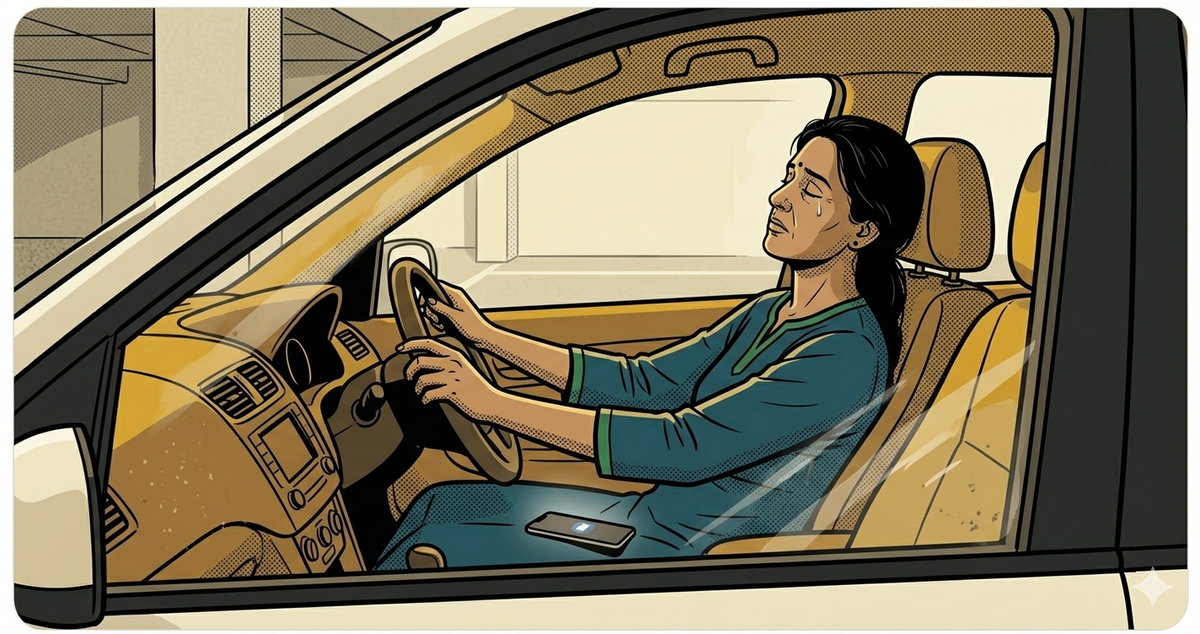
Meghna (name changed; shared with consent) is thirty four. She runs a small design studio in Pune, has a son who is seven, and for the last two years she has also been the person who manages her father's Parkinson's. She came to me because she had started crying in the car. Not at home, not in front of her father, not in front of her son. In the car, in the basement parking, engine off, for the eleven minutes it took before she had to walk back up and be fine again.
Her brother lives in Bangalore and calls every Sunday to ask how Papa is doing, which Meghna had begun to find unbearable, because the asking was the entire job he had given himself. She handled the medication and the neurologist and the physiotherapy slots and the mornings her father refused to eat and the nights he was frightened and could not say why. She did all of it. And the thing she could not forgive herself for was that some mornings, when his name lit up her phone, her first feeling was not love. It was dread.
Why does caring for a parent produce love and resentment at the same time?
Because the relationship was never built to hold this much contradiction, and now it has to. The psychologists Kurt Lüscher and Karl Pillemer named this in 1998: intergenerational ambivalence, the simultaneous experience of positive and negative feelings toward a parent that genuinely cannot be reconciled, sitting at the level of social roles and private emotion at once. It is not confusion. It is two true things refusing to cancel each other out.
Think about what the role actually asks of you. For your whole life, this person was the one who held things. Now you hold them. You schedule their appointments, you ration their salt, you learn the names of medicines you cannot pronounce, you become the adult in a relationship where you were always the child. Doctors have a blunt phrase for the emotional weather this produces in adult children: resentment, anger, frustration, ambivalence, guilt and demoralisation, often within the same hour. The role reversal is not a metaphor. You are parenting your parent, and nobody taught you how, and you are not allowed to find it hard.
For Meghna, the dread was not the opposite of love. It sat right next to it. She loved her father exactly as much as she always had. She also wanted, with her whole body, one ordinary morning where the first thing she did was not check whether he had slept. Both were true. They had been true for months. What she had been doing was treating the second one as proof that the first one was fake.
What does caregiver burnout actually feel like from the inside?
Caregiver burnout is the state of physical, emotional and mental exhaustion that builds when you spend your reserves on someone else's survival faster than you can replace them. It rarely announces itself. It looks like a short fuse over small things, a flatness where feeling used to be, dread before a phone call, sleep that does not repair you, and a slow withdrawal from the friends who used to ask how you were.
The cruel part is how it disguises itself as a verdict on your love. You snap at your father over a dropped glass and you do not think, I am depleted. You think, I am a terrible daughter. The exhaustion gets read as evidence of a moral failing rather than what it is, which is the predictable result of one person trying to carry a load designed for several. Burnout is not the absence of love. It is the bill that love runs up when no one helps you pay it.
And here is what I want you to notice. None of the symptoms above are about how much you care. They are about how much you are carrying, and for how long, and how alone. Those are different questions, and conflating them is the single most exhausting thing a carer does to themselves.
Loving someone and resenting what their care costs you are not opposites. They live in the same chest, at the same time, and they always have.
Why is this so much harder for Indian carers, especially daughters?
Because in India the care of a parent is not framed as a choice you make. It is framed as a debt you repay, a duty written into who you are supposed to be, and increasingly, a duty written into law. The Maintenance and Welfare of Parents and Senior Citizens Act of 2007 makes provision for ageing parents a legal obligation for adult children, not only a moral one. Most carers never read the Act. They do not have to. They absorbed it as children, in the form of a story about the good son and the dutiful daughter, long before it was ever a statute.
The numbers behind this are not small. India already has roughly 153 million people aged sixty and above, a figure the UNFPA projects will reach 347 million by 2050, when close to one in five Indians will be elderly. HelpAge India's 2024 report found that 68 percent of family caregivers provide support to their elderly every single day. This is happening inside a culture where placing a parent in an old age home still carries a stigma sharp enough to silence the conversation entirely, so the only socially acceptable answer is for one family member to absorb everything.
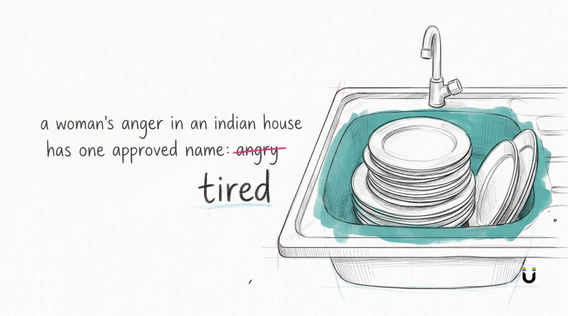
And that one family member is usually a woman. Across Indian studies of elder care, it is daughters, and the women who marry into the family, who give up careers, sleep and time to become the primary carer, often while the sons who are praised for being devoted limit their contribution to the Sunday phone call. If you are a woman doing this work, you are not imagining the imbalance. You are living inside a script that assigned you the role before you were old enough to refuse it. Learning to set limits inside that script is its own difficult skill, which is why setting boundaries without drowning in guilt matters as much here as the caregiving itself.
What if you don't actually like the person you're caring for?
This is the part most articles will not touch, so I will. Not every parent was kind. Some of the people now needing care were, for years, the source of the harm their adult child is still recovering from. And the cultural script offers that child precisely nothing. There is no honourable position in our stories for the daughter who shows up every day for a father who frightened her, and feels no warmth while she does it, only obligation and a low, constant anger she has nowhere to put.
If that is you, I am not going to hand you a reframe that dissolves it. The resentment you feel is not only the fatigue of the task. It is older than that, and it is real, and the caregiving has dragged it back into the room. You can be the person doing everything right and feel none of the things you are supposed to feel. That does not make you cold. It makes you honest about a relationship that was complicated long before it became your responsibility.
Sitting with that without rushing to fix it is harder than any practical tip, and it is also where the actual relief lives. Pretending to feel warmth you do not feel costs more energy than the caregiving does. If you are running on empty in that particular way, it is worth understanding what burnout does to the body and mind over time, because this version of it is the one people hide best and pay for longest.
So what does taking care of the carer actually look like?
It starts with separating the two questions you keep collapsing into one. Do I love this person, and can I keep carrying this alone, are not the same question, and the answer to the second one is allowed to be no without touching the first. Once you stop using your exhaustion as evidence against your love, you can finally treat the exhaustion as a problem to solve rather than a sin to confess.
Practically, that usually means naming the imbalance out loud to the family members who have been allowed to stay comfortable, asking your brother for a specific task and not a Sunday phone call, accepting paid help where it is possible without treating it as abandonment, and protecting a small, ordinary piece of your own life that has nothing to do with anyone's medication. None of this is selfish. A carer who is running on nothing is not more loving. They are just closer to collapse.
And it means having one place where you are not required to be fine. For Meghna, that was the room she sat in once a week, where she did not have to perform competence for her father or reassurance for her brother. Caring for a parent is one of the few experiences where the person doing the hardest work is the one nobody thinks to ask after. Speaking to a therapist who treats the carer as the patient, and not as a support service for someone else, is not a luxury. It is the thing that keeps you intact enough to keep showing up.
Meghna still cries in the car sometimes. The Parkinson's did not change, and neither, much, did her brother. What changed is that she stopped treating the dread as a referendum on her love and started treating it as a measure of how much she was holding. The week she let her cousin take her father to one physiotherapy appointment, she did not feel free. She felt guilty, and then she felt rested, and then she realised those two could share a Tuesday. You are allowed to be tired. You are allowed to want pieces of your life back. None of it cancels the love. It is the cost of it, and you were never meant to pay it by yourself.
If the only place you can fall apart right now is a parked car, you deserve a room of your own to do it in. Our therapists work with carers as the people who need care, not as an extension of someone else's treatment.
Book a session with therapist in Mumbai. And if writing helps you find the edge of what you are feeling, our journals for hard seasons are a place to start.
Frequently Asked Questions
Is it normal to feel resentment while caring for an ageing parent?
Yes. Feeling resentment alongside love is one of the most common experiences carers have. Psychologists call it intergenerational ambivalence: positive and negative feelings toward a parent existing at the same time without cancelling each other out. The resentment is usually a signal of how much you are carrying, not proof that your love is fake.
What are the signs of caregiver burnout?
Common signs include constant exhaustion that sleep does not fix, a short temper over small things, emotional numbness, dread before seeing or speaking to the person you care for, withdrawal from friends, and physical symptoms like headaches or frequent illness. Burnout reflects how much you are carrying and how alone you are in it, not how much you care.
Is it wrong to want outside help or an old age home for my parents in India?
No. Wanting help is not the same as abandoning a parent, even though the cultural stigma in India often makes it feel that way. Paid help, day care, shared family responsibility and assisted living are ways of making care sustainable. A carer who collapses helps no one. Choosing support is a way of protecting both yourself and the person you care for.
Where can a family caregiver in India find support?
Start by naming the imbalance to other family members and asking for specific, concrete help rather than vague gestures of concern. Organisations like HelpAge India offer resources and guidance for elder care. A therapist who treats the carer as the patient gives you a space to process the guilt and exhaustion. Carer support groups, online and in person, also reduce the isolation that fuels burnout.