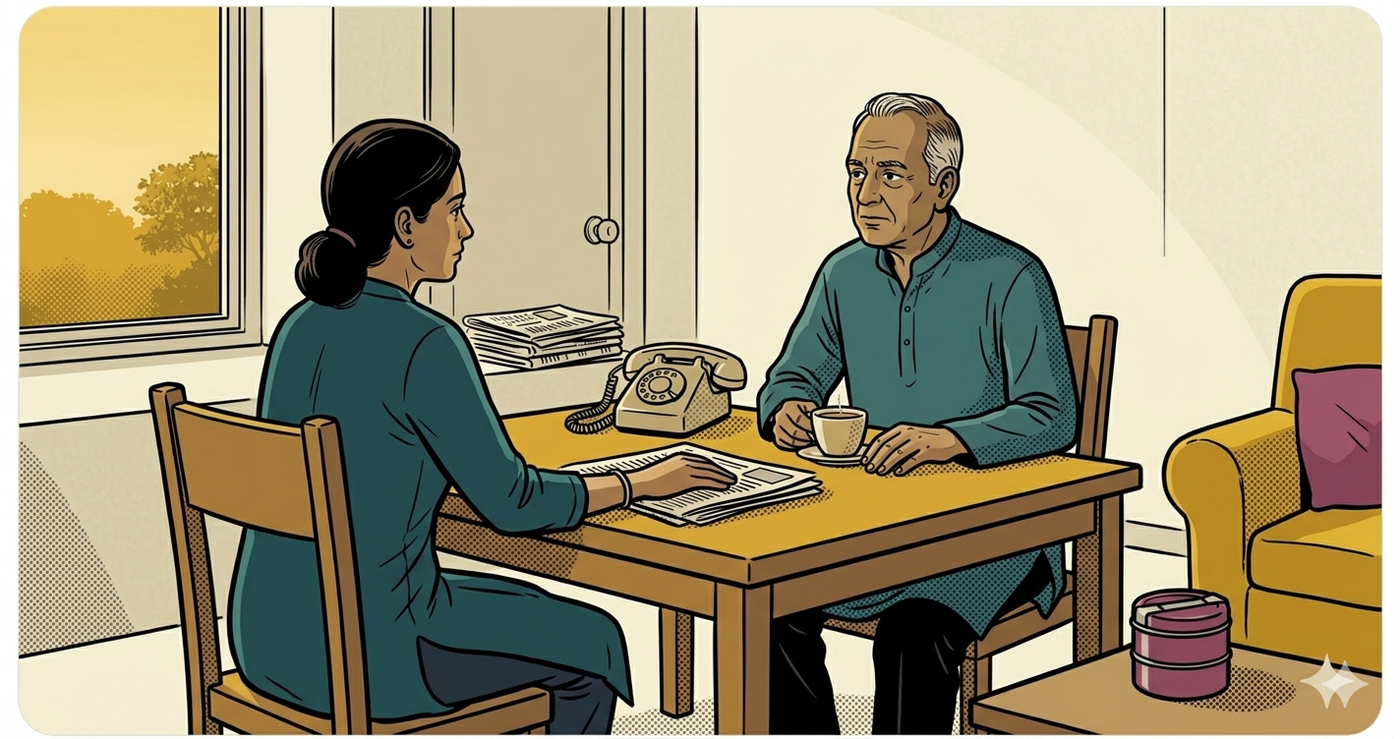
The first time most of us try to talk to an ageing parent about their mental health, we get it wrong. Not because we do not care. Because we walk into the room holding a conclusion instead of a question.
Aditi (name changed; shared with consent) had flown down to Pune for a long weekend and found her father living like a man waiting for something to be over. The newspapers were stacked unread by the door. The fridge held three jars of pickle and not much else. Her mother had died fourteen months earlier. Her father, a retired bank manager who had once ironed his own handkerchiefs, was in the same kurta she had seen him in two visits ago. He told her he was fine. He told her he was just tired. He told her, when she pushed, that he had survived things she could not imagine and did not need to be psychoanalysed by his own daughter.
What she had actually said, standing in that kitchen, was this. "Pappa, I think you are depressed. You need to see someone." She meant it as love. He heard it as a sentence being passed.
Aditi is not a careless daughter. She is one of the most attentive people I have worked with. She had simply done the thing almost all of us do when we are frightened for a parent. She arrived at the diagnosis before she arrived at the conversation.
"You are not trying to win the argument that something is wrong with them. You are trying to make it safe for them to admit that something is hard."
Why does bringing it up feel like passing a verdict?
Because for almost your whole life, the parent was the one who decided what was wrong and who needed fixing. Raising their mental health inverts that order, and both of you feel the floor shift. The fear is not really that you will say the wrong thing. The fear is that saying anything turns them into a case and you into the authority, a swap neither of you signed up for.
In Indian families this runs deeper than discomfort. The parent who held the family together is not supposed to be the one who is coming apart. Our scripts have a strong, capable elder and a child who defers. There is no scene written for the daughter who notices her father has stopped eating. So when you finally speak, it can feel like you are accusing him of failing at being the parent, which is the one role he has performed without complaint for forty years.
And the stakes are not small. India's first national ageing survey, the Longitudinal Ageing Study in India, conducted across 2017 and 2018, screened tens of thousands of adults over sixty. An analysis of that data by Muhammad and colleagues, published in PLOS One in 2022, found that close to a third of older Indians screened positive for depressive symptoms. The National Mental Health Survey of 2015 to 2016 documented something just as stark: a gap between the people who need care and the people who receive it so wide that most Indians with a diagnosable condition are never treated at all. Your parent is not an outlier. The silence is the norm.
What makes an ageing parent shut the conversation down?
Usually it is not the topic. It is the temperature. Decades of research on something called expressed emotion shows that what predicts whether a struggling person opens up or retreats is the emotional climate they are spoken to in, not the words alone.
In the 1960s the psychiatrist George Brown and his colleagues noticed something while studying people discharged from psychiatric hospitals. The strongest predictor of relapse was not the diagnosis or the medication. It was the home they returned to. Christine Vaughn and Julian Leff later turned this into a measure they called expressed emotion: how much criticism, hostility, and emotional overinvolvement a family directs at the person who is struggling. High expressed emotion, the warmth of worry curdled into pressure, reliably made people worse.
Now read Aditi's line again. "I think you are depressed. You need to see someone." In this framework it is almost a textbook high expressed emotion statement. It is a verdict, a description of his failure, and a directive, all in one breath, delivered before he has said a single word about how he feels. It does not matter that every part of it was true. It landed as criticism, and criticism makes a frightened person close the door. The urge behind it, to fix, to correct, to hand someone the solution before they have finished describing the problem, is the most natural impulse in the world and almost always the wrong opening move.
How do you bring up an ageing parent's mental health without it sounding like a diagnosis?
You replace the verdict with an observation, your own feeling, and an open question, in that order. You name what you have seen, you say what it stirred in you, and then you stop talking and let them answer. No label. No instruction. No therapy referral in the first conversation, or the second.
So instead of "you are depressed," you say: "Pappa, I noticed you have not been going for your evening walks. It has been on my mind. What do your days look like now?" Instead of "you need therapy," you ask: "Is it like this every day, or are some days lighter than others?" You are not gathering evidence for a case. You are signalling that this is a conversation he is allowed to have, not a problem he is being handed.
This is also why "how are you, really?" works when "how are you?" never does. The "really" tells your parent you are not going to accept the reflexive answer. Our parents say theek hoon and sab badhiya the way they breathe, especially a generation that was taught that complaint was ingratitude and need was weakness. The second question, asked gently, without an edge, says: I know that was the automatic reply, and I am still here, and I actually want to know. I have caught myself saying theek hoon to my own mother in exactly the tone I am asking you not to accept. The reflex runs in both directions.
Then comes the part everyone gets wrong. The silence. After you ask, do not fill it. Most of us cannot bear three seconds of a parent not answering, so we rush in with "no no, you are probably just tired, na," and in one sentence we close the door we just opened. The silence is not empty. It is your parent deciding whether it is safe to say the true thing. Let it be uncomfortable. Count to ten in your head if you have to. The pause is where the conversation actually lives. And if grief is underneath it, as it so often is with a parent who has lost a spouse, you may find that what they need first is not a solution but a witness. There is more on what unhurried grief actually asks of us in this piece on why grief does not run on deadlines.
What do you do when they still refuse?
You hold the door open and you make your peace with the fact that they may not walk through it. You cannot install insight in a person who is not ready, and if your parent is a competent adult, you cannot consent to care on their behalf. This is the part nobody tells you, and it is the hardest part.
Sometimes you will do everything right. You will lead with the observation, you will sit with the silence, you will keep your own fear out of your voice, and your father will still say theek hoon and ask why you have lost weight and whether the marriage is going well. The temptation then is to push harder, which is to say, to raise the expressed emotion, which is to say, to slam the door you spent the whole visit prising open. Do not. Pushing is for the people who feel better after pushing, not for the people who get pushed.
Underneath all of this is a loss with no name in our families. The reversal of roles is its own grief. The person who held the door for you now needs you to hold it, and the indignity of that may be exactly what he is refusing, not your concern but what your concern implies. The loneliness an ageing parent carries can be invisible even to them, the way it often is during festivals when the house is full and they still feel unreached, which I have written about in this piece on holiday loneliness. Naming that out loud, "I think this past year has been lonelier than you let on," sometimes does more than any referral.
One limit worth saying plainly. If a parent ever speaks about not wanting to be here, or you sense they may be in danger, that is no longer a conversation to hold alone, and it is not the subject of this piece. Get a professional involved. Everything above is for the slow, ordinary withdrawal that families mistake for ageing, not for a crisis.
What does staying in the conversation actually look like?
It looks like nothing momentous, which is precisely why people give up on it. It is not one big talk that fixes everything. It is small, repeated openings that carry no pressure, spread across weeks and months. It is calling without an agenda. It is asking "how are you, really?" enough times that the question stops feeling like an ambush. It is you regulating your own worry so it does not leak into the room and become the thing he has to manage.
And then, sometimes, on a Tuesday with no special reason, months after the conversation you were sure had failed, the parent says it himself. "That counsellor you mentioned. What was the name." Not because you won. Because you kept the door open long enough that walking through it stopped feeling like a defeat and started feeling like his own idea, which, by then, it genuinely is.
You are not trying to win the argument that something is wrong with them. You are trying to make it safe for them to admit that something is hard. Those are not the same conversation. Only one of them has a door you can hold open.
If your parent is not ready yet, you may be the one left holding all of this, the worry, the helplessness, the strange new grief of becoming the carer. That is a real load and it deserves somewhere to go. You can book a session with a TTC psychologist to think it through with someone, or if writing helps you sort the worry from the facts, a journal to keep alongside you can hold what you are not ready to say out loud.
Frequently Asked Questions
How do I know if my elderly parent is depressed or just getting older?
Slowing down is part of ageing. Withdrawing from the things they once loved is not. Persistent low mood, loss of interest, changes in sleep and appetite, and pulling away from people, lasting more than two weeks, point toward depression rather than age. The research is clear that depression is not a normal part of growing old, even though it is common in older Indians and routinely missed. If the change is marked or lasting, treat it as worth a conversation, not as something to wait out.
What do I say to a parent who refuses to talk about their feelings?
Stop asking about feelings and start naming what you have seen. "I noticed you have stopped your morning walk" is easier to answer than "are you depressed." Lead with a specific observation, add that it has been on your mind, then ask an open question and let the silence sit. You are lowering the pressure, not gathering evidence. A parent who refuses a label will sometimes answer a question that does not contain one.
How do I convince an Indian parent to see a therapist?
You usually cannot convince them in one conversation, and trying often backfires. Skip the therapy referral entirely at first. Make it safe to admit something is hard before you suggest who might help with it. When you do raise it, frame it around relief rather than diagnosis: someone to talk to, the way they would see a doctor for a knee. For many aging parents, the idea becoming theirs over time works better than any single argument you make.
Is it my responsibility to manage my ageing parent's mental health?
It is your responsibility to notice, to raise it with care, and to keep the door open. It is not your responsibility, nor within your power, to force a competent adult into insight or treatment they do not want. Holding that line protects you from burning out and protects the relationship from becoming a battle. The exception is a safety risk, which is no longer a conversation to manage alone and needs a professional involved.