My building has 200 flats. I have lived in mine for six years. I know the names of three neighbours. Two of them are the building managers. The third is a woman who once needed to borrow sugar at 11pm and has not spoken to me since, possibly out of embarrassment, possibly because the social contract that made her come to my door that night does not technically exist anymore in the building we both pay maintenance for.
I write this from a Bandra coffee shop. Forty per cent laptops. Sixty per cent strangers performing busyness. Zero per cent eye contact. Everyone here is, in the technical sense, in public. Almost nobody here is in company. We are sitting in the same room and we are alone in it together, which is a sentence that should not make sense and yet does.
Full disclosure: I have been writing some version of this piece for years and not publishing it, because I was worried it would read as either self-help or polemic. I have decided to publish it now because I think we have been gaslighting ourselves about something for two decades, and the cost of that has shown up in my therapy room often enough that I am no longer willing to be polite about it.
Loneliness is not only a personal failing. It is also an architectural and cultural one. And the architecture is doing more of the work than we have been willing to admit.
The third places we used to have
The American sociologist Ray Oldenburg coined the phrase third place in the late 1980s for the kind of public space that is neither home nor work. The neighbourhood pub. The corner cafe. The post office where you ran into people. He argued that these places are the basic infrastructure of community life, and that when a city loses them, the community thins out, regardless of how its individual residents feel about each other.
Indian cities used to have an extraordinary density of third places. The temple that doubled as a community courtyard. The chai stall where the same six men came at the same time every evening. The neighbourhood park with an actual neighbourhood around it. The Resident Welfare Association that actually met. The building society where Ganpati was a collective production and Holi happened on the road outside, not in the clubhouse if you booked it forty-eight hours in advance.
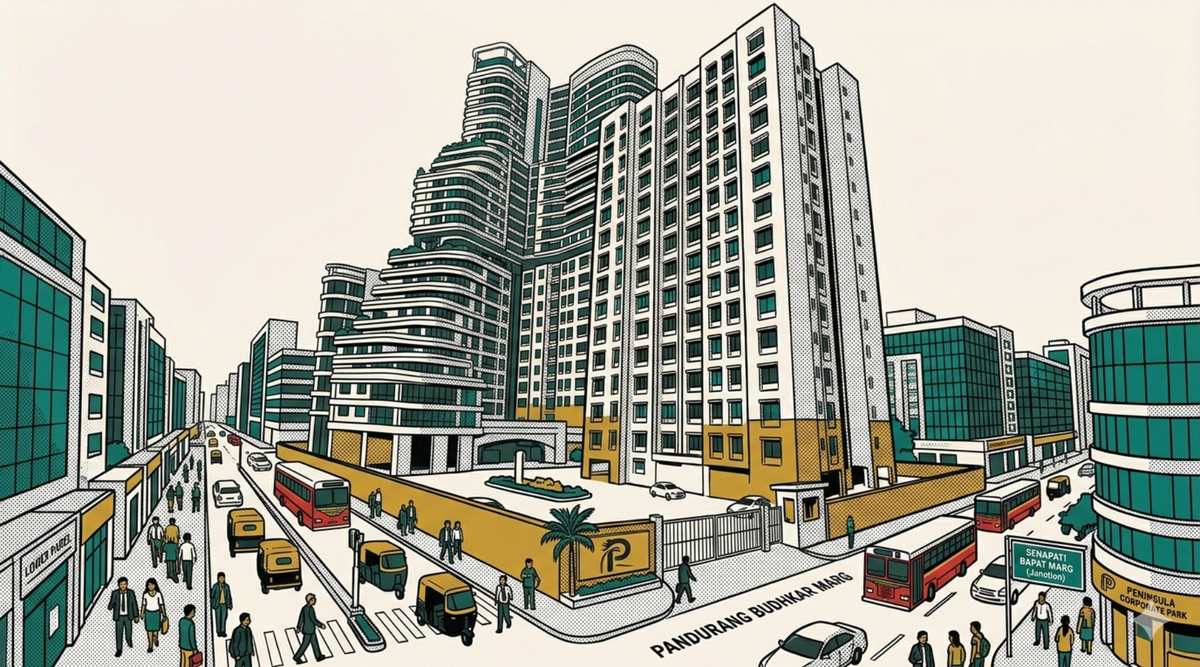
Most of these have been systematically hollowed out. Privatisation took some of them. Gating took most of the rest. Social life migrated first to malls, then to phones. The architectural shift to high-rises produced a new role I find clinically interesting: the security guard whose entire job, despite the official description, is to prevent spontaneous contact between residents. He is the buffer between you and your neighbour. He calls upstairs to confirm that the food delivery is expected. He notes the car. He logs the visitor. The system is built to prevent the unannounced arrival, which is the same as saying it is built to prevent the conditions under which neighbourliness used to grow.
The Indian city stopped being designed for connection somewhere around the year 2000, and we are now living inside the consequences of that design choice. We did not vote for those consequences. We were sold them, one glass tower at a time, as success.
The cultural shift sits alongside the architectural one, and it is more delicate to talk about, so I will go slowly. The joint family had real costs. It enforced patriarchy. It demanded that women carry an unreasonable share of domestic and emotional labour. It punished privacy. It punished anyone who did not fit. We do not need to romanticise it, and I am not going to.
And. The joint family, and the neighbourhood texture that surrounded it, offered an ambient social presence that the nuclear-family-plus-WhatsApp model does not replicate. Most urban Indians under 35 now live in households of one to four people, in buildings where they do not know their neighbours, in cities where their closest friends are scattered across two-hour commutes that make casual meeting almost impossible. The casual community is not gone because young people are selfish or because their parents raised them wrong. It is gone because the structures that produced it have been replaced. The infrastructure of casual community has been replaced by the infrastructure of digital community, and the trade has not been an even one.
The US Surgeon General Vivek Murthy declared loneliness a public health epidemic in 2023, citing mortality risk on par with smoking fifteen cigarettes a day. India has not yet officially named what it is seeing, but the data and the rooms full of clients are saying the same thing. The thing is structural.
What the room is now telling me
I have been a therapist long enough to notice my own questions changing. When a client used to tell me they were lonely, my first instinct was to ask what was going on internally. Their attachment style. Their relational history. The story they were telling themselves about their loveability. These questions still matter. I still ask them. But over the last few years they have stopped being the first question.
The first question is increasingly: what is going on around you? Where do you live? How long is your commute? When was the last time you saw a person without scheduling it? When did you last eat a meal you did not order on an app? Who in your physical neighbourhood would you call if a pipe burst at midnight? What would happen if you walked downstairs right now without your phone?
The locus has shifted. Sometimes the work of therapy is helping someone metabolise an old wound. Increasingly, sometimes the work of therapy is helping someone build connections their environment has actively made harder to build. The city is doing something to our nervous systems, and the therapy room cannot keep pretending it is not.
I want to be careful here, because this argument can be misused. The structural framing does not absolve the personal. The city did not text your friend back for you. The city did not ask the woman in 4B her name. The city did not stop you from going downstairs. You still have to do the work. The reaching out is still yours.
The point of naming the structural is not to give you an excuse. The point is to take a layer of shame off, so that the reaching out gets fractionally easier. You are not lonely because you are unlovable, or unfunny, or fundamentally too much for people. You are lonely partly because the place you live is designed in a way that makes connection harder. Knowing this is not a free pass. It is a relief that lets you start.
If your loneliness is partly structural, then the answer cannot only be individual, and it cannot only be self-care. Choose buildings with shared spaces when you can afford the choice. Push your RWA on the question of whether the clubhouse is functioning as a clubhouse or as a wedding rental. Push your city for parks, real ones, with benches that are not designed to be uncomfortable. Refuse to romanticise the gated, glass-tower, no-eye-contact version of urban life that is being sold to us as having arrived. Walk to the chemist. Know the watchman's name. Know the cook's name. Know the names of the people in the three flats nearest yours. Sit in cafes and occasionally look up from your laptop. Re-learn the small competence of accepting an unscheduled cup of tea.
The small acts that make a city less lonely are the same acts that make a country less lonely. We will heal more loneliness with better cities than with more apps. We will heal more of it with neighbours than with notifications.
And if you are tired of being told that your loneliness is your fault, it is okay to be tired. It has not, in fact, been only your fault. The system around you has been failing you in ways nobody named, and you have been carrying the full weight of it as a personal deficiency, and that has been unfair.
Now go reach out anyway. The city will not do it for you. The reaching out is still yours to do, and it still counts.
If any of this has named something you would like to think through more carefully, the Sunday Journaling Series is built for exactly this kind of locating. He Didn't Say He Was Lonely. He Said He Was Tired. sits alongside this one. An Optimist's Guide To Tackling Loneliness is a softer entry point. The Truth About Why The Festive Season Makes You Feel All Those Feelings belongs in the same conversation. And if speaking is easier than writing, therapy is here.
Sources: Ray Oldenburg, The Great Good Place: Cafes, Coffee Shops, Bookstores, Bars, Hair Salons and Other Hangouts at the Heart of a Community, 1989. Vivek Murthy, Our Epidemic of Loneliness and Isolation, US Surgeon General's Advisory, 2023.