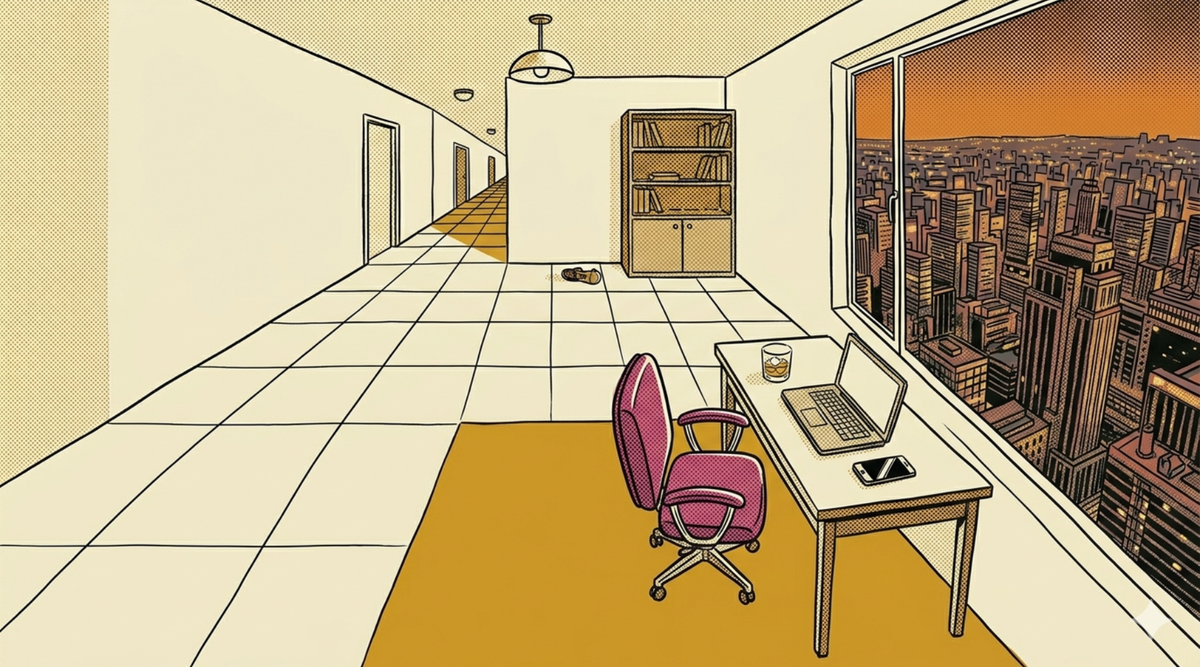
Rahul, 29, came in for insomnia. He had not slept properly for six months. He told me, twice in the first session, that it was just a deadline issue and would pass. He has worked in product since his early twenties. He is unmarried, lives alone in a one BHK in Powai, calls his mother every Sunday. (Name changed; shared with consent.)
Anand, 34, came in because his wife had asked him to. Anger problems, she said. He was breaking things in the kitchen. He sat across from me with the carefully arranged face of a man who had decided to be reasonable. He said his wife was overreacting. He said work had been stressful. He said he was fine. (Name changed; shared with consent.)
Vikram, 41, came in because his stomach had been off for a year and three doctors had ruled out everything physical. The gastroenterologist had finally said the word stress, and his wife had finally said the word therapist, and here he was. He told me he was a happy person. He said this several times. (Name changed; shared with consent.)
None of them said the word lonely.
All three of them were, profoundly.
The script that does not exist
Indian male loneliness almost never presents as sadness. It presents as everything except sadness. It presents as overwork. As irritability. As drinking too much, too often, too alone. As gaming till 2am with the headset on. As the strange flat affect that wives and mothers describe with the phrase he just seems off. As the gym obsession. As the work obsession. As the way an entire personality reorganises itself around being busy, because being busy is the only socially permitted form of being unwell.
Indian masculinity has no script for I am lonely.
It has a generous script for I am stressed. So loneliness becomes stress, and stress is worn as a badge, and the man wearing it gets praised for wearing it well. He is the dependable one. The hard worker. The one who is taking care of everything. And meanwhile he is rotting from the inside, on a Tuesday afternoon, at his desk, while his colleagues compliment his work ethic.
The data on what this costs is not subtle. Indian men account for over 70% of all suicide deaths in this country, year after year (NCRB, 2022). Men aged 18 to 39 are the highest risk group. The American Psychological Association's 2024 Work in America survey found that working men report some of the highest rates of loneliness across the global samples studied, with younger men consistently more isolated than younger women. Read those two findings together.
The strong silent type is not strong. He has been forbidden from saying he is in pain. There is a difference, and we have spent generations refusing to name it.
Some of you are reading this and thinking but he has friends, he goes out for drinks, he has a group chat. I would like you to look more carefully. Ask him when he last said the words I am having a hard time to anyone in that group chat. Ask him when anyone in that group chat last said it to him. The infrastructure of male friendship in this country is built almost entirely around shared activity. Cricket. Drinking. Gym. Complaining about bosses, about traffic, about Mumbai rents. It is not built around disclosure. It is, in fact, built around the careful and skilled avoidance of disclosure.
This is not a personal failing of any individual man. This is what they were taught. We learned the rules from our fathers and uncles, and our fathers and uncles learned them from a colonial-era idea of masculinity that nobody asked us if we wanted. The Indian man who cannot say he is lonely is not broken. He is fluent in the only emotional language he was offered.
The one outlet, and what it costs everyone
Here is the thing nobody says out loud. Indian men, when they do have an emotional outlet, often have exactly one. And she is, almost without exception, a woman.
The order goes mother first, then partner, sometimes one sister. That is the entire emotional infrastructure of a generation of men. One person. Sometimes two.
This is bad for everyone in the system, and it is bad in ways that are not symmetrical. It exhausts the woman, who becomes responsible for the entire emotional life of a person who is otherwise unsupported. She is his wife and also his therapist and also his friend group and also his journaling practice. She is doing four jobs and being told she is doing one. And it isolates the man further the moment that one relationship hits trouble, because there is no backup circle. When the marriage cracks. When the mother dies. When the girlfriend leaves. The loneliness that was always there, that he had managed to outsource to one person, becomes catastrophic. The infrastructure was never there. She was the infrastructure.
I have sat with men in their forties and fifties whose mothers had died, and what was being grieved in my room was not only the mother. It was the loss of the only person to whom they had ever been allowed to say I am not okay. They were grieving her, and they were grieving the version of themselves that had existed only in her presence.
This is not a sustainable design. We have known it is not sustainable for a long time. We have built the infrastructure anyway, generation after generation, and we have called it love.
If you are a man reading this, I am not asking you to come out as lonely. I am not asking you to do a TED talk or post a long Instagram caption or call a helpline tonight. I am asking you for one sentence to one person this week. The sentence is I am having a hard time. That is the entire sentence. The other person will probably mess up the response. They will tell you it is fine, or that you should hit the gym, or that you should drink water. That is not the point. The point is the sentence is now in the world, and the next one will be slightly easier. An Optimist's Guide To Tackling Loneliness is a place to start if you want one. The Sunday Journaling Series is a place to start if you are not ready to talk yet but might be ready to write.
If you are a woman reading this, exhausted from being someone's only outlet, I want you to know you are allowed to ask him to broaden the circle. That is not abandonment. That is care. Your loving him does not mean you must be his entire emotional infrastructure. Ask him to find one more person. Two more. Help him if you can. Suggest the friend, the cousin, the therapist. But do not be the only one. It is not sustainable, and it is not actually what either of you needs. Why the Most Capable People Often Feel the Most Alone is a piece I wrote that some women have found useful to send him.
The men in my therapy room are not failing at being men. They are succeeding at exactly what they were taught. They are good sons, good husbands, good earners, good providers. They are excellent at the script. The script is the problem. The question we have been refusing to ask, for several generations now, is whether what they were taught was ever actually survivable.
I do not think it was. I think we have been losing them slowly, and calling it stress, and praising them for how well they were holding up, and the bill for that is now fully due.
If you or someone you love is struggling, therapy is available here. If writing feels easier than talking, the Sunday Journaling Series is a quieter way in.
Sources: National Crime Records Bureau, Accidental Deaths and Suicides in India, 2022. American Psychological Association, Work in America Survey, 2024.