Why Do I Send A Meme Instead Of Saying How I Feel
Because a meme lets you say it without having said it. If they laugh back, the feeling landed. If they don't, it was only a meme.
You do it at 1am in the college group, or to the one friend who always replies. A cat flat on the floor, captioned "me, since Monday." Nobody asks how you are. They send a worse one back.
Aaj Tak wrote this week about young people using memes for sadness and stress they find hard to say outright. It works as a test. You find out whether the other person can take the real version before you hand it over.
The step that goes missing has a name: affect labelling. It means putting the feeling into plain words. In a 2007 brain imaging study, Matthew Lieberman and colleagues found that people showed lower amygdala activity when they labelled the emotion in a face than when they only matched the faces.
You didn't dodge the feeling. You posted it unsigned.
A meme can carry a feeling a long way. It can't carry the sentence.
If you'd like somewhere to write the sentence the meme was standing in for, there's the Explore journal, a self exploration journal built on CBT prompts. Nobody has to see it. Just see what the sentence turns out to be.
See the journalThings people also ask
Why do I use memes to express my feelings?
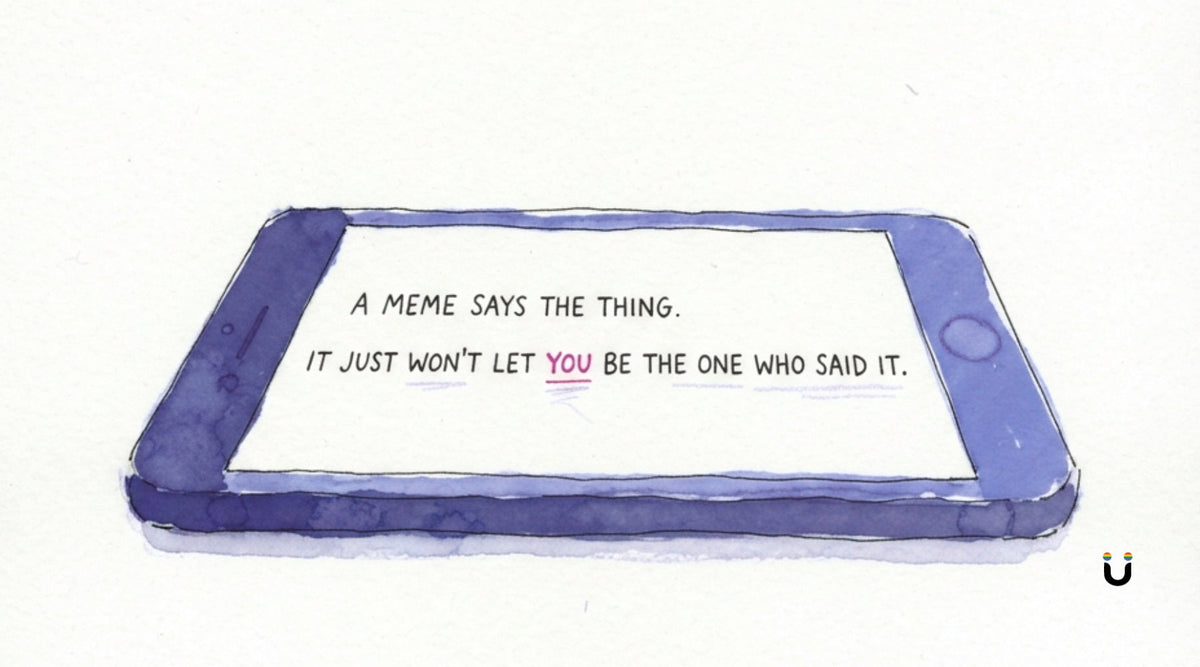
Because a joke carries the feeling and lets you step back if it lands badly. A meme says the thing without making you the person who said it.
Is it unhealthy to use memes to express emotions?
No. Sending a meme is a normal way to reach someone. It is worth a second look when it is the only way a feeling ever gets said.
How do I stop hiding my feelings behind jokes?
Start with one plain sentence under the meme: "this is how my week actually is." The joke can stay. It just stops working alone.