Somebody in your leadership team has read about psychological safety and asked HR to measure it. A search returns a list of seven statements, copied across dozens of sites, usually with no source and no instructions. Before you paste them into a form and send them to four hundred people, there are some things worth knowing.
Psychological safety is measured with seven items from Amy Edmondson's 1999 study, which defined it as a shared belief that a team is safe for interpersonal risk taking. The items concern admitting mistakes, asking for help, raising difficult problems, and being different. The scale carries no published thresholds.
That last sentence is the one that causes the most trouble.
Where Does the Standard Measure Come From?
A single paper, and one that was not written to give employers a dashboard. Amy Edmondson published Psychological Safety and Learning Behavior in Work Teams in Administrative Science Quarterly in 1999. She was studying manufacturing teams and testing whether a team's shared sense of safety predicted its learning behaviour and performance. The seven items were built to test that relationship in research, not to grade a department.
Her definition is the load bearing part, and the important word in it is shared. Psychological safety in this tradition is a property of a group, not a trait of a person. Two people on the same team should give similar answers, because they are describing the same climate. If they do not, that divergence is itself the finding.
The idea did not start with her. Schein and Bennis used the term in 1965, and Kahn's 1990 work on engagement described something close to it at the individual level. Edmondson's contribution was making it a team level construct you could measure.
What Do the Seven Items Actually Ask About?
Four kinds of interpersonal risk, which is a more useful way to hold them than as a list of statements.
The risk of being wrong. Whether a mistake here becomes a thing people remember about you. This is the item that separates teams who surface problems early from teams who conceal them until they become expensive.
The risk of not knowing. Whether it is difficult to ask people on this team for help. In hierarchical settings this is often the lowest scoring area and the least discussed.
The risk of raising something hard. Whether members can bring up problems and tough issues, and whether taking that risk is safe.
The risk of being different. Whether people get rejected for being unlike the group, whether anyone would deliberately undermine your work, and whether your particular skills are actually valued and used.
We are not reprinting the seven statements here, and the reason is worth stating because it affects you too. That comes further down.
The scale asks whether it is safe to be wrong, safe to not know, safe to say the difficult thing, and safe to be different. Four questions any Indian manager could answer about their own team without a survey at all.
Why Can't You Compare Your Score Against Another Company's?
Because there is no agreed scoring convention, and the same instrument gets administered differently everywhere. A 2025 systematic review of psychological safety in software workplaces examined twenty eight studies. Fifteen used Edmondson's scale. Of those, nine used the original seven items, and the response scales ran from one to five in some studies and one to seven in others. Three studies rewrote the items to fit their context.
A score of 4.2 therefore means one thing on a five point scale and something quite different on a seven point scale. Any benchmark you are shown should come with the response format attached, and most do not.
The absence of thresholds gets filled in locally. The University of South Carolina's HR office, for instance, publishes an assessment sheet informed by the scale with its own interpretation bands: high above 4.0, moderate around 3.0 to 3.9, low below 3.0. That is a reasonable working convention and it is theirs, not Edmondson's. Different organisations invent different bands, which is the clearest evidence that the original does not supply any.
The review also flags something directly relevant here. Among its noted concerns about the instrument are cultural interpretations of the items and the influence of context on how safety is perceived and measured. Edmondson and Lei had already argued in 2014 that psychological safety is context specific and that caution is needed when generalising across settings. An item about being rejected for being different does not carry identical weight in a Bengaluru product team and a Boston manufacturing plant.
Do You Need Permission to Use the Scale?
Probably, and this is the part almost nobody publishes.
The seven items sit inside a copyrighted journal article. They are not released under an open licence. That makes them different from the WHO-5 Well-Being Index, which the World Health Organization publishes openly under a Creative Commons licence and actively wants disseminated. Academic researchers using Edmondson's scale routinely record having obtained her permission.
Edmondson also has her own commercial route. Her site points people to the Fearless Organization Scan, a separate instrument built with her, sold with certified practitioners and a global benchmark. So the free items circulating on the internet and the paid product she endorses are two different things, and anyone building a commercial service on the former should think about the latter.
This is why you will not find the seven statements reproduced on this page. We sell workplace mental health services. Reprinting another researcher's instrument on a commercial site, when she has her own licensed product measuring the same thing, is not a position we want to be in. If you want the items, read the 1999 paper or her 2018 book, and if you plan to use them at scale, write and ask.
What Does the Research Actually Support?
More than the sceptics allow and less than the vendor decks claim.
Frazier and colleagues published a meta analytic review in Personnel Psychology in 2017. As summarised in the systematic review above, the strongest associations with psychological safety were task interdependence and peer support, and the outcomes most strongly linked to it were information sharing and learning behaviours. Note what is not at the top of that list. Revenue, retention and innovation appear in vendor material far more prominently than the evidence supports.
The honest caveat is bigger than that, though. The systematic review found that most studies in its field relied on single source data, meaning the same people rated both psychological safety and the outcome. It says plainly that this can inflate the observed relationships and weaken any causal claim, and that it found no studies using multiple sources. It also found no longitudinal studies, so how psychological safety moves over time in real teams is largely unmeasured.
Which means: measure it, take it seriously, and stop short of telling your board that a 0.4 improvement caused anything.
What Has to Be True Before You Send the Survey Out?
Three conditions, and the first one is not administrative.
Leadership has to decide in advance how it will receive a bad result. A leadership team that punishes a low score has demonstrated the low score. This has to be said out loud before anyone answers anything, because the survey is not a neutral instrument. Asking people whether it is safe to speak is itself an act of speaking.
Report at team level, never at individual level, with a floor on group size. Psychological safety is a team property, so an organisation wide average is close to meaningless: it hides the two teams that are in trouble inside a comfortable middle. Report per team, use a minimum of about eight respondents, and combine anything smaller. We have set out how to run that kind of measurement honestly, and the same rules apply. Because you will be handling data about how people feel at work, read our note on what an employer can and cannot see first.
Have somewhere for the result to go. A red team contains real people. If your plan ends at a heat map, you have collected distress and filed it. The psychosocial hazards that produce low scores are workload, role ambiguity, unfairness and how mistakes are handled, all of which sit in the territory ISO 45003 describes and none of which are fixed by a benefit.
The four risks the scale asks about are not mysterious. Any manager who has watched a junior colleague go silent in a review already knows the answer for their own team. The survey's real function is to make that knowledge discussable, in a room where the culture currently prevents anyone from saying it. If the room is not ready for that conversation, the number will not create it.
What Else Do People Ask About Measuring Psychological Safety?
What are the psychological safety survey questions?
The standard measure is a set of seven items from Edmondson (1999), published in Administrative Science Quarterly. They cover four kinds of interpersonal risk: whether mistakes are held against people, whether it is difficult to ask colleagues for help, whether difficult problems can be raised, and whether people are penalised for being different. The items sit inside a copyrighted article and are not released under an open licence.
What is a good psychological safety score?
There is no established answer. Edmondson's scale does not carry published cut off points, and organisations that use it invent their own bands. Scores are also not comparable across organisations, because studies administer the same items on five point and seven point response scales. Compare a team against its own earlier score rather than against anyone else's.
Can you measure psychological safety across a whole organisation?
You can average it, but the average is close to useless. Psychological safety is defined as a shared belief held within a team, so it varies by team and by manager. An organisation wide figure hides the specific teams where people cannot speak. Report per team with a minimum group size of around eight respondents.
Do you need permission to use Edmondson's psychological safety scale?
For research and commercial use, seek permission. The items are published inside a copyrighted 1999 journal article rather than under an open licence, and academic studies using the scale commonly record obtaining the author's permission. Edmondson separately endorses the Fearless Organization Scan, a licensed commercial instrument, which is worth knowing if you intend to build a paid service on the measurement.
Is psychological safety the same as trust?
No. Trust is generally about whether you can rely on a specific person. Psychological safety is a belief about the group climate, held collectively, concerning whether taking an interpersonal risk in that group is safe. Edmondson distinguished it from team cohesion for a similar reason: a cohesive team can also be one where nobody wants to disturb the harmony by raising a problem.
A note on the cover image
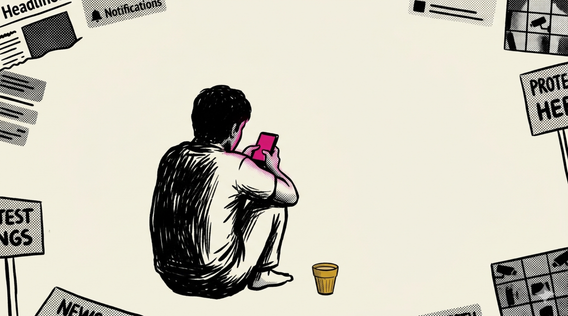
The image at the top of this piece was generated by AI, to a brief written by us. It is not a photograph and does not depict a real person or place.
Sources
Edmondson, A. C. (1999). Psychological Safety and Learning Behavior in Work Teams. Administrative Science Quarterly, 44(2), 350-383. DOI 10.2307/2666999. Paywalled; the DOI blocked automated access at the time of writing.
Santana, B., Monte, L., Santana de Araújo Silva, B., Carneiro, G., Freire, S., Macedo Santos, J. A., & Mendonça, M. (2025). Psychological Safety in Software Workplaces: A Systematic Literature Review. Preprint submitted to Information and Software Technology. 28 studies reviewed. Full text
Frazier, M. L., Fainshmidt, S., Klinger, R. L., Pezeshkan, A., & Vracheva, V. (2017). Psychological safety: A meta-analytic review and extension. Personnel Psychology, 70, 113-165. Relied on here via the summary in the systematic review above rather than read directly.
University of South Carolina, Office of Organizational and Professional Development. Psychological Safety Assessment and Action Framework, informed by Edmondson's scale. Assessment sheet
The Fearless Organization Scan, the licensed commercial instrument built with Amy Edmondson. fearlessorganizationscan.com and Amy C. Edmondson's site