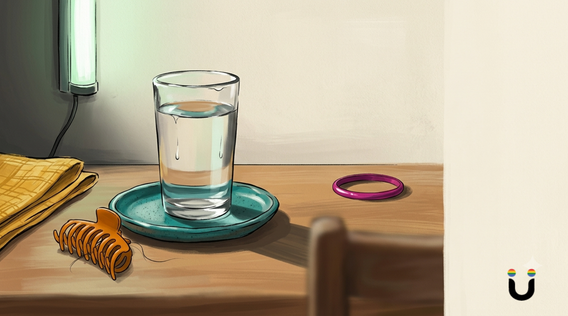

Image Source: AI Generated
You practise the sentence in the car. You have been too ashamed to tell your therapist the truth for weeks now, and today, finally, you are going to say it. You have even worked out how you will start. Then you walk in, you sit down, she asks how your week has been, and out of your mouth comes: fine. Bit tired. Work has been a lot.
Everyone in therapy is holding at least one thing back. Sometimes it is nothing much. Sometimes it is the entire reason they came, the thing they will circle for a year and never quite land on. And sometimes it is not a memory or a feeling at all. It is a whole life you are living right now, this week, that you cannot make yourself describe to the one person you are paying to listen.
Aditi (name changed; shared with consent) is 34, married, and has spent the last year in love with a man who is married to someone else. She is, in the phrase nobody uses to their own face, the other woman. She is also, let us not forget, somebody's wife. She has been seeing a therapist she genuinely likes for over a year. She has never once brought him up.
"You can spend a whole year in therapy building a very convincing life with a hole cut out of the middle."
Why is the truth you most need to say the one you can't?
Because the secret is exactly as big as the fear of saying it. Holding back from your therapist is so common it is almost the house rule. Two clinical psychologists, Matt Blanchard and Barry Farber, ran a study in 2015 and found that around 93 percent of clients had lied to or withheld from their therapist, and most of them said it never once got named in the room.
Which is strange when you stop and look at it properly. You find the therapist. You fill in the forms, you clear the fee, you show up week after week, and then you leave the one thing you came for locked in the boot of the car. Not because you are foolish. Because it feels dangerous. The mind treats the shameful thing as if it were radioactive, and it will let you discuss your sleep, your mother, your manager, anything at all, for months, before it lets that near daylight.
Aditi could talk about her insomnia. Her snappiness with her husband. That flat, grey feeling she could not account for. She just could not say where it was coming from. So she did months of good, earnest work on the symptoms of a wound she refused to name.
Is it guilt you're feeling, or is it shame?
These two get muddled constantly, and the difference decides whether you can open your mouth at all. June Tangney and Brené Brown put it plainly. Guilt says, I did something bad. Shame says, I am bad. Guilt is about a thing you did, so you can set it on the table and look at it together. Shame is a ruling on the whole of you, and every instinct it carries is to hide, because being seen is the danger itself.
It is why you can hand over your anxiety but not this. Anxiety feels like something that happened to you. An affair feels like evidence of what you are. And for Aditi, the sentence that stuck was never really I am having an affair. It was the smaller one sitting underneath it: and that must mean this is simply who I am. Guilt would have let her talk about the choices she was making. Shame told her the choices were her, all of her, and that the warmth in that room would curdle the second her therapist knew. So she said nothing, week after week, and paid for the silence in every session.
Why does an affair carry a different weight in an Indian marriage?
Because here, a marriage was never just a private matter between two people. It belongs to the parents, the in-laws, the cousins, the aunties with opinions. Step outside it and you are not only breaking a promise to your husband. You are breaking something half the family already considers partly theirs.
Most of us grew up on one very particular picture of the good wife. The pativrata. The Sita, the Sati-Savitri, the woman whose entire worth is measured by how completely she folds into her husband's life and wants nothing of her own. You can have a career and a therapist and strong opinions about all of it, and that picture still sits somewhere under the ribs, deciding in advance who you are allowed to be. It turns a private choice into a referendum on your family's honour.
The law, for whatever it is worth, already moved on. In September 2018 the Supreme Court struck down Section 497, and adultery stopped being a crime in India. The statute let go. The shame did not. It was older than the law and it has comfortably outlasted it. This is also, as it happens, why the person on the receiving end of an affair carries such a specific injury of their own; if that is the chair you find yourself in, this piece on why betrayal lands as genuine psychological trauma is about exactly that.
What if the guilt is telling you something true?
Most writing on affairs picks a lane. It either wags a finger at you in the voice of a stranger who has already decided, or it pats your hand and tells you the affair does not define you and you really should release the guilt and be gentle with yourself. I am not going to do either, because both are just ways of skipping the difficult part.
So, the difficult part. The guilt might be right. You may in fact be living against your own values, and that ache is not a glitch to be soothed off. It is a signal. In the acceptance and commitment work I am trained in, that specific discomfort tends to point straight at the thing you care about most. Numbing it does not make you free. It keeps you exactly where you are, with the bonus of feeling less.
So the guilt is not the enemy here. The shame is. Guilt says, I have done something that matters and I need to look at it. Shame says, I am past saving, so I had better keep this to myself. You can work with the first. The second just leaves you alone in the boot of the car with all of it. And a therapist can hold the whole tangle, including the part where you do not know what you are going to do and do not get to feel clean while you work it out. That is not therapy fixing it for you. It is the thing that has to come first. It is, as another TTC therapist writes, the moment shame gets named instead of hidden, and something in you finally lets out a breath.
So what happens if you finally say it out loud?
Not the thing you are bracing for. The relief people describe almost never has to do with being forgiven, because a good therapist is not going to hand you a verdict either way. What changes is stranger than that. You stop doing therapy around the hole. The person you have been paying to help you can finally work with the real thing, instead of the decoy you slide across the table every week.
Aditi told hers eventually. Not in some cinematic confession, just one flat sentence with her eyes on the carpet, braced for the temperature in the room to drop. It did not. Her therapist did not flinch, did not sentence her, did not tell her what to do. She asked one question, how long Aditi had been carrying this on her own, and Aditi cried in a way she had not managed in a year. Nothing got solved that afternoon. She was still married. He was still married. The situation was exactly as complicated at six as it had been at five. She simply was not the only one holding it anymore. There is a reason so much of the weight shifts the instant one other person knows; this reflection on how isolating guilt and shame become, and why being witnessed loosens them, gets at it well.
You do not go to therapy to be told you are a good person. You go so that the truest thing about your life can finally sit in the room with you, instead of waiting out in the car while you talk about your sleep.
Frequently Asked Questions
Is it normal to hide things from your therapist?
Yes. Research suggests the large majority of clients withhold or edit the truth at some point, usually out of shame rather than dishonesty. It does not mean therapy is failing. More often it means the withheld thing is the important one, and naming it is where the real work begins.
Will my therapist judge me for having an affair?
A trained therapist's job is to understand you, not to sentence you. They have almost certainly sat with infidelity many times before. Their attention is on what the situation is doing to you and to your ability to choose, not on whether you qualify as a good person.
Should I tell my therapist about an affair if I'm still in it?
Yes, and you can bring it in completely unresolved. You do not need to have ended it, decided anything, or feel ready. Therapy is one of the few spaces designed to hold a situation while you are still living inside it, without demanding you clean it up first.