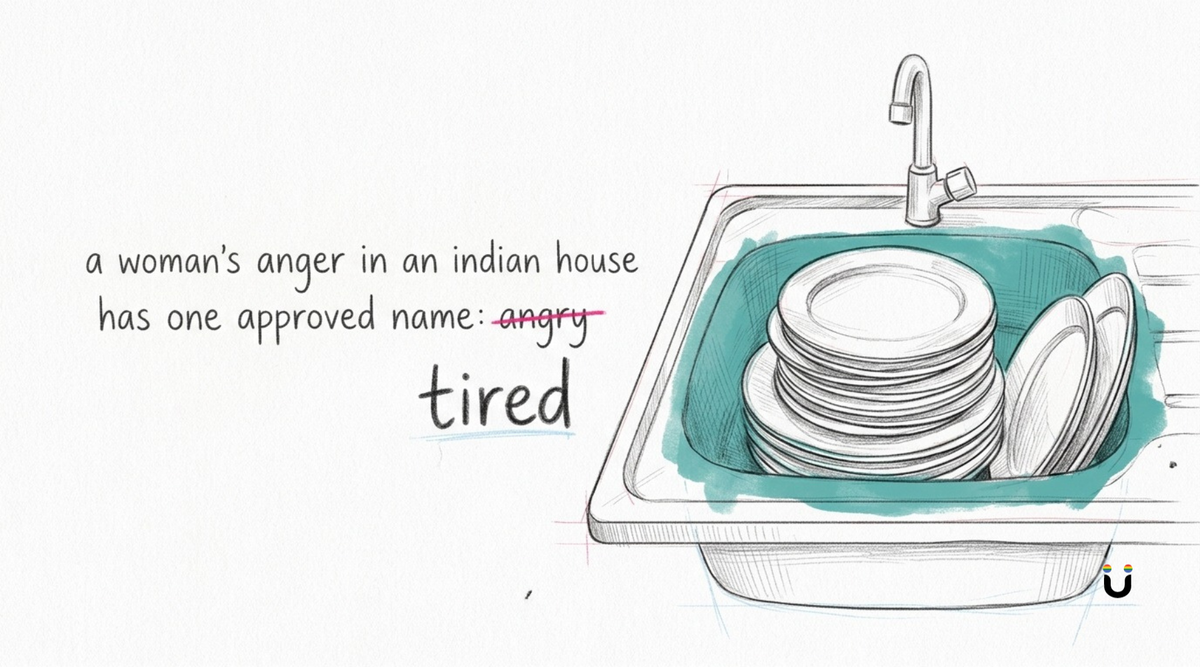
The plates come faster than anyone can keep up with. Riya scrapes, stacks, wipes the counter, scrapes again. Behind her, through the window, the rest of the house sits out under the fairy lights, laughing at something someone's husband said. In here it's her and three other women and a tap that won't run hot.
She used to dread this before it even started. Not in a way anyone could see. She shows up on time. She hugs everyone. She asks about the kids, the knees, the board exams. But a few days before every gathering a low hum starts in her chest, and by the time the doorbell goes she's already somewhere else, thinking about the inbox, the Monday deadline, anything but the room she's standing in.
The other women don't seem to carry this. Her mother, her aunts, her cousins are dressed early and happy about it, genuinely happy, laughing in the kitchen like the kitchen is the party. Riya stands among them wondering what's wrong with her. Why can't she just enjoy it like they do?
By the time the last dish is done her feet hurt and her lower back has locked from bending over the sink. She goes out, lowers herself into a chair, relieved to finally sit. And then can't follow a word of it. Too tired to laugh on cue. Too tired to add anything. She's there and not there.
Then, out of nowhere, she wants to cry.
She doesn't. She sits with it, confused by it. Why does this feel so wrong when everyone else is fine? Am I making a big deal out of nothing?
That night she tries to tell her mother. Not a scene, not an accusation. Just that she was on her feet all evening while the rest of them enjoyed the party. That it felt unfair. That some part of her is angry about it.
Her mother answers before Riya has finished the sentence. "You're irritated because you're tired. Don't make a fuss, you'll spoil the mood. Go and rest."
That's it. Conversation closed.
Riya didn't have the words to push back that night. She's not sure she has them now. But something settled in her anyway, and it wasn't peace, it was closer to giving up. She understood, without anyone having to say it, that her anger was not welcome in this house. That she was allowed to be tired. Not allowed to be upset. That saying the true thing out loud would only make her the problem in the room.
She's carried it for years. Every gathering, she's in the kitchen. Every time someone asks afterward if she's okay, she gives them the sentence her mother handed her.
"I'm just tired."
This is the bit that gets tricky about "I'm just tired." It's true.
Riya was tired. Her back did hurt. The sentence is accurate, and that's exactly what makes it so useful. You can hand it to anyone at the door and they'll take it and go, and nobody has to find out what was underneath. It's the most polite lock ever made.
I have my own version. Mine is "it's fine, I'm just a bit low," which I've said at roughly four hundred family functions, two funerals, and once to a dentist who had only asked me to open wider. It works every time. That's the problem with it.
You know the feeling, even if yours lives somewhere other than a kitchen. A manager who talked over you. A partner who made you smaller. A friend who took, and took. Something sharp and real moved through you, and instead of saying it you heard yourself explaining it away. Or maybe you never even had the moment. Maybe you just watched a woman in your house say "I'm fine" one time too many, and learned young what you do with the sharp thing: you don't say it. You rename it.
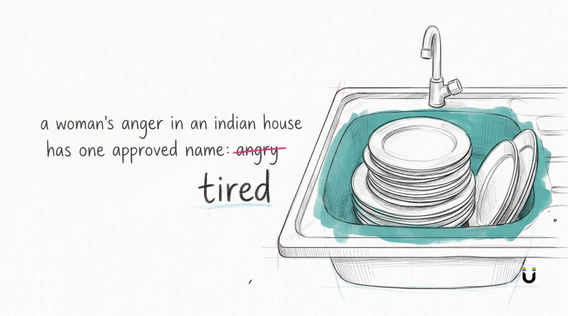
Because anger, when you're a woman in an Indian house, is not something you have. It's something you cause. You get angry and suddenly the mood is spoiled, the evening is ruined, your mother's face has done the thing. So you learn to move it somewhere it won't show. Into your shoulders. Into a Monday deadline. Into a plate you scrape a little harder than it needs.
It goes by exhaustion. It goes by guilt for having felt anything at all. It goes by a headache that arrives on schedule. It will answer to every name except its own.
So what do you actually do with it?
I would love to end on the sentence that fixes this. I don't have it. Nobody's mother is going to read this and stand up from the dining table and say sorry beta, you were right. That's not how any house I know works.
But there's a smaller thing, almost nothing really, and it's where most people start. The next time the word "tired" is halfway out of your mouth, notice it. Don't correct it. Don't announce it. Don't, whatever you do, make a speech about it in the kitchen. Just clock, privately, that this is the moment you renamed something.
You don't have to say the real word to anyone. Not yet.
You only have to stop lying to the one person still doing the dishes.
Riya is a composite. Details have been changed.