Why Do I Take On My Colleague's Work When They Leave
Priyanka Varma, psychologist, The Thought Co. · 3 min read
Because the work has to land somewhere, and you are the person it lands on. The name for it is overfunctioning: doing more than your share so the system keeps running.
This week HRKatha wrote about jobs growing in place. A colleague leaves, the seat stays empty, the work does not wait. A Korn Ferry survey of more than 16,000 professionals, cited there, found 61% now do the work of more than one role.
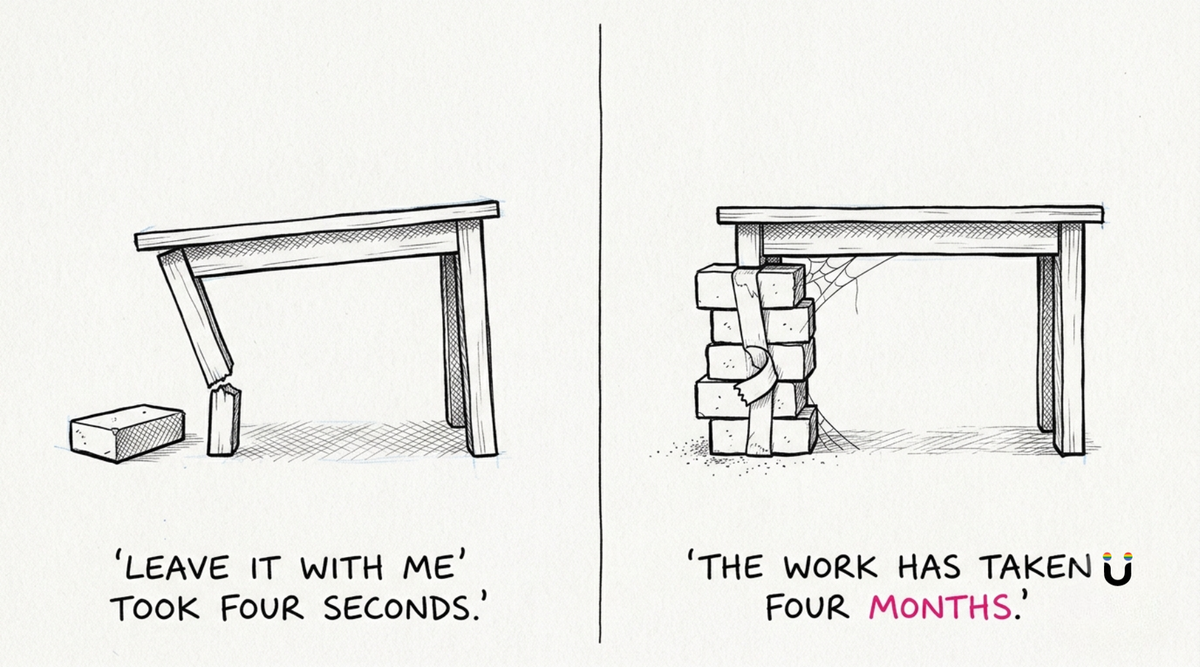
So you said "leave it with me" in the corridor, before anyone asked. It was meant to be two weeks. It is now month four, with no new title, no new grade, and a thumbs up in the team group as the thank you. You keep it private because complaining sounds like you cannot cope, and at home the only question is "office kaisa chal raha hai?"
Murray Bowen, the family systems psychiatrist, described overfunctioning in families in the 1970s. One person steps up, so another does not have to. The pattern holds because it works. You are the load bearing wall nobody put on the plan.
You do not owe anyone a heroic version of yourself. You notice the gap first, so you fill it first. That is a habit of attention, and it can be looked at without being answered tonight.
There is a two minute tool we made for sorting a week into what is yours and what is not. It asks nothing of you.
Free. Nothing gets saved.
People also ask
Is it normal to take on a colleague's work after they quit?
Yes. It is a common pattern, and it usually starts with an offer made in the moment, not an order.
Why can't I say no to extra work at the office?
Often because you notice the gap before anyone else does, and filling it feels faster than discussing it. Saying no gets easier once the work has been named as someone else's first.
Is it fair to be asked to do a resigned colleague's work?
I cannot tell you what is fair at your company. Temporary cover tends to become permanent when nobody names an end date, and asking for one is a reasonable first move.
Why do I feel guilty when I rest Why do I feel guilty I didn't get laid off All the check-in games, free
Source for this week's trigger: The two job job is becoming the new normal, HRKatha, 4 October 2026.
If tonight feels bigger than a heavy workload, this page is not the thing you need. Talk to a person.
A game and a blog are not a replacement for therapy or crisis care.
This piece was edited with AI assistance, and the accompanying image was AI-generated.