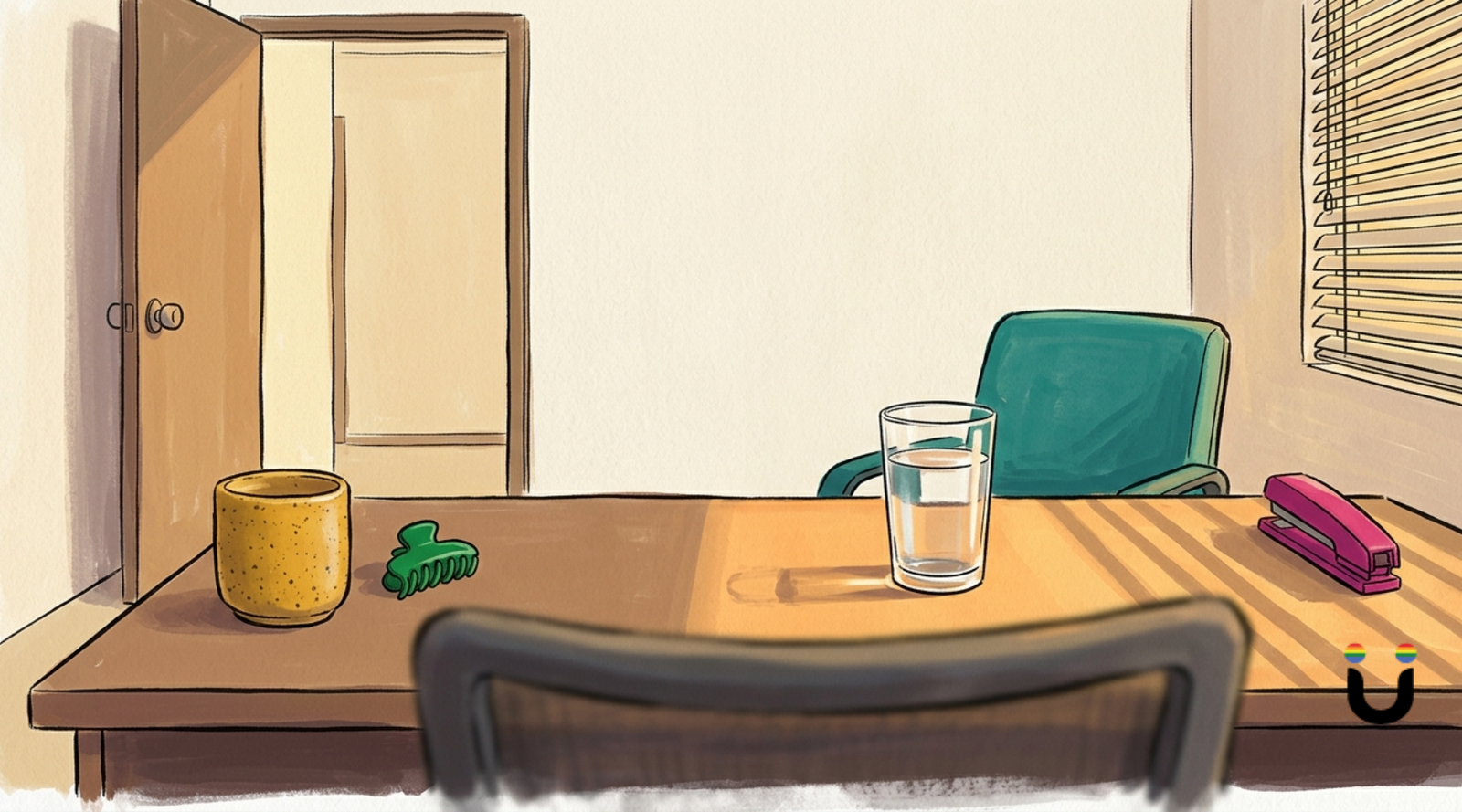
The change is rarely dramatic. Someone who used to argue in sprint reviews starts saying "sounds good." The camera stays off. Leave comes in as scattered single days with no plan attached. Most managers in India notice this weeks before they say anything, because nobody taught them how to talk to an employee about mental health, and the fear of saying the wrong thing wins by default. So the most common management response to a struggling team member in this country is silence. Concerned, well intentioned, watching silence.
To talk to an employee about mental health, find a private moment, name what you have noticed without interpreting it, ask an open question, and listen without fixing. A manager's role is to notice, care, and refer to professional support. Diagnosis and ongoing monitoring belong to professionals, never to managers.
That is the whole method. The rest of this piece is what it looks like in an actual Indian workplace, with actual sentences, because "check in with empathy" is advice nobody can act on at 4pm on a Tuesday with a team member who has stopped making eye contact.
What does "notice, care, refer" actually ask of a manager?
Notice, care, refer is a boundary as much as a method. You notice a change in someone's behaviour at work. You care enough to name it privately and ask about it. You refer them toward professional support if they need more than a conversation. That is the entire lane. A manager who stays inside it can genuinely help. A manager who drifts outside it, into diagnosing, counselling, or keeping watch, usually makes things worse while exhausting themselves.
The WHO's 2022 guidelines on mental health at work recommend training managers for exactly this, and estimate that 15% of working age adults live with a mental disorder at any point in time. Take a team of twenty. The question was never whether this conversation would land on your desk. It was when.
How do you notice someone is struggling without playing psychologist?
You notice by tracking change from that person's own baseline, in observable work behaviour. Not moods you infer. Things you can see. Missed deadlines from someone who never missed them. Withdrawal from discussions they used to lead. Irritability in someone patient. Visible exhaustion. The Friday resignation joke that repeats a little too often.
The baseline matters more than the behaviour. A team member who has always been reserved is not a concern because they are reserved this week too. The person to pay attention to is the one who is different. In Indian workplaces, where asking for help is still read by many as weakness, changed behaviour is often the only signal you will ever get. Very few people will walk into your cabin and announce they are not okay. Almost everyone will show you first.
Notice is also where your interpretation has to stop. "Rohan has missed three deadlines" is an observation. "Rohan is depressed" is a diagnosis, and you are not qualified to make it. Neither am I allowed to make it from a paragraph of behaviour, and I do this for a living.
What do you actually say to open the conversation?
Open with the specific thing you noticed, then an open question, in private, with time. The structure is: observation, question, silence.
"I've noticed you've been logging off past midnight most days this month, and you seemed flat in Monday's review. That's not like you. How are you doing, really?"
"You've stopped speaking up in meetings the last few weeks. I might be reading it wrong. But I wanted to ask rather than assume. Is everything okay, at work or outside it?"
Notice what these sentences do. They name evidence, so the person knows this is not a random ambush. They admit you could be wrong, which lowers the stakes of the answer. And they end with a question that cannot be closed with one word. Then you stop talking. The silence after the question is the hardest part of the entire conversation, and it is where most of the work happens.
Do this in a one on one you already have scheduled, or ask for ten minutes and go somewhere without glass walls. Never in front of the team. Never on a group call. Never over text, where "are you okay?" reads as an HR summons.
Why does "sab theek ho jayega" make things worse?
"Sab theek ho jayega" makes things worse because it ends the conversation the moment it starts. It is the most common response in Indian offices to any disclosure of struggle, and it means well every single time. It is what our parents said to us. But listen to what it actually communicates: your problem is not big enough to discuss, the discussion is now over, and the socially correct move is to smile and agree that yes, everything will be fine.
Its cousins do the same job. "Don't take tension." "Be positive." "Have you tried yoga?" "Chalta hai, happens to everyone." Each one is a door closing gently. The person walks out of your cabin having learned that they tried to say something true and got handed a proverb.
A manager who notices and says nothing teaches the whole team that struggling is something you hide. A manager who notices and hands out reassurance teaches them it is something you hide better.
The replacement is smaller and harder: "That sounds difficult. I'm glad you told me. Tell me more?" No solving. No silver lining. Reassurance can come later, and only after the person has actually finished speaking.
What if they cry, deflect, or say they're fine?
If they cry, stay. Do not retract the question, do not apologise for asking, do not fill the room with words. Pass the water, wait, and when they settle, say "take your time." Tears in a workplace conversation feel like an emergency to the manager and usually feel like relief to the person crying. You have not broken anything. Something that was already full has finally been allowed to spill.
If they deflect, accept it and leave the door visibly open. "Fair enough. I just wanted you to know I'd noticed, and that this conversation is available whenever you want it." Then actually let it go. Pressing past a deflection turns care into interrogation. Many people say no the first time and yes the third, once they have watched you take the no gracefully.
And if they say they're fine, believe them provisionally. You asked. They heard it. That is not a failed conversation. Check in again in two weeks, on the behaviour, not the feeling: "the workload we talked about, how is it sitting now?"
What if they tell you something serious?
If someone discloses something serious, your job compresses to one question: is this person in immediate danger, yes or no. That is the only assessment a manager ever makes. Not how severe it is, not what condition it might be, not whether they seem like the type. Danger now, or not.
If yes, or if you are unsure, treat it as yes. Stay with them. Do not leave them alone, and do not put them in charge of getting their own help later. Call emergency services on 112, or Tele MANAS, the government's free 24x7 mental health helpline, on 14416, while you are still with them. Erring on the side of caution costs an awkward afternoon. Erring the other way can be irreversible.
If no, thank them for trusting you, and be honest about what happens next rather than promising perfect secrecy. "I won't be discussing this with the team. If I ever think your safety needs someone else involved, I'll tell you first." Then connect them to the professional route your company has: the EAP, or a therapist, and offer the practical help that actually gets people there. Time off for a first appointment moves someone toward help faster than any amount of encouragement.
Where does the manager's job end?
The manager's job ends where clinical work begins: at diagnosis, at counselling, and at monitoring. You are not their therapist, and trying to be one is not generosity. It hands a struggling person an untrained clinician and hands you a weight you cannot carry. The same goes for keeping watch. Checking in occasionally is care. Tracking someone's moods week to week is surveillance, and they will feel it.
The law backs the boundary. India's Mental Healthcare Act, 2017 gives every person with mental illness a right to non-discrimination under Section 21 and a right to confidentiality under Section 23. What someone tells you in that cabin is not material for the promotion discussion, the staffing call, or the corridor. Founders and managers in small Indian companies get this wrong most often, because in a thirty person team everyone knows everything. Which is precisely why the one person who holds a disclosure and does not pass it on becomes the most trusted person in the building.
Here is the part no training slide will tell you. You can do all of this correctly, word for word, and nothing visible may change. They may decline help. They may keep struggling in front of you for months. The conversation is not a lever that moves a person somewhere better. It is a door. Whether they walk through it is theirs to decide, and watching someone not walk through a door you opened is its own specific ache. Managers deserve to know that going in.
What the conversation does change, every time, is what your team knows about you. That struggling near you is speakable. In most Indian offices, that is still rare enough to be remembered for years.
What else do managers ask about these conversations?
Can a manager ask an employee if they are okay mentally?
Yes. A manager can and should ask, privately, based on observed changes in work behaviour. Name what you noticed, ask an open question, and listen. What a manager cannot do is diagnose, counsel, or require an employee to disclose anything about their health.
What should a manager never say to a struggling employee?
Avoid dismissals dressed as comfort: "sab theek ho jayega," "don't take tension," "be positive," "others have it worse." Avoid amateur diagnosis ("sounds like depression") and avoid making support conditional on performance. Each of these ends the disclosure and teaches the person not to try again.
What if the employee refuses help?
Accept the refusal, keep the door open, and keep managing the work with normal fairness. Adults are allowed to decline support. Revisit the conversation after a few weeks if the behaviour you noticed continues. If they ever indicate immediate danger to themselves, that is the one situation where you act at once: stay with them and call 112 or Tele MANAS on 14416.
Is an employee's mental health information confidential in India?
Yes. The Mental Healthcare Act, 2017 gives every person a right to confidentiality (Section 23) and to non-discrimination (Section 21). A disclosure made to a manager should not travel to the wider team or into performance decisions. The narrow exception is safety: if someone is in immediate danger, bringing in emergency or professional help is care, and the manager should say so honestly.
Sources: WHO guidelines on mental health at work, World Health Organization, 2022 · The Mental Healthcare Act, 2017 (Act No. 10 of 2017), Government of India, official gazette text · Tele MANAS (helpline 14416), National Mental Health Programme, Directorate General of Health Services, MoHFW, Government of India. Cover image for this article is AI generated.