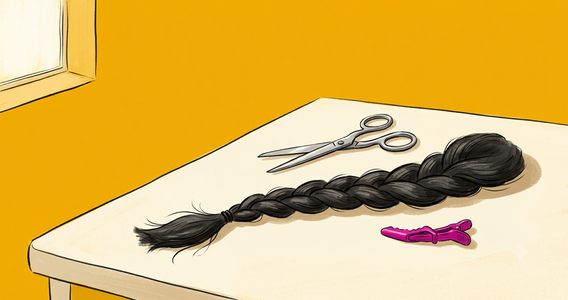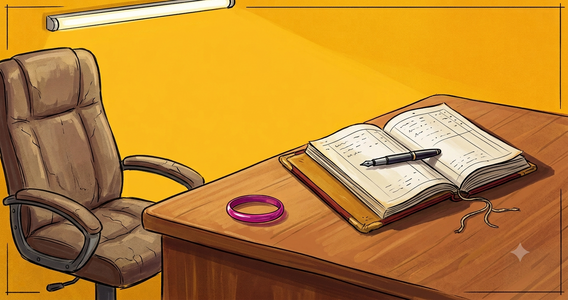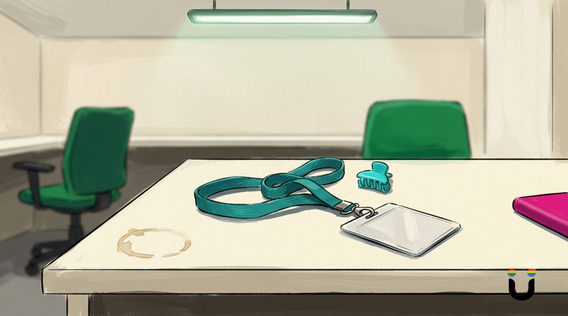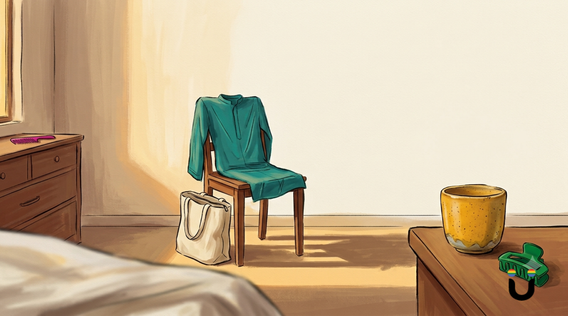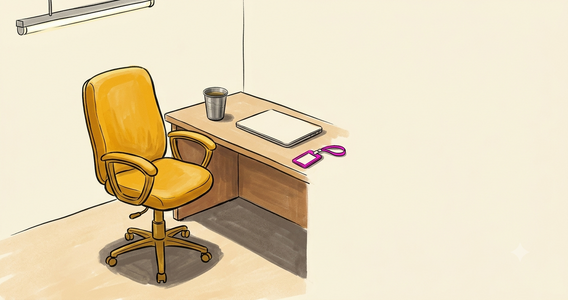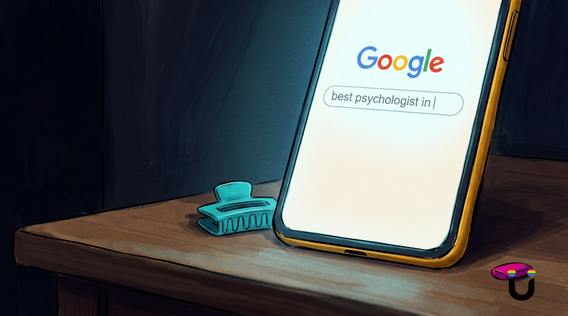
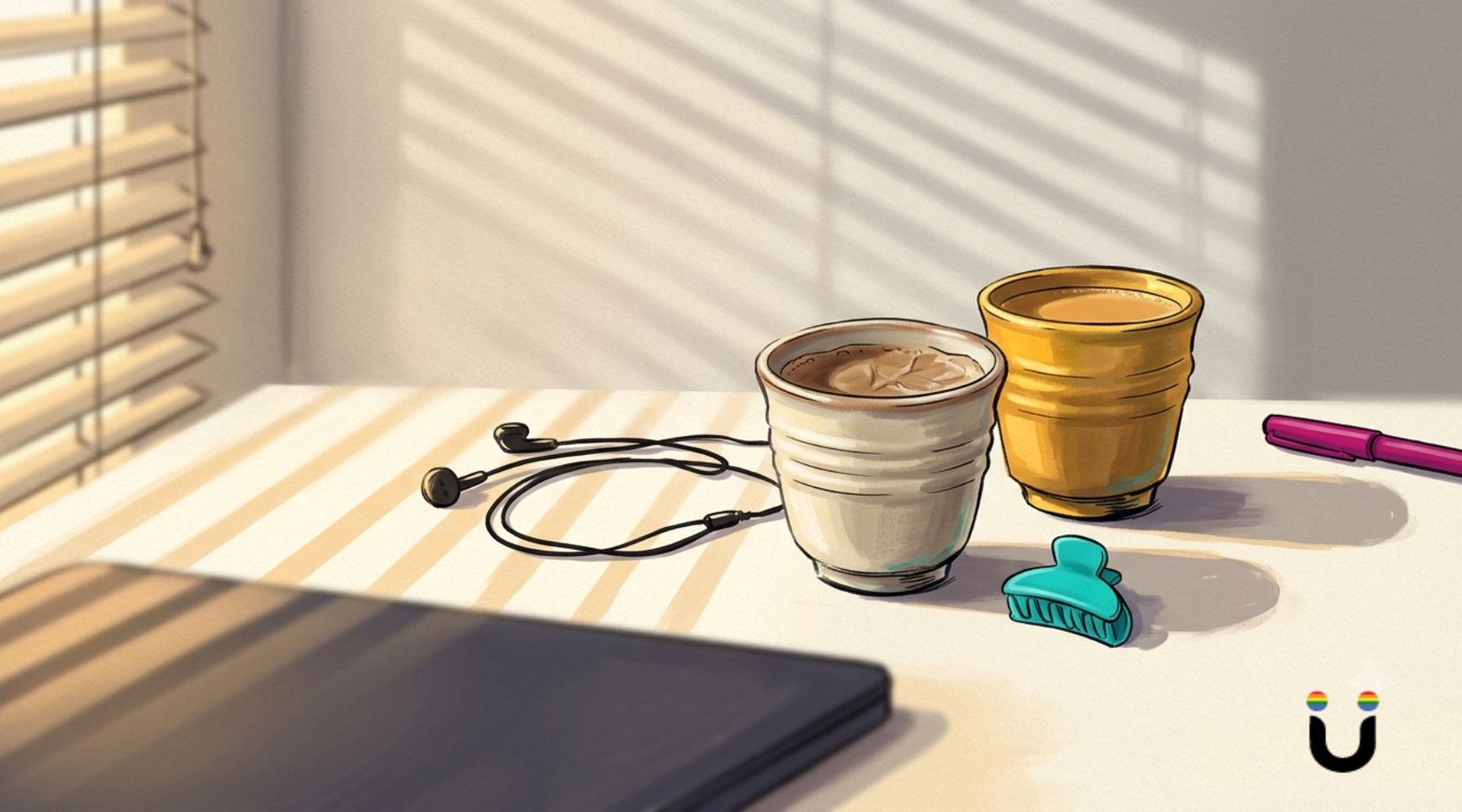
Sana is managing. That is the word her team uses about her, the word she uses about herself, the word that would go in the appraisal notes if anybody wrote any. Until about a month ago she was the loudest person on the office floor, the one who fought with the AC remote and knew everyone's chai order. Now she eats lunch at her desk with her earphones in, and her Slack replies have shrunk to "noted."
To talk to a colleague who is struggling, name what you have noticed in private, without diagnosing them. Say what changed and when. Ask one open question, then listen without rushing to fix anything. If the difficulty continues, point them gently toward professional support and keep treating them normally at work.
That is the short version, and the rest of this piece walks through it with actual words. But stay with "managing" for a moment, because the word is doing more than we give it credit for. It comes from the Italian maneggiare, to handle a horse, from the Latin manus, hand. When we say a colleague is managing, we are saying she has both hands full of something large and alive, and she is keeping it from bolting in public. The question is what you do once you have seen her hands.
How Do You Know a Colleague Is Struggling and Not Just Busy?
You are looking for change, held over time. The person who was never late, drifting in late. Lunch alone where lunch used to be company. A deadline missed by someone whose whole identity was never missing one. Irritability that arrives faster than it used to. Or the opposite, which is easier to miss: flatness. The jokes stop. Capability makes this worse, because the deliverables keep going out on time while the person behind them empties, a pattern we have traced in why high performers burn out first in Indian tech. One bad Tuesday means nothing. Three weeks of a different person is a pattern, and patterns are what you are allowed to name.
Here is why your noticing carries more weight in India than the same noticing would in, say, Copenhagen. The National Mental Health Survey, which sent interviewers into 34,802 households across 12 states, found that roughly one in ten Indian adults was living with a mental health condition at the time of the survey. Of those, 84.5 percent were receiving no treatment at all (Gautham, Gururaj and colleagues, 2020).
Eighty-four and a half percent.
Run that number through an office. The colleague whose change you have been watching has, in all likelihood, told no psychologist, no doctor, and quite possibly no one. The World Health Organization's guidance on mental health at work lists limited support from colleagues among the conditions that make workplaces harmful, and recommends training ordinary workers, on the logic that the person at the next desk is positioned to notice things a system never will. In an Indian office, where the system frequently amounts to a wellness poster near the lift, the person at the next desk is often the entire early detection apparatus. You did not apply for this. You have it anyway.
Why Is It So Hard to Say Anything?
Partly because we were all raised on the same rule: ghar ki baat stays in the ghar. What is private stays private, and distress is filed under private. The office inherits that rule and adds its own clause, which is that anything you disclose can and will be remembered at appraisal time. People are not paranoid to fear this. Plenty of Indian workplaces have earned exactly that fear, and we have written before about what those cultures do to the people inside them.
And partly because of something less flattering. The fear of saying the wrong thing feels like consideration, and it functions as self-protection. Silence is a decision that dresses itself up as tact. An Indian office will reward you for spotting a formatting error on slide 14 and look at you strangely for spotting that a colleague has not laughed in three weeks. We have collectively decided that only one of those counts as being observant. It is the wrong one.
What Do You Actually Say?
Say what you saw. Privately, without a diagnosis attached, and without demanding anything back.
"You've seemed quieter these past couple of weeks. I'm not trying to pry. I just wanted you to know somebody noticed. Chai?"
The words matter less than what they avoid. No label ("are you depressed?" from a coworker lands like being caught). No audience: never on the floor, never in a group channel, never in the two minutes before a review. And no obligation. You are opening a door, and the other person gets to decide whether to walk through it, today or in three weeks or never.
If they do start talking, your only job is to stay. Most of us respond to another person's pain by producing solutions, mainly because a solved problem lets us stop feeling the discomfort of witnessing it. Resist that. "That sounds hard" is a complete sentence. "How long has it been like this?" beats any advice you own. If they cry, let them finish. Indian offices treat tears as an emergency requiring immediate shutdown, when they are usually the sound of someone relieved that the question finally came.
What If They Say They Are Fine?
They probably will. "I'm fine, yaar, bas thoda tired" has ended more of these conversations than any of us could count. Take it gracefully, and leave the door where they can see it.
"Okay, I believe you. The offer doesn't expire, though. If some week you want lunch and zero work talk, I'm around."
Then behave normally. This is the part people get wrong. Having asked once, they begin monitoring, hovering, sending checking-in messages with rising frequency, and the colleague who declined help now also has to manage her manager of concern. The kindest thing after a declined offer is the absence of surveillance. People return to the person who asked once and let it be.
If things keep worsening, or their safety starts to worry you, one conversation with a manager or HR is fair, framed around what you observed rather than what you suspect. Whether that route is safe depends on the office, and you know yours. Their privacy is the default. Risk is the one exception.
When Do You Bring Up Therapy?
When the struggle has outlasted your conversations, or was always bigger than them. A rough fortnight after a breakup is one thing. Weeks of sleeplessness, drinking that has changed, panic before every meeting, talk that has gone hopeless: this is past the point where a caring colleague is enough, and pretending otherwise serves nobody.
In India the word therapy can land as a verdict, so attach it to the load instead of the person.
"You've been carrying this for a while and it sounds exhausting. Talking to someone trained doesn't make it a bigger deal than it is. It means it stops being a thing you handle alone at 2 am."
Then offer a next step, because "you should see someone" without one is a sentiment, and sentiments get shelved. Your company's assistance programme, if one exists and is trusted. A practice you know. If they ask where a person even starts, therapy with a qualified psychologist is the honest first stop for most of what an office surfaces. One boundary worth knowing: if you manage this person, the conversation carries power that changes its shape, and we have a separate guide for managers that takes that seriously.
What If They Mention Wanting to Hurt Themselves?
The fear that keeps people silent here has been studied, and it does not survive the evidence. A review in Psychological Medicine (Dazzi and colleagues, 2014) went through the published research on this question and found no study in which asking someone about suicide increased suicidal thinking. The findings pointed the other way: being asked directly tends to reduce distress. You cannot plant the thought. If it exists, it is already there, and it is heavy, and your question is what makes it shareable.
So if someone hints, ask plainly: "Are you thinking about hurting yourself?" If the answer is yes, or anything near it, stay with them and connect them to trained help the same day. Tele MANAS, the Government of India's free mental health helpline, answers at 14416, round the clock, in more than 20 languages. Do not promise secrecy you cannot keep. Say instead that you will only involve people who can actually help. This is the single situation where their privacy stops being the highest value. Their life is.
What Is the Limit of What You Owe?
A colleague's role has a ceiling. Notice, care, refer, and everything above that ceiling belongs to professionals and to the person themselves. You can do all of it well and they may still refuse help, still deteriorate, still leave, and you will be left holding the particular guilt of the one who saw it coming. That guilt overstates your job. Seeing it coming was the job. Fixing it never was.
We went looking, while writing this, for Indian data on how often a colleague, rather than family, is the first to notice that something is wrong. We could not find any. Nobody appears to have counted, which says something about how invisible this role is, and it also means we cannot tell you how often the conversation above changes an outcome. What the treatment gap data does tell us is that for most struggling Indians, no professional is watching. Somebody informal usually is.
There is a cost to being that somebody, and in Indian offices it lands hardest on women, who get handed the emotional housekeeping along with everything else. You are allowed limits, and setting them is a skill you can practise. "I care about you, and I'm not the right person to hold the weight of this" is a caring sentence even on the days it feels like desertion. If being the one who holds everyone has started to feel less like a role and more like your whole personality, that pattern is worth its own attention, and we have written about why the most capable people often feel the most alone.
Sana's colleague did say something in the end, by the water cooler, clumsily. Sana said she was fine. Two weeks later she asked him whether he knew anyone who did, you know, the therapy thing. She is still managing. The difference is that one person on that floor now knows what the word is holding.
Frequently Asked Questions
What do you say to a coworker who is struggling?
Name the change you noticed, privately and without a label: "You've seemed quieter these past two weeks. I just wanted you to know somebody noticed." Then ask one open question and listen without offering solutions. Care lands through specificity and patience, never through diagnosis or advice.
Should I tell HR or a manager about a colleague's mental health?
Only if the situation keeps worsening or you are worried about their safety, and even then, report what you observed rather than what you suspect. Their privacy is the default. The exception is any risk of harm to themselves or others, where escalating the same day is the right call.
What if my colleague refuses help completely?
Accept it without withdrawing your warmth. Say the offer stands, then treat them normally; surveillance pushes people further in. Adults get to decline support. Your job is to keep the door visibly open, revisit gently if things worsen, and escalate only if their safety is at risk.
Is it okay to ask a colleague directly about suicide?
Yes. A 2014 review in Psychological Medicine found no evidence that asking about suicide increases suicidal thinking; it tends to reduce distress. Ask calmly and directly, stay with them, and connect them the same day to trained help such as Tele MANAS at 14416, free and available round the clock across India.
Sources. World Health Organization, Mental health at work, fact sheet (2024). Gautham M.S., Gururaj G., et al., The National Mental Health Survey of India (2016): Prevalence, socio-demographic correlates and treatment gap of mental morbidity, International Journal of Social Psychiatry, 66(4), 361 to 372 (2020); survey of 34,802 adults across 12 Indian states. Dazzi T., Gribble R., Wessely S., Fear N.T., Does asking about suicide and related behaviours induce suicidal ideation? What is the evidence?, Psychological Medicine, 44(16), 3361 to 3363 (2014). Tele MANAS, Ministry of Health and Family Welfare, Government of India: 14416, free, 24x7. Sana is an illustrative composite, and no client's story appears in this piece. Cover image generated with AI.