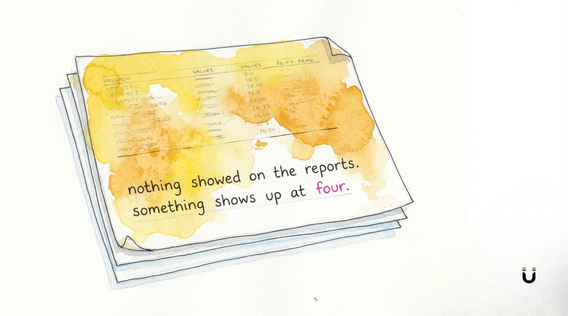

Look at your EAP invoice. It is priced per employee, per year: a clean number multiplied by your headcount, the same maths as your laptop insurance. Now ask what the invoice actually paid for. It did not pay for employees being helped. It paid for employees being allowed to be helped, which is a different product, and the gap between the two is where this industry's business model lives.
Most EAP contracts in India are priced per employee per year, which means companies buy coverage: the right of employees to use a service. Usage is different. With published case level utilisation averaging 4.5%, the real cost per employee actually helped is roughly 22 times the per head price.
Full disclosure: we sell retainers priced this way too. This piece is the argument we make against our own invoice format, because the buyer who understands it becomes the client the whole industry has to get better for.
What does a per head EAP retainer actually buy?
It buys an entitlement, and entitlements are cheap to issue. When a vendor quotes you a per employee per year price, the quote is built on an assumption the deck never states: most of those employees will never call. The largest published study of external EAP vendors, Attridge and colleagues (2013, Journal of Workplace Behavioral Health), covering 82 vendors and over 160 million covered lives, found average case level utilisation of 4.5% of covered employees per year, with a median of 3.6% and about 2.5 sessions per case. Read those numbers the way an accountant would. More than 95 of every 100 seats you bought will go unused in a typical year, and the pricing model knows it.
None of this makes coverage worthless. A safety net has value before anyone falls. But a net is valued by whether it catches people, and the invoice format swaps that question for an easier one: how many people are standing above it.
What is the real cost per employee actually helped?
Divide your retainer by the number of employees who actually opened a case, and the comfortable per head price becomes an uncomfortable per person price. The arithmetic needs no vendor disclosure, only the published averages. At 4.5% utilisation, whatever you pay per covered head, the cost per employee actually helped is that figure divided by 0.045: about 22 times the sticker price. At the median of 3.6%, it is nearer 28 times. A 1,000 person company at average utilisation is buying real help for about 45 people a year and coverage for the other 955, and every rupee of the invoice is described by the second number while being justified by the first.
Run this on your own contract before renewal. Ask your provider for your real utilisation number and its formula, divide, and put the result in the renewal discussion next to the per head price. The conversation changes shape immediately, in your favour.
Why does the market price coverage instead of usage?
Because both sides of the transaction are comfortable, and the discomfort has been outsourced to the one party not in the room. Follow the vendor's economics first. Under a per head retainer, every unused seat is margin: the low usage that should embarrass the industry is, structurally, what funds it. A vendor paid this way has no financial reason to drive utilisation up, whatever the deck says about engagement, and the occasional vendor who counts webinar attendance as "utilisation" is simply putting the unsaid part on a slide.
Now follow the buyer's. An HR team under budget pressure needs the benefits box ticked, the logo on the careers page, the answer ready when the board asks about wellbeing. Coverage delivers all three on day one, before a single session happens. Usage, by contrast, is slow, hard to move, and risks producing a number that looks like failure. So the buyer's incentive lines up with the vendor's: both are better served by a program that exists than by a program that is used. The employee who needed session six of therapy in February is the only person in the arrangement with no seat at the table, which is precisely why whether their manager can even have the first conversation ends up mattering more than the benefit itself.
The unused seat is not the program failing. Under this pricing model, the unused seat is the product.
What would paying for usage look like?
Four contract mechanics, all of them askable today. A utilisation review clause at a defined midpoint, with an agreed remediation plan rather than a shrug. A minimum engagement commitment from the vendor: launch communication, manager training, the things that actually move usage, written into scope rather than sold as add ons. Pricing with a usage linked component, so the vendor's margin improves when more people are helped instead of fewer. And outcome reporting on recognised clinical measures, so the renewal conversation is about whether users got better, with the other eight questions asked alongside. Vendors can structure all of this. Most are simply never asked to, because the per head format has trained buyers to negotiate the multiplier and ignore the denominator.
Where does this argument honestly stop?
Three places, and naming them matters more than winning the point. First, usage is not outcome. A program can be heavily used and clinically mediocre; utilisation tells you people came, and only proper outcome measurement tells you they were helped. Chasing a usage number for its own sake just creates a new number to game. Second, low utilisation is not only vendor design. Stigma does real work here: in workplaces where struggling reads as weakness, employees will not call whatever the contract says, which is why the culture around the program moves usage more than the program does. Third, coverage has genuine option value; the employee who never calls but knows they could is not receiving nothing.
What we keep coming back to is that none of these caveats rescues the pricing model. They just relocate the question. If usage depends on culture, the vendor selling you seats without training your managers is selling you the part that was never going to work alone. If usage is not outcome, then a market that cannot even report usage honestly is two full steps from reporting what matters. The per head invoice survives because nobody at the signing table is the person it fails. Read your own invoice again, and this time ask which number on it describes a human being who got help. There is no such number. That is the finding.
What do buyers ask about EAP pricing?
How is EAP pricing structured in India?
Almost always as a per employee per year retainer: a flat rate multiplied by covered headcount, payable regardless of how many employees use the service. Some providers offer session bundles or usage linked components, but the per head retainer remains the default, and it prices the entitlement rather than the help.
What is the cost per employee actually helped?
Your total retainer divided by unique employees who opened a counselling case. Using the published average utilisation of 4.5% (Attridge et al., 2013), the cost per employee helped is roughly 22 times the per head price; at the 3.6% median it is nearer 28 times. Ask your provider for your own utilisation and run the division before renewal.
Is low EAP utilisation the vendor's fault?
Partly. Per head pricing removes the vendor's financial incentive to drive usage, and thin launch and manager training effort keeps it low. But workplace stigma and culture also suppress usage independently, so the honest answer is shared responsibility: a contract that obliges vendor engagement, and an employer that makes using the program safe.
Does high utilisation mean the EAP is working?
Not by itself. Utilisation shows people came; it does not show they got better. Working means measured improvement on recognised clinical outcome measures among users, reported honestly and without claiming causation the data cannot support. Ask for outcome reporting alongside utilisation, never one as a substitute for the other.
Sources: Attridge, M., Cahill, T., Granberry, S., & Herlihy, P. (2013). The National Behavioral Consortium industry profile of external EAP vendors. Journal of Workplace Behavioral Health, 28(4), 251-324. DOI 10.1080/15555240.2013.845050 (open archive record). The cost multiples above are arithmetic derived from that study's published utilisation figures and apply to any per head price; they are not a claim about any specific vendor's rates. Cover image for this article is AI generated.