Small Habits for Mental Health: The Science of Habit Formation
If you have ever set a goal, started strong, and then slipped back into old patterns, it is not a character flaw. It is a habit system issue. Small habits for mental health work because they lower resistance, create reliable cues, and teach the brain to repeat what feels rewarding.
Why small habits work better than motivation
We have all lived the cycle. You set an intention, begin with enthusiasm, and then life happens. The routine breaks, and self criticism replaces momentum. The truth is that mental health does not improve through grand overhauls. It improves through repetition. The brain learns patterns, prefers efficiency, and eventually runs familiar behaviours with less effort.
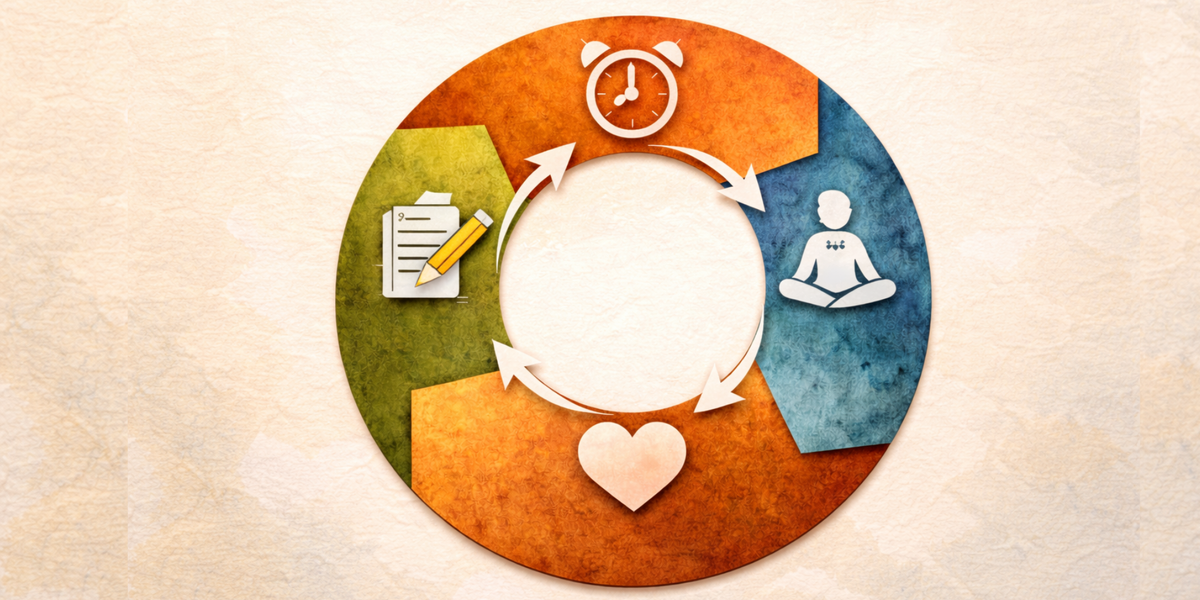
In Hooked, Nir Eyal describes a cycle often used by products to keep users engaged: trigger, action, reward, and investment. You can use the same loop to build habits that support your mental wellbeing, especially when anxiety, low mood, stress, or burnout make consistency feel hard.
The habit loop: trigger, action, reward, investment
Step 1: Choose a trigger that already exists
A trigger is the cue that prompts behaviour. The most reliable triggers are already part of your day: waking up, brushing your teeth, shutting your laptop, making tea, or getting into bed. When a mental health habit is attached to an existing routine, it asks for less decision making. Less friction equals more follow through.
Example trigger: after brushing your teeth.
Why it works: it is consistent, neutral, and already automated.
Step 2: Make the action feel almost too small
Most habits fail because the action is too ambitious. Mental health habits should be scaled to your most tired day, not your most motivated one. Two minutes of breathing, one short walk outside, one sentence of journaling, or a five minute stretch can be enough to start.
Small actions reduce internal resistance. They help the nervous system associate the habit with completion rather than pressure. Once consistency exists, duration can grow naturally.
Step 3: Reward is about noticing, not treating
Rewards do not need to be external. Internal rewards are often the most powerful for mental health habits: the slight calm after breathing, the clarity after writing, the steadiness after movement. The brain learns through feedback. If you do not consciously register the shift, the loop weakens.
A simple sentence is enough: “I feel a little better than I did five minutes ago.” That acknowledgement is a psychological reward.
Step 4: Investment makes the habit part of your identity
Investment is what deepens a habit over time. It can look like creating a small corner for journaling, buying a notebook you enjoy, saving a prompt you return to, or setting a recurring reminder. Investment signals importance to the brain. The more you invest, the more the habit becomes part of how you live, not something you are trying to do.
The habit of reflection: why journaling changes everything
One of the most overlooked mental health habits is reflection. Journaling is not about writing pages. It is about creating a pause where the mind processes experience instead of storing it as tension. Reflection consolidates learning. Even one line can build emotional awareness and pattern recognition.
If you want journaling to stick, keep it specific. Try a one line check in: name the feeling, name the trigger, name what helped. That is enough to create psychological integration.
One line journaling prompt: “Right now I feel ____ because ____. The smallest thing that helped was ____.”
A practical example: a gratitude habit that reduced anxiety
A client, Sarah, experienced anxious mornings that made the day feel unstable before it even began. We did not redesign her entire routine. We chose one trigger and one small action. After brushing her teeth, she wrote down three things she appreciated. At first it felt trivial. Over time, she noticed her mornings felt steadier. The habit did not eliminate anxiety, but it changed her relationship with it.
Consistency beats perfection
Missing a day does not break a habit. Abandoning it does. What matters is return. Returning to the practice teaches your brain that you are reliable. That is a mental health skill in itself.
Start small, let repetition do the work
If you want small habits for mental health to last, begin with a cue you already have, choose an action that feels doable, notice the internal reward, and add one small investment that supports the loop. Start where you are. Keep it honest. Keep it repeatable.
References
- Eyal, N. (2014). Hooked: How to Build Habit-Forming Products. (Book reference)
- Duhigg, C. (2012). The Power of Habit. (Book reference)
- Wood, W., & Neal, D. T. (2007). A new look at habits and the habit-goal interface. Psychological Review. (Journal reference)