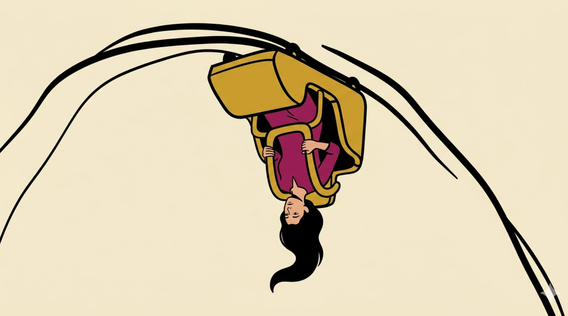

I noticed my hands before I noticed anything else. I had been sitting with a client for forty minutes, asking the right questions, nodding at the right moments, and my hands had not moved once. Not because I was relaxed. Because something in my body had decided, without consulting me, to hold very still.
I work with people whose nervous systems learned one particular lesson early and learned it well: when something feels threatening, the safest move is to stop. Stop moving. Stop speaking. Stop registering, if possible, as a person who might provoke a response.
What I want to say to you, before anything else, is that this doesn't belong only to people who have lived through what the world labels as trauma. It belongs to the person who grew up in a home where the adults were unpredictable. The person who learned that being invisible was safer than being seen. The person who, in a perfectly ordinary meeting today, felt their mind empty out the moment someone's tone shifted.
That emptying is not a flaw. It is a skill your nervous system developed, probably when you were very young, probably because it worked.
What Is the Freeze Response, and Why Does Nobody Talk About It?
Fight and flight get most of the attention. They show up in the body in ways that are hard to miss: racing heart, the urge to leave, snapping at someone you care about for reasons that make no sense thirty seconds later.
Freeze is different. It is the third response to threat, and it is invisible by nature. That invisibility is also why so many people spend years not recognising it in themselves.
In The Body Keeps the Score, Bessel van der Kolk describes what happens when the brain registers a threat it can neither fight nor escape. The system does not escalate. It collapses inward. Heart rate drops. Muscles go soft. The prefrontal cortex, which handles thinking and speaking and making decisions, goes offline. The body is doing something ancient and actually very intelligent: it is making itself small enough to survive.
In an animal, this is the moment the opossum goes limp. The predator loses interest. The animal lives.
In a person sitting at a Monday morning meeting, it looks like going blank. It looks like staring at a screen for several minutes without knowing why. It looks like being asked a direct question and feeling the answer dissolve before it can form. It looks, from the outside, like composure. Inside, there is nobody home.
Not stupidity. Not weakness. Not a character problem.
A survival response running in the wrong context.
Why Does It Happen When There Is No Actual Threat?
This is where people get stuck, and where a lot of shame gets generated.
You are not in danger. The meeting is fine. Your family is fine. The conversation is not a threat. Your brain knows this. And yet your body responds as though something is very wrong, because the part of your nervous system that handles threat does not run on current information. It runs on pattern recognition built from old experience.
Van der Kolk makes this point clearly: trauma is not stored as a story you can analyse. It is stored as a body state. A physiological record of what it felt like to be in that original moment. The temperature. The sound of a particular tone. The specific quality of tension in a room when someone was about to lose control.
When something in the present resembles that record, the body responds before the thinking brain has time to evaluate. Before you have registered the word "threat," your system has already begun its response.
Rohan is twenty-six. He works at a startup in Bengaluru and came to therapy because he kept missing deadlines he cared about. He was not lazy. He cared enormously. But when his team lead's tone shifted from collaborative to questioning, something happened. Rohan would go still. Stop asking for help. Produce work that was technically acceptable and felt completely hollow. He could not explain what came over him.
What had not yet connected: Rohan grew up in a home where his father's moods were the weather everyone else planned around. Not cruel, Rohan was always careful to say. Unpredictable. Warmth could become withdrawal in a single exchange. Rohan had learned, very early, that the safest response to an adult whose temperature was shifting was to shrink. Be competent. Be unobtrusive. Let the moment pass without drawing attention.
His nervous system had one instruction built in from years of practice: when the temperature shifts, disappear.
His team lead's mild questioning tone held no rational resemblance to his father's anger. But the body does not reason. It recognises patterns, and the pattern was close enough.
What Does This Feel Like From the Inside?
People describe the freeze response in ways that resist ordinary language, because ordinary language was designed for experiences people can narrate. This one happens below narration.
"I just wasn't there."
"My mind went white."
"I heard the words but nothing was landing."
"I was watching the whole thing from somewhere slightly outside myself."
"I went very, very calm. Not the good kind."
That last description is the one I return to most. Freeze can feel, in the moment, like you are handling it. Like you have found some composure. This is why people who grew up in homes where showing feeling was not safe can spend years believing their freeze response is strength. It felt like strength. It functioned like strength. It helped them survive.
It is not strength. It is also not weakness. It is a highly practised response doing an old job in a context where that job does not apply.
The gap between what freeze feels like and what it actually is, that gap holds a lot of shame. Why can I never speak up for myself? Why do I go blank when it matters most? Why can I find the words an hour later and never in the room? The shame is searching for a character explanation for something that is, in fact, physiological.
Why This Generation Feels It So Specifically
Something I have noticed in years of working with people in their twenties and thirties, and something I don't see discussed enough in the conversations about trauma and nervous system responses.
Many of us grew up in Indian homes that were not violent, not abusive in any way that had a name, but were pressurised. Households where achievement was the primary language of love. Where conflict did not escalate into shouting so much as it descended into something colder and harder to name. Where "how are you feeling" was either never asked, or asked with an energy that communicated that the correct answer was fine.
These homes do not produce the kind of trauma that announces itself. They produce the kind that lives in the body for years without a label, surfacing as an inability to speak up in certain rooms, a tendency to go flat in certain conversations, a strange calm in moments that should feel activating.
If you have wondered, genuinely, why can't I feel things properly, not with alarm, just with honest confusion, I want to offer this: your nervous system may not be broken. It may be exceptionally well-trained.
Is There a Way Through?
Yes. Not through reasoning, though. That is the instinct and it does not work here.
The freeze response lives below the reach of language. It predates the part of the brain that can process a logical argument. You cannot talk a body state into changing through the mind alone. What you can do is work through the body itself.
Van der Kolk's contribution, and the clinical work built on it since, points consistently to body-based approaches as the path. Not because movement is magical, but because the nervous system communicates in sensation. Slow, deliberate physical attention, the weight of your feet on a floor, the temperature of the air against your skin, the pace of your breath, begins to bring the prefrontal cortex back online. Gradually. The way a room fills with light after a power cut: not all at once, but unmistakably.
The next time you notice you have gone somewhere, that the lights have dimmed and you are not fully in the room, try not to make that mean something about you. Notice it. Name it internally. There it is.
That act of witnessing is, in miniature, what therapy is. It begins to create a gap between the trigger and the disappearing. Over time, that gap widens. Inside that gap, eventually, there is room for a choice.
Rohan still freezes sometimes. But he texts me after sessions now with things like: I noticed it happening today and I didn't pretend I wasn't. Small thing.
It is not a small thing.
If you recognised something in this, the way Rohan described going blank, or the description of the calm that is not the good kind, that recognition is worth something. It is worth bringing into a room where someone can sit with it alongside you.