Your 10-Minute Delivery Has a Price. Someone Else Is Paying It.
What India's Gig Economy Is Doing to Its Workers' Minds.
Image Source: Ai Generated
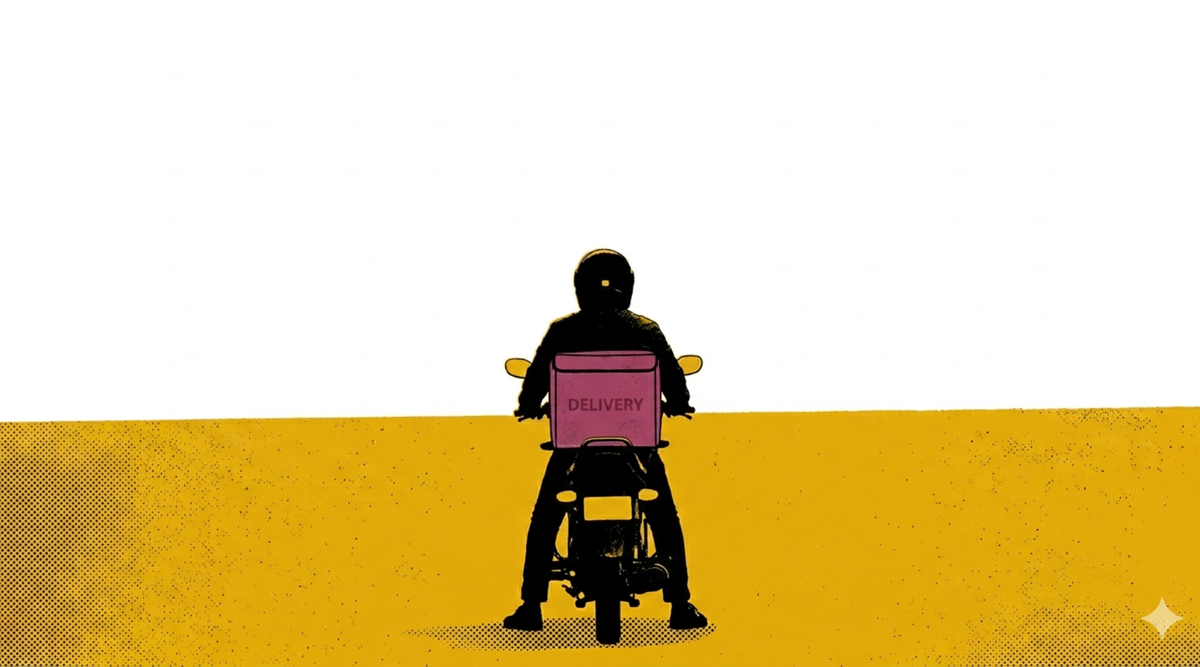
It was a Saturday night, around 10 pm, Bandra, which means the roads had that specific weekend quality—stiff with cars wedged into lanes that stopped making sense twenty minutes ago. We were barely moving. And then, threading through the gap between our car and the divider, came a delivery rider on the wrong side of the street. It seemed like a committed decision.
We almost hit him. The person driving braked hard. The gap between our bonnet and his bike was so close, I felt it in my chest before I understood what had happened.
The rider didn't look back. Didn't brake. Didn't glance over his shoulder. There was no anger, no relief, no acknowledgment that anything had just occurred. He simply moved ahead into traffic, delivering whatever was strapped to the back of his bike for whoever had been waiting eleven minutes ago.
What I'd seen on his face was neither arrogance nor recklessness. It was something far more disturbing. He looked like a man who had stopped registering danger altogether.
I know that look from the therapy room. From anyone who has sat across from me and said some version of the same thing: I don't feel scared anymore. I don't feel much of anything. I just keep going. They say it like it’s a confession, like they know it should alarm them, but the alarm system itself has gone offline.
Psychologists call this depersonalisation. It is not a dramatic state, and it does not look like a breakdown. It looks exactly like what I saw on that bike—a person going through the motions of their life from somewhere slightly outside it, as though the self has stepped back from the controls and left the body to manage. The lights are on; nobody's home in the way that matters.
Depersonalisation doesn't arrive all at once. It builds. It is what the nervous system does when it has been asked to process more than it can hold, for longer than it should. Fear, threat, financial pressure, and physical danger—these require energy to feel. And when that energy has been spent day after day with nowhere to recover it, the system decides without consulting you. It stops transmitting.
Not because you chose numbness. Because numbness chose you.
How Does Depersonalisation Work?
When someone reaches a point where the nervous system can no longer sustain the emotional weight of what it's processing, the mind does something very specific: it creates distance.
If this article stayed with you, start here.
Burnout and depersonalisation are not abstract ideas. They show up quietly, often before we recognise them as signals.
The Ground Breaking Mindfulness Cards were designed by psychologists at The Thought Co. to help you pause, notice what your nervous system is holding, and reconnect with your internal signals before exhaustion turns into disconnection.
They are simple, structured reflection prompts you can use in under ten minutes.
Explore the Ground Breaking Mindfulness CardsWhy this conversation matters
India’s gig economy workers are holding together the infrastructure of urban convenience. Their mental health is not separate from ours. It is part of the same system.
Understanding burnout, depersonalisation, and algorithm-driven stress is not just a labour issue. It is a public mental health issue.