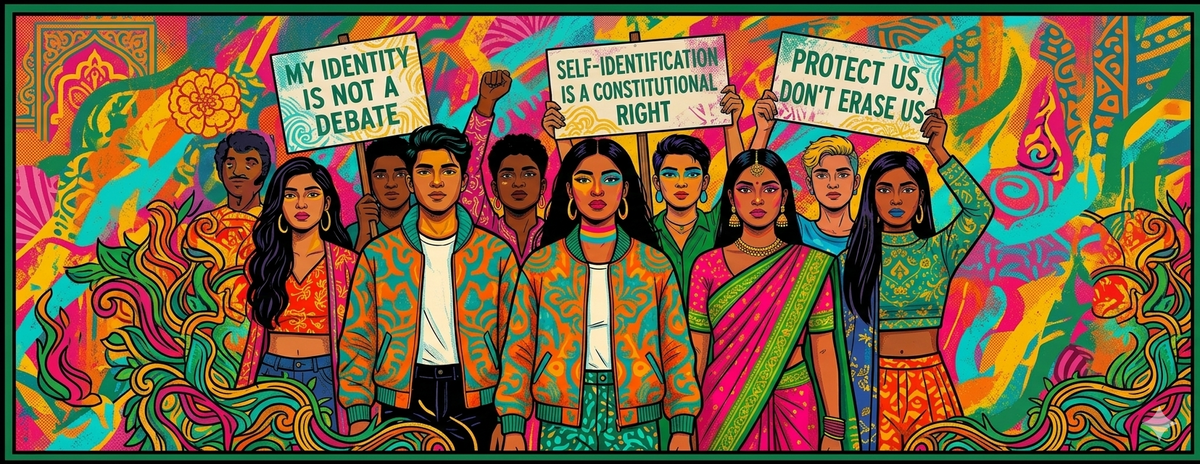
Full disclosure: I have been sitting with this, trying to write it without rage getting ahead of the analysis. I am not sure I fully succeeded.
Parliament passed the Transgender Persons (Protection of Rights) Amendment Bill, 2026, in twelve days. March 13, introduced. March 24, Lok Sabha. March 25, Rajya Sabha. Outside the Parliament gates, the community it was named after stood in protest. Inside, MPs moved on.
Twelve days.
What the Bill Actually Does
The government says this amendment exists to streamline protections and prevent misuse of welfare schemes. The Bill's Statement of Objects and Reasons cites the existing definition of "transgender person" as too broad — too many people claiming too much, apparently. The solution, as the government saw it: narrow the net.
What got cut? Trans men. Trans women who do not fit into named socio-cultural categories. Genderqueer individuals. Non-binary people. All removed, legally. The Bill retains recognition for hijras, kinnars, aravanais, jogtis and persons with specific congenital biological variations. It adds "eunuch" back into the statute. And it creates a new category: persons who have been "forced" to assume a transgender identity through mutilation, castration or coercion.
In a law named for the protection of rights, the government has decided that a primary way transgender identity comes into being is through force. Through legislation, the state has drawn a line around what kind of transgender person is real — and that line has nothing to do with how people actually live.
The Medical Board Question Is Not Procedural
The 2019 Act allowed a person to apply to the District Magistrate for a certificate of identity based on their self-perceived gender. The 2026 Amendment changes this. A medical board, headed by a Chief Medical Officer or Deputy CMO, now has to review and recommend before a certificate is issued.
The government frames this as due diligence. Activists, rightly, frame it as pathologisation.
In May 2019, the World Health Assembly voted to remove gender identity disorder from the chapter on mental and behavioural disorders in the ICD-11. Moving "gender incongruence" into a new chapter on sexual health, the WHO described it as reflecting a better understanding that it was not actually a mental health condition. The ICD-11 is explicit: trans-related and gender diverse identities are not conditions of mental ill-health, and classifying them as such causes enormous stigma.
When you require a medical board to certify someone's gender identity before the state will recognise it, you are reintroducing the diagnostic gatekeeper that global medicine has spent decades removing. You are telling a trans person: your self-knowledge does not count. A Chief Medical Officer has to agree before you exist, legally, in your own gender.
The research is consistent on what actually causes harm. Ilán Meyer's foundational work, published in Psychological Bulletin in 2003, established the minority stress model — showing that elevated rates of mental distress among gender and sexual minorities are not intrinsic to who they are, but produced by exposure to stigma, discrimination and hostile legal contexts. A 2016 field study found the same: distress among transgender individuals was more strongly predicted by social rejection and violence than by gender incongruence itself. The harm is not inside the person. It is built into the environment around them.
The 2026 Amendment adds to that environment. Deliberately.
The Word "Eunuch" Is Not Incidental
This is being under-discussed, and it deserves attention.
The Bill reintroduces the word "eunuch" into Indian statute. Its definition in this context covers persons of the male sex who "admit themselves or on medical inspection clearly appear to be impotent." If that sentence sounds like it was written in another century, it is because it was. The source is the Criminal Tribes Act, 1871 — Part II of which was titled: An Act for the Registration of Criminal Tribes and Eunuchs.
Under that Act, colonial authorities built district registers of eunuchs. Police were required to record names, residences and property of all "eunuchs" reasonably suspected of kidnapping children, sodomy or castration. Hijras caught dancing in public or wearing women's clothing could be arrested without a warrant. The Act's stated goal, in the 1865 words of the Lieutenant-Governor of the North-Western Provinces, was the "gradual extinction" of the Hijra community.
Historian Jessica Hinchy, in her 2019 book on the colonial criminalisation of Hijras, documents how these registers were instruments of elimination masquerading as administration. Children found living with Hijra communities were forcibly removed — even when they were orphans who had been adopted. The British government called this child protection.
The 2026 Bill introduces imprisonment of up to fourteen years for forcing a child to assume a transgender identity. It calls this child protection, too.
The echo is structural. The same logic runs through both: the state stepping in to save children from a transgender community that, by implication, manufactures its own members. The Criminal Tribes Act was repealed in 1949. Seventy-seven years later, a law named for the protection of transgender rights is borrowing its vocabulary — and its logic — from a colonial surveillance and elimination project.
What "Coercion" Becomes in Practice
The Bill criminalises forcing, inducing or deceiving someone into assuming a transgender identity, with penalties ranging from ten years to life imprisonment for adults, and life imprisonment where children are involved. Coercion and forced castration should be punishable. They should not go unaddressed.
But the law makes no distinction between coercion and chosen belonging. In a country where most trans youth lose their biological families on disclosure, the chosen family networks of Hijra gurus and disciples — or of community elders in any trans support structure — become legally precarious. An elder welcoming a young person into community life, a support group helping a teenager make sense of an identity they have carried for years: under this Bill's framing of "allurement" and "inducement," any of this could be read as forcing a transgender identity.
It is the same playbook. Colonial authorities used child protection language to justify removing children from Hijra households, even where researchers found almost no evidence of harm — the children removed were predominantly orphans who had been taken in. In 2026, the state arrives with the same language. The community stands to lose the care networks it has built precisely because the state and biological families so often fail them.
On "Genuine Beneficiaries"
I have been looking for the data substantiating the government's claim that the 2019 Act definition was being misused. I have not found it. I would genuinely like to see it.
What I do know is this: the 2019 Act, for all its limitations, reached a fraction of the people it was supposed to help. Implementation was patchy. Certification processes under the existing framework were already bureaucratic enough that activists routinely described them as barriers rather than gateways. A trans woman named Gargi, quoted in The Leaflet's coverage of the protests, said she had to approach the High Court simply to obtain an identity card under the broader 2019 definition.
The problem was not too much recognition. It was too little reach. Shrinking the category of persons who qualify does not fix under-implementation — it compounds it. Exclusion dressed up as administrative efficiency is still exclusion.
The NALSA Question
The 2014 Supreme Court judgment in NALSA v. Union of India is unambiguous. It recognised the right of transgender persons to their self-perceived gender identity as a constitutional right — requiring no surgery, no medical board, no external verification. The Court directed the government to treat transgender persons as a third gender, extend reservations in education and employment, and build welfare frameworks in consultation with the community.
The 2019 Act was already a retreat from that. No reservations were implemented. Bureaucratic layers were added that the judgment had not required. The 2026 Amendment goes further, removing the statutory right to self-identification entirely. Constitutional challenges to the 2019 Act have been sitting before the Supreme Court since 2020, unheard — and Parliament, in twelve days, has moved further in the opposite direction from what the Court said the Constitution requires.
Activists say they will challenge this, too. Given how long the earlier petitions have waited, relief — if it comes — will not come soon. Meanwhile, trans men, non-binary persons and genderqueer individuals no longer exist within the frame of this law. The Bill states explicitly that the Act "will never have included" persons with self-perceived identities not covered by its new definition.
Never have included. A retroactive erasure, written into the statute in the present tense.
What I Keep Coming Back To
In the room with clients over the years, I have watched people describe what it costs to live without legal recognition of who they are. Every hospital visit, every police interaction, every landlord, every employer, every ID check. Legal recognition does not fix discrimination. But its absence makes every discrimination easier to carry out and harder to challenge.
The 2026 Amendment takes hundreds of thousands of people and removes the legal floor beneath them. That it was done in twelve days, while the people it affects stood outside and protested, tells us everything about who this bill was written for.
It was not written for the transgender community. It was written about them. And the distance between those two things is exactly what is at stake.