Image Source: AI Generated
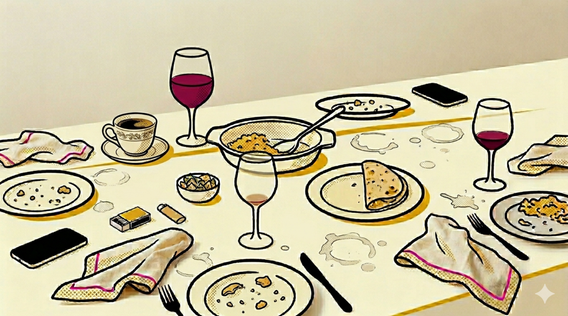
The dinner was good. You know it was good. You laughed at the right moments, asked the right questions, and caught up with people you actually like. You left at a reasonable hour thinking, yeah, that was nice.
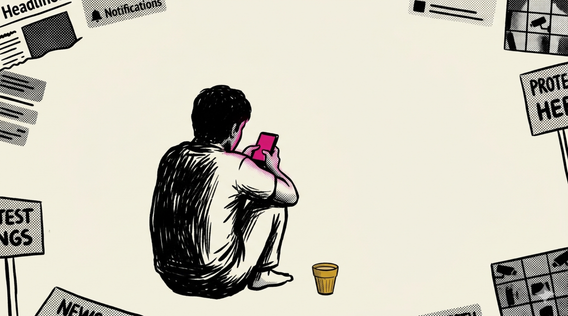
And yet, on the way home, you feel oddly far away from yourself. Like you've returned from somewhere but haven't quite landed yet. You sit on your bed and don't know what to do with your hands. Not tired, exactly. Just absent. Like you left a version of yourself back there and came home without it. So you do what we all do: pick up your phone and doom-scroll until you can't keep your eyes open.
I hear some version of this in the therapy room more than almost anything else. People come in describing evenings they genuinely enjoyed, with friends they actually like, doing things they actually wanted to do, and yet they came home feeling strangely hollowed out. Not sad about anything specific. Not anxious. Just depleted. And almost universally, the first thing they do is turn it into a question about themselves. Do I actually like these people? Am I more introverted than I thought? Is something wrong with me that I can't enjoy a nice evening and feel fine afterward?
Almost always, the answer is no. Nothing is wrong with you.
But still, something worth understanding is happening.
The enjoyment and the exhaustion are not contradictions. You can have genuinely loved the evening, the conversation, the food, the company, and still come home depleted. You can be with people you love, people who make you laugh, people in whose presence you feel lucky to be, and still feel that particular flatness that follows. This isn't ingratitude, and it isn't a sign that the friendship is wrong or that you've secretly outgrown the people. It's a sign that being with other people, even the right people, even in the best circumstances, requires something of you.
That something is presence. Not just physical presence, but the sustained effort of being attuned: to the room, to the mood, to what's being said and what isn't, to how you're coming across and whether the dynamic feels okay. We are wired to track all of this, constantly and mostly without realising it. It is also what makes us tired.
What most people don't realise is that they've spent the evening working. Nothing about it would show from the outside. But they've been holding a specific version of themselves in place for hours. And even a good performance costs something. The cost is the effort of being seen in a particular way, consistently, for hours at a stretch.
Is This Just an Introvert Thing?
Almost always, there's an edge of self-blame to it. Like the flatness is evidence of something broken. And the first conclusion people reach is: I must be more of an introvert than I thought.
But the introvert label stops being useful at some point. Even in evenings you genuinely enjoy, with people you genuinely love, you are still managing yourself. Reading the room, adjusting your tone, keeping things light because this isn't the kind of night where you bring the heavy thing. You're being the version of yourself that feels most appropriate in gatherings like these: warm, present, not too much. None of that is fake or dishonest. It's just what we do in social contexts.
Yes, introverts tend to hit their social limit faster, and the energy cost of being around people is real. But a researcher named Jeffrey Hall found that how drained people felt afterwards had very little to do with how loud, crowded or long the event was. What actually predicted the tiredness was how connected they'd felt during it. You can come home from big, chaotic, exciting evenings feeling completely fine if you felt genuinely present while you were there. And you can come home from quiet, perfectly pleasant dinners feeling hollowed out, because something in you was lonely even while you were sitting right there.
So it's not really about how many people were in the room, or how long you stayed, or whether you're an introvert. It's about the gap between the version of you that showed up and the version of you that actually exists right now.
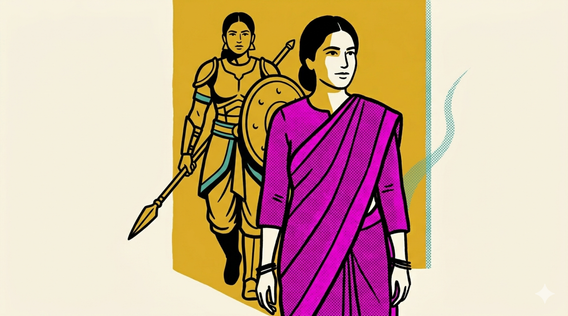
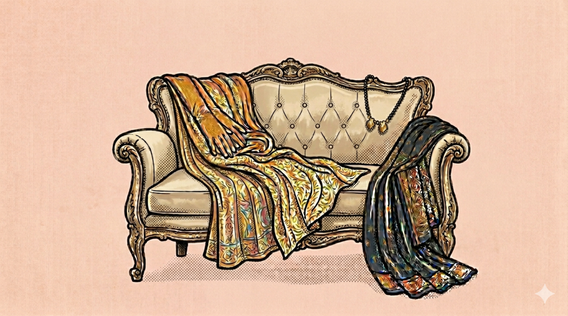
You can be entirely present at a dinner, laughing, contributing, enjoying yourself, and still be showing up as a slightly edited version of yourself. The you that exists right now might be carrying something heavy: a difficult week, a relationship that's been strained, an anxiety you haven't quite named yet. The you that showed up tonight set all of that neatly to one side, because this wasn't the context for it. That editing is normal and often necessary. But it has a cost. The version of you that actually needed something tonight didn't get to be there. She was in the waiting room while the other version handled the evening. And when you get home, she's still there. Still waiting.
That's the gap. And crossing it, coming back to yourself after an evening of being a slightly different self, takes more energy than anyone tells you it will.
What Is Actually Happening When You Perform Yourself?
Erving Goffman, a sociologist who spent a lot of time thinking about this, called it impression management: the constant, mostly unconscious work of calibrating how you show up depending on who's watching. We are always, to some degree, performing. We make calculations, mostly without realising it, about how to present ourselves in any given situation. You speak differently to your boss than to your best friend. You carry yourself differently at a family function than at a party where you know no one. You decide, in the space of a second, what's appropriate to say, what's better left unsaid, what version of the story to tell.
This isn't manipulation. It's social fluency. It's what humans have learned to do to navigate being around other humans. But fluency has a price, and the price goes largely unacknowledged, because the better you are at it, the less anyone can see the cost. The problem arises when there is a persistent gap between what you're feeling and what you're showing, or when the social context simply doesn't allow you to be the particular version of you that actually feels real.
Why Does the Drop Feel Worse After Evenings That Went Well?
This is the confusing part, and it's worth sitting with.
If the evening had been awful, awkward silences, a fight, someone saying the thing they shouldn't have said, the tiredness would make sense. You'd have a story to attach it to, something to blame. But when the evening was fine, the flatness feels like something was wrong with you, rather than something being right with your nervous system.
When an evening goes well, you have worked to make it go well. There's also something specific about how we socialise in India that's worth naming. We are often taught to run on performed warmth, and there's an obligation structure quietly built into it. We play different roles in different relationships, required to be different versions of ourselves with each person. You can't say everything you want to say, and most times cannot object to things that don't sit right with you. By the time you get home, you have been doing the social equivalent of holding a plank position for two hours. You are fine. The plank was fine. But your core is done.
What Is the Drop Actually Telling You?
While this kind of social performance is normal, it's easy to treat the feeling afterwards as simple depletion rather than information.
When we constantly feel the need to perform, we are also constantly putting ourselves under a microscope. We become extra careful, hyper-aware of what we say, harsh critics of ourselves in real time. What might look like reading social cues can quietly become a way of refusing to be ourselves, of becoming someone we feel will be more accepted.
The version of you that showed up tonight was not worse or dishonest. You just didn't mention that work has been hard. You didn't bring up the thing with your family. You laughed at the joke that landed slightly wrong and let it go. All of this accumulates. The drop, in those cases, is not just tiredness. It is a mild form of longing for the version of yourself that didn't get to be in the room tonight. And that version has needs, too.
What Do You Actually Do With This?
I'm not going to give you a list of tips for managing your social battery. That framing, while comforting, skips past the more interesting question.
What's actually useful, and what I've seen be useful in the room, is getting curious about what the flatness feels like. Is this tiredness, or is it something closer to loneliness? Did I feel genuinely present tonight, or was I mostly keeping things smooth? Is there someone in my life with whom I don't come home feeling like this, and what's different about how I am with them?
Those aren't comfortable questions. But they're more useful than writing yourself off as an introvert who needs to recharge. They point at something real: the quality of your relationship with yourself.
Because the drop you feel after social evenings is really about how much of yourself you were able to bring into the room, and how much had to be left outside. When that gap is small, when you were with someone in front of whom you could be largely, honestly yourself, you tend to come home feeling full rather than empty, even if the evening was long or loud or tiring in the ordinary sense. When the gap is large, when the whole evening required you to be carefully managed, curated, appropriate, you come home feeling hollowed out regardless of how well it went.
So the real question underneath all of this isn't about social batteries or personality types. It's about where in your life you actually get to be yourself. And whether the answer to that, when you sit with it honestly, feels like enough.
If you notice that social situations tend to leave you more emptied than connected, that's exactly what therapy is good for. Having somewhere to put the real version of yourself is not a small thing.
Come Back to Yourself
If you often come home from good evenings feeling strangely far away from yourself, a small grounding ritual can help you land again.
Ground Breaking - Mindfulness Cards are psychologist-designed prompts created to help you pause, reconnect with your body, and return to the version of you that may have been waiting underneath the performance.
Explore Ground BreakingBusting the Myths
Myth: If you enjoyed it, it shouldn't have tired you out.
Enjoying something and finding it effortless are two different things. Even genuinely good evenings involve sustained invisible work: reading the room, tracking the mood, calibrating what to say and what to leave out, being warm and present and appropriate for hours at a stretch. The fact that you enjoyed it doesn't mean it didn't take something from you. It just means the work was worth it. Both things are true at the same time.
Myth: Post-social exhaustion is just an introvert thing.
Introvert fatigue is about overstimulation: too many people, too much noise, too much going on for a nervous system that needs quiet to reset. Post-social exhaustion is something different. It's the tiredness that comes specifically from having held a particular version of yourself in place for a few hours. Introverts can experience both, but post-social exhaustion doesn't actually care whether you're introverted or not. It can happen to anyone who spent the evening performing, which is most of us, most of the time.
Myth: Feeling flat and empty afterward means something went wrong.
Nothing went wrong. When there's a gap between how you showed up and how you were actually feeling underneath, the emptiness afterward tends to feel less like ordinary tiredness and more like a mild loneliness. Which makes sense, because in some quiet way, the version of you that actually needed something tonight didn't get to be in the room. The flatness isn't a sign the night failed. It's a sign that something in you is still waiting to be attended to.
Myth: Feeling drained after socialising means you have social anxiety.
Social anxiety tends to show up before and during: the dread going in, the hypervigilance while you're there, the replaying of conversations afterward looking for evidence you said something wrong. Post-social exhaustion is quieter than that. It arrives after, not during, and doesn't carry the same quality of threat or fear. It feels less like what did they think of me and more like coming home from a long day of being someone specific and needing to not be anyone for a while. If you're also experiencing significant dread around social situations, or spending a lot of mental energy on how you came across, that's worth exploring with someone. But on its own, feeling drained after a good night out is information, not a diagnosis. It's worth getting curious about what it's telling you.