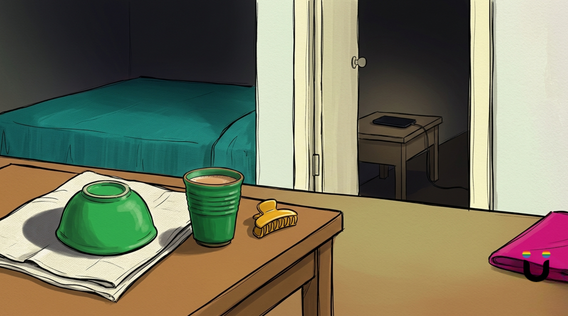
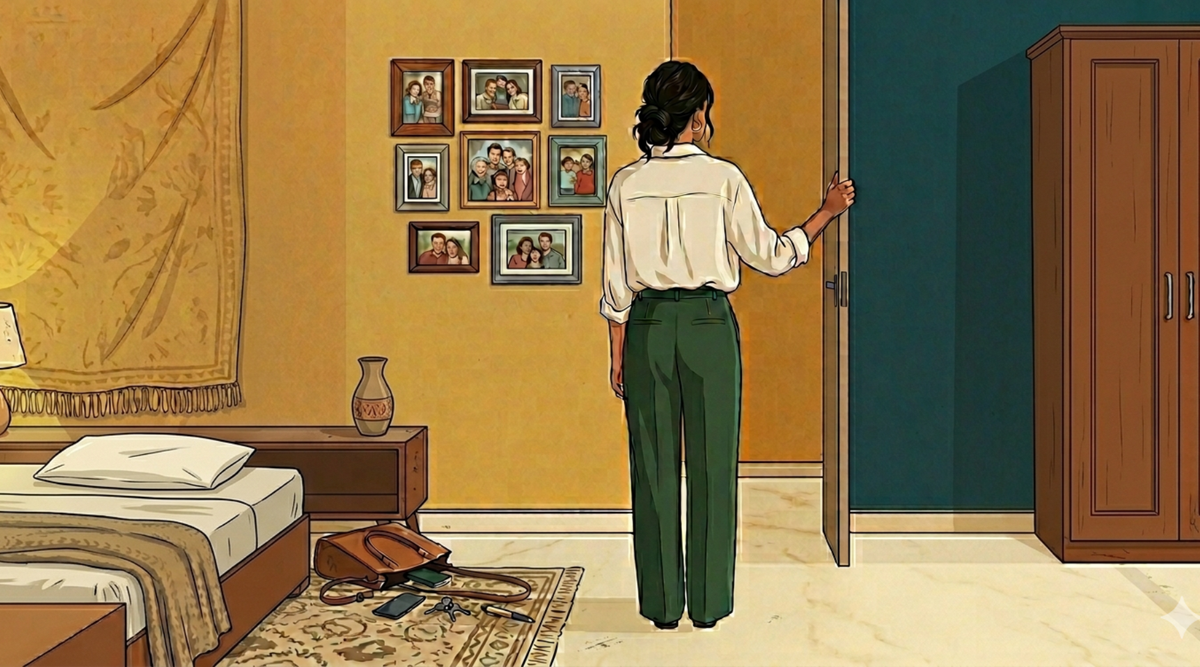
She had thrown her handbag against the door.
Not at anyone. Just against. It hit, slid down, fell open. Her phone, her wallet, her keys, the small comb she carried for the baby, all of it on the floor of the entryway. The baby was, mercifully, asleep in the next room. Her mother was at the temple. There was a single still moment in the hallway where Anaya (name changed; shared with consent) stood and looked at her things scattered across the marble and thought, very clearly: who is this woman.
She was thirty-six. She had been a person who was famously calm. She had not raised her voice in a relationship in fifteen years. The baby was nine weeks old. She came to my office three days later because she was, in her own words, terrified of herself.
This is the post I have been waiting to write. Partly because I have sat across from a version of Anaya more times than I can count. And partly, and I will be honest about this in a moment, because some version of what she described had also happened, in a slower and more internal form, to me.
Rage is data, not a personality flaw.
So what is postpartum rage?
Postpartum rage is a sudden, often disproportionate surge of anger that arrives in the postpartum period without much warning and leaves the mother, after, with a particular sort of horror. It can be directed outward (at the baby, the partner, the mother in law, the courier who was three minutes late) or inward (at oneself, in the form of relentless self attack). It affects roughly 21 to 31 percent of new mothers, which is more than report postpartum depression, and yet it is not in the DSM-5-TR, not on the Edinburgh Postnatal Depression Scale, and not on most clinical screening tools your gynaecologist might give you.
So a perfectly common, perfectly real experience that affects roughly one in four new mothers has been, in clinical terms, almost entirely uncatalogued. Until very recently, the academic literature on it could fit on two sides of a page. A 2026 paper in Frontiers in Global Women's Health was the first proper study of maternal anger in urban Indian mothers. The first.
The fact that you have never been told this is a feature of motherhood is not because it is rare. It is because it is inconvenient.
Why is your body actually doing this?
Three reasons, working at the same time.
The first is hormones. The same crash that produces the baby blues, the steep drop in estrogen and progesterone in the seventy-two hours after birth, also affects the systems that govern frustration tolerance. Your body's threshold for being irritated has been clinically lowered. Things that would have rolled off you a year ago do not roll off you now. This is biology, not personality.
The second is sleep. There is substantial research showing that fragmented sleep, specifically the kind new mothers get, increases emotional reactivity by something close to sixty percent in controlled studies. You are not reacting badly to small things. You are reacting normally to small things, but with a brain that has been working with three percent battery for eleven weeks.
The third, and this is the one nobody talks about, is unmet needs and violated expectations. The most useful framework I have for postpartum rage came from a 2022 grounded theory study by Ou and colleagues in Qualitative Health Research, which found that maternal anger almost always emerged at the intersection of two things: a need that was not being met, and an expectation about who would meet it that turned out to be wrong. The partner who was supposed to take the night feed and did not. The mother in law who was supposed to help and is criticising the swaddle instead. The body that was supposed to bounce back and has not.
Rage, from this lens, is the body's way of saying: something is structurally wrong here, and the polite version of asking for help has stopped working.
What about the rage that is directed at yourself?
This is the version I want to spend a moment on, because it is the one almost nobody writes about, and it is the one I have the most personal familiarity with.
Most of the public conversation about postpartum rage, what little of it exists, talks about the outward kind. The bottle thrown at the wall. The shout at the partner. The slammed door. These are the versions that look like anger from the outside, and they are real, and they are common.
There is another version. It is interior. It does not look like rage to anyone watching, including, often, to yourself. It is the voice in your head that tells you, the second you put the baby down wrong, that you have failed at the only thing you were supposed to be good at. It is the disproportionate fury at yourself for forgetting to sterilise a bottle, for letting the baby cry for an extra two minutes, for needing a nap, for needing anything. It is the punishing internal monologue that turns small mistakes into evidence of unfitness.
Postpartum rage that turns inward is, clinically, the same beast as the outward kind. Same hormones, same sleep deficit, same unmet needs, same violated expectations. The only difference is the direction. And because it does not look like anger, it almost never gets named as anger. It gets named as self criticism, or perfectionism, or being a conscientious mother. None of those are the right name. The right name is rage that has nowhere to go and so has gone home.
I will say this directly. Some version of this happened to me. Less visible than what happened to Anaya. More internal. But the same mechanism. And the thing that scared me most was not the intensity of it. It was that I, professionally trained to spot exactly this in other women, could not for a long time spot it in myself.
Why is this an Indian conversation, specifically?
Because Indian women have been raised, mostly, to not have anger. Not to suppress it. To not have it. Anger is unfeminine. Anger is a problem. Anger is what badly raised girls and bad wives have. Most of my female clients can describe sadness, anxiety, even shame, in fluent emotional vocabulary. Anger they cannot describe at all. They describe being "frustrated." Being "on edge." Being "a bit much lately."
The postpartum period is often the first time the suppressed reservoir breaks. Hormones, sleep deprivation, and a complete restructuring of life all happen at once, and the dam holds for about six weeks and then it does not. This is not a moral failure. This is what happens when you ask a system to perform under thirty years of accumulated pressure plus a newborn.
And, because Indian women have been trained not to direct anger outward at the people who taught them not to have it, a great deal of postpartum rage in Indian households goes inward instead. The cultural training and the clinical mechanism conspire. The rage that should, if we are being honest, be at the partner who is not pulling his weight, or at the mother in law who has criticised the same thing for the eighteenth day in a row, that rage cannot be safely expressed in most Indian households. So it lands on the only target the woman has been given permission to attack: herself.
When is postpartum rage a sign of something more?
Postpartum rage can occur on its own. It can also be a presentation of postpartum depression (anger is one of its most underrecognised symptoms), or postpartum anxiety, or, occasionally, postpartum OCD. If your rage feels like it is constantly there, if it is starting to scare you, if it has spilled out at the baby in any physical way, or if you have hit a wall or thrown something while the baby was in the room, that is the call to make today, not next week.
If you are not sure whether what you are experiencing is rage or something else, our companion piece on how to tell baby blues from postpartum depression covers the two week clinical line and what to watch for.
And if the rage is mostly directed at yourself, please hear this. The threshold for help is the same. Postpartum rage that turns inward and has begun to feel like contempt, or that is making it hard to bond with the baby, or that includes thoughts that frighten you about your own worth or your right to be here, that is also the call to make. The fact that you are the one being attacked does not make the attack smaller.
If you are in immediate crisis, you can call iCall on 9152987821 or Vandrevala Foundation on 1860-2662-345.
What does recovery from postpartum rage actually look like?
Anaya, the woman in the entryway, is, today, completely fine. She came in, we worked together for about fourteen sessions, her psychiatrist briefly added a low dose of an SSRI which she came off after eight months, and she stopped throwing things. More importantly, she stopped being terrified of herself. She started reading the rage as information instead of as evidence. The information, in her case, was that she had been doing eighty percent of the night work, her mother in law's repeated praise of her husband was unbearable in ways she could not say out loud, and nobody had asked her in weeks how she was doing. None of those are character flaws. They are circumstances.
And the version of this that happened to me, less visible, more internal, the rage that went home, also resolved. Differently. With its own work. With the slow, awkward business of learning that the punishing internal monologue was not the truth about who I was. It was a symptom of where I was.
Your rage, whichever direction it points, is not who you are. It is what your body is telling you about where you are. Listen to it. Then, if you can, get help translating it.
Circumstances are easier to change than characters. That is the good news.
If any version of this is happening to you right now, outward or inward, visible or invisible, postpartum rage is one of the most treatable presentations in perinatal mental health. It responds well to therapy. Sometimes briefly to medication. Almost always to both, plus an honest reassessment of who is doing what at home. Our team includes psychologists trained in this exact window.
Book a first session with a TTC therapistFrequently Asked Questions
What is postpartum rage and how is it different from postpartum depression?
Postpartum rage is sudden, intense, often disproportionate anger that emerges in the weeks and months after childbirth. It affects roughly 21 to 31 percent of new mothers, which is more than report postpartum depression. Crucially, it is not a formal DSM-5-TR diagnosis and is not screened for by the Edinburgh Postnatal Depression Scale. It can occur on its own, alongside postpartum depression or anxiety, or as a presentation of either. The Ou et al. 2022 study found that half of women experiencing intense maternal anger did not meet clinical criteria for depression, suggesting it is a discrete affective response, not just a depressive symptom.
Why am I so angry after having a baby?
Three mechanisms work simultaneously. The hormonal crash after birth lowers your frustration tolerance at a biological level. Fragmented sleep increases emotional reactivity by close to sixty percent in controlled studies. And the framework from Ou et al. (2022) explains why: maternal anger emerges at the intersection of unmet needs and violated expectations, particularly when the support you assumed would arrive (from your partner, your family) does not, or arrives with conditions attached. None of these mechanisms are about your character.
Is postpartum rage harmful to the baby?
Postpartum rage that has not become physical and is not directed at the baby is psychologically uncomfortable but not in itself harmful. It does, however, warrant clinical attention because it is highly treatable and tends to compound when ignored. If you have hit a wall, thrown an object while the baby was in the room, or felt a physical urge toward the baby, that is the threshold to seek help immediately, not next week. Help is available and the prognosis with treatment is excellent.
What if my postpartum rage is mostly directed at myself?
Postpartum rage that turns inward is clinically the same condition as outward postpartum rage; the only difference is the direction. The hormones, the sleep deficit, the unmet needs, and the violated expectations are identical. Because it is often misnamed as self criticism, perfectionism, or being a conscientious mother, it goes untreated longer than the outward kind. The threshold for seeking help is the same: if it has begun to feel like contempt, or is interfering with bonding, or includes thoughts that frighten you about your own worth, please contact a mental health professional.
Sources
Ou, C. H. K., Hall, W. A., Rodney, P., & Stremler, R. (2022). Seeing Red: A Grounded Theory Study of Women's Anger after Childbirth. Qualitative Health Research, 32(12), 1780–1794.
Ou, C. H., Hall, W. A., Rodney, P., & Stremler, R. (2022). Correlates of Canadian mothers' anger during the postpartum period: a cross-sectional survey. BMC Pregnancy and Childbirth.
Roy, S., et al. (2026). Mothering on the edge: exploring maternal anger through feminist psychoanalysis and socio-ecological inequities of two mothers in urban India. Frontiers in Global Women's Health.
Postpartum Support International. (2025). Mom Rage: Causes, Ways to Cope, and Reasons for Hope.