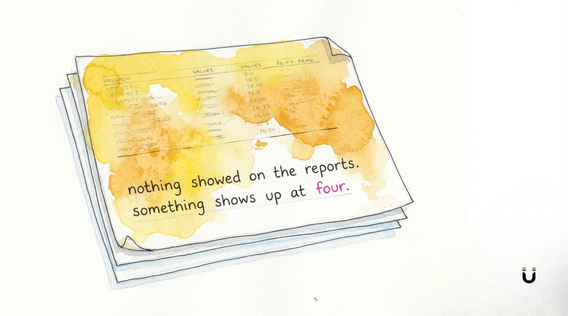

There are three trimesters, and then there is the one nobody told you about.
It does not appear in any of the books your mother in law gave you. It is not on the laminated chart at the gynae's office. It does not have a scan to mark its end. It is twelve weeks long, it begins the moment they hand you the baby, and it might be the most psychologically intense developmental phase of your entire adult life.
They call it the fourth trimester. It deserves more than a footnote.
I am writing this as someone who has, professionally, helped women through this exact window. I am also writing it as someone who lived through it, and who, if I am being entirely honest, did not have the vocabulary I needed to name what was happening to me until I was well past it. Most of us do not. That is partly because we were not given the vocabulary. It is also partly because the fourth trimester is, by design, very hard to think clearly inside of.
The third trimester was not the last one. There is a fourth.
So what is the fourth trimester, actually?
The fourth trimester is the first twelve weeks after birth, and it is treated, by paediatricians and increasingly by obstetricians, as a continuation of pregnancy rather than a separate phase. The term came from American paediatrician Harvey Karp, who pointed out something that should have been obvious: human babies are born too early.
Three months too early, give or take. Compared to other primates, our babies arrive in a state of neurological half readiness, because if we waited until they were fully formed, their heads would not fit through anyone's pelvis. Evolution made a deal. The baby finishes developing on the outside.
Which means the first twelve weeks postpartum are not really separate from the pregnancy. They are an extension of it. Just outside the body now. With more visitors.
This is the framing used by paediatricians and lactation consultants. It is helpful, as far as it goes. But what almost nobody says in India is that the fourth trimester is not just a developmental window for the baby. It is a developmental window for the mother. And the second one is harder.
Why does it feel like this, exactly?
Because everything that can be reorganised in your life has been reorganised, simultaneously, in roughly seventy-two hours.
Your hormones have crashed. Your sleep architecture is gone. Your body is healing from major medical work; most Indian women either had a C-section, an episiotomy, or both. Your relationship with your partner has been restructured along lines you did not negotiate. Your mother is in your kitchen. Your mother in law has opinions about the swaddle. Your career has been, at minimum, paused.
And underneath all of that, the thing nobody warns you about. Your sense of who you are, that thing you spent thirty something years building, has been handed a small new role: provider of food, holder of body, carrier of name.
This is the part I want to spend a moment on, because it is the part that, for me and for most of my clients, was the hardest thing about the fourth trimester. Not the sleep. Not the body. The disappearance of a self I recognised.
The psychiatrist Daniel Stern, in The Birth of a Mother, called this period exactly that, the birth of a mother. He meant it literally. He argued that becoming a mother is its own developmental phase, comparable in scale to adolescence, except that adolescence happens slowly over seven years and matrescence (a term coined by anthropologist Dana Raphael in 1973) happens, mostly, in twelve weeks.
Of course you feel like a stranger in your own life. You are one. You are a person whose entire reference system has been reset, with no time to update the map.
Why is the Indian fourth trimester both better and worse?
Better, because we have not, yet, fully forgotten what the rest of the world is rediscovering as a wellness trend. Most Indian families still have some version of the jaapa or confinement period. Forty days of food cooked for you. Someone to hold the baby while you sleep. A mother or mother in law in the house, doing the work of running it so you do not have to.
This is, in clinical terms, a remarkable mental health intervention. The single biggest predictor of postpartum mental health, according to almost every meta-analysis on the subject, is social support. Indian women, structurally, get more of it than American women do. This is real.
I will say, plainly, that I would not have made it through my own fourth trimester without the people who showed up to do the cooking and the holding and the staying. There are women in my life, my mother, a few friends who have since become more like sisters, the maushi who has been with my family longer than I have been alive, without whom that period would have been actually unsurvivable. That is not an exaggeration. It is, in clinical terms, what the literature predicts.
And worse, because that same structure can be the source of suffering for some women. The mother in the kitchen has opinions. The mother in law on the sofa has more opinions. There is no privacy. There is no closed room. Every parenting decision you make is observed and footnoted. The script for what a new Indian mother should be doing, looking like, feeling, was written long before you, and the people around you are the supervisors of the production.
Both of these are true. The Indian fourth trimester gives you support that women in nuclear family cultures would weep for, and, depending on your specific household, can also ask you to give up something quite particular in exchange. The presence of help is not the same as the presence of the right help. If you have the first kind, the kind that genuinely sees you and lets you rest, hold it close. It is what gets people through this. If you have the second kind, the kind that arrives with a critique attached, you are allowed to name that too.
What helps, when nothing seems to?
Five things, in my clinical experience and in my own, do most of the work in the fourth trimester. They are not glamorous. They are clinically supported and they are unfashionably specific.
The first is sleep, in any continuous block longer than three hours. This is not a luxury. It is the single most clinically supported intervention for postpartum mental health, and the one that gets sacrificed first when a mother is told she should be grateful for what she has.
The second is fifteen minutes a day where you are not a mother. Sit on the balcony. Read two pages. Have a cup of tea no one is asking you to share. The point is not the activity. The point is the existence of a small daily reminder that there is still a person inside the role.
The third is one person who lets you be honest. Not five. One. The friend who does not fix it. The sister who does not tell your mother. The therapist whose office is the only room in which you do not have to perform okayness.
The fourth is specifics from your partner, not vague help. "Take the baby from 8 to 11pm" works. "Tell me how I can help" does not. Vague help puts the cognitive load of running the household back on the woman who is least equipped, in that moment, to carry it.
The fifth is knowing the line. The two week line, the warning signs, when to call someone trained in this. We wrote a separate piece on how to tell baby blues from postpartum depression, and it is the companion piece to this one. Read it if anything in this piece felt familiar in a way that worried you.
What does the end of the fourth trimester look like?
The fourth trimester ends, eventually. Around twelve weeks, sometimes a little later, you will look up and notice that the floor is back under your feet. The baby starts smiling at you and meaning it. You sleep four hours in a row. You laugh at something and recognise the sound of your own laugh.
You will not be the woman you were before the pregnancy. You will not be the woman you were in those first six weeks either. There is a third person now, and the work of the fourth trimester, the part nobody told you about, is the slow, often disorienting business of meeting her.
She is, in my experience, worth meeting. She is, in many ways, who you were always going to become. She is also exhausted. Both of those are allowed.
If you are inside the fourth trimester and reading this at an hour you should not be awake, the work of meeting yourself again does not have to happen alone. TTC's therapy team includes psychologists trained in perinatal mental health and matrescence. The first session is the hardest one to book and the easiest one after that.
Book a first session with a TTC therapistFrequently Asked Questions
What is the fourth trimester?
The fourth trimester is the first twelve weeks after a baby is born, framed as a continuation of pregnancy rather than a separate phase. The term was popularised by American paediatrician Harvey Karp, who argued that human babies are born neurologically incomplete and finish developing outside the womb. Increasingly, clinicians use the term to describe the mother's recovery and psychological transition, not just the baby's development.
What is matrescence and how is it different from postpartum depression?
Matrescence is the developmental transition into motherhood, comparable in scale to adolescence. The term was coined by anthropologist Dana Raphael in 1973 and developed clinically by psychiatrist Daniel Stern. It is a normal psychological process, not a disorder. Postpartum depression, by contrast, is a clinical condition that affects roughly one in five Indian women and persists beyond two weeks. Matrescence is the identity shift; postpartum depression is what can happen during it if support is missing.
How long does the Indian jaapa or confinement period last?
The traditional Indian jaapa or sawa mahina lasts approximately forty days, sometimes extended to three months. During this period the mother is given specific foods designed to support recovery, is largely relieved of household work, and is cared for by older female relatives. While this structure is one of the most protective postpartum traditions globally, its psychological benefit depends entirely on whether the mother feels supported or surveilled within it.
How can my partner actually help during the fourth trimester?
The most useful help is specific, scheduled, and does not require the mother to delegate. "I will take the baby from 8pm to 11pm so you can sleep" is more useful than "let me know how I can help." Vague offers put the cognitive load of running the household back onto the person who is most depleted. The other most useful contribution is protecting the mother's sleep in continuous blocks of at least three hours, even at the cost of formula feeding for one shift.
Sources
Stern, D. N., Bruschweiler-Stern, N., & Freeland, A. (1998). The Birth of a Mother: How the Motherhood Experience Changes You Forever. Basic Books.
Raphael, D. (1975). Being Female: Reproduction, Power, and Change. Mouton Publishers. (Original concept of "matrescence" introduced.)
Karp, H. (2002). The Happiest Baby on the Block. Bantam. (Origin of the "fourth trimester" framing in popular paediatrics.)
Upadhyay, R. P., et al. (2017). Postpartum depression in India: a systematic review and meta-analysis. Bulletin of the World Health Organization, 95(10), 706–717.
American Academy of Family Physicians (2019). Postpartum Care: An Approach to the Fourth Trimester.